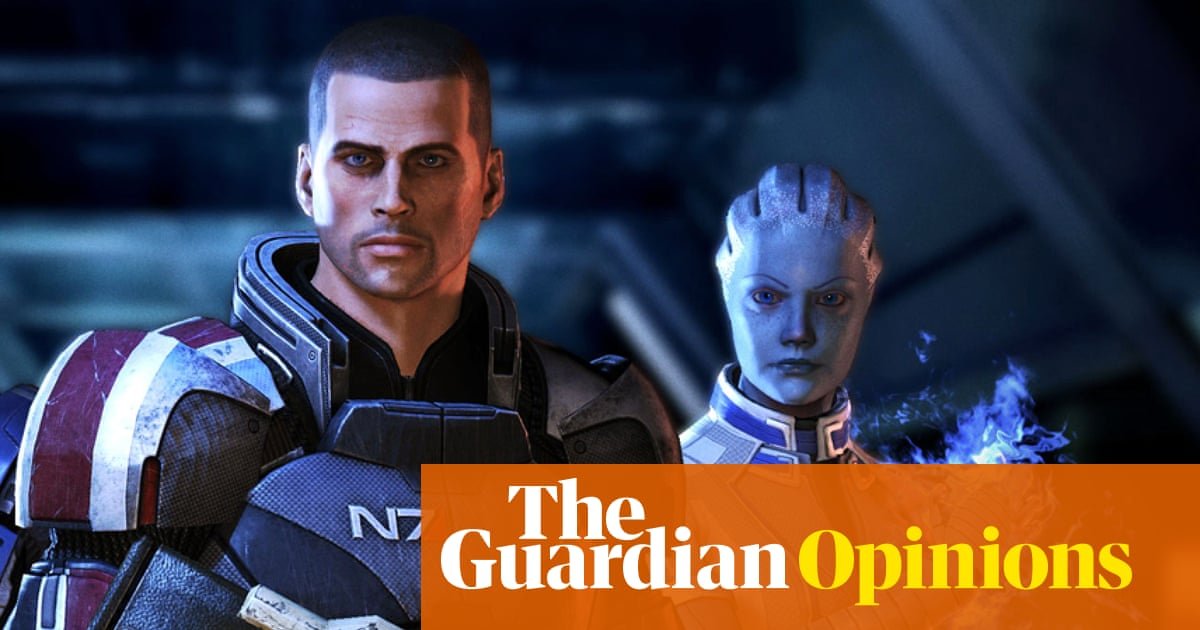
Strong foundations … Mass Effect 3.
Photograph: EA/BioWare EA has closed BioWare – and Mass Effect fans like me are bereft Lucy James The closure of the studio responsible for some of the best games of the 21st century leaves the world of RPGs feeling smaller without the hope of another instalment of the much-loved sci-fi series Earlier this week, EA announced the closure of BioWare, a game studio with a 30-year history of compelling role-playing games, complex characters and bold, choice-driven narratives.
Its forthcoming game in the Mass Effect sci-fi series has been cancelled, and more than 400 people are losing their jobs.
As someone who has worked in the video games industry for 15 years and spent almost 20 as a BioWare fan, I am among millions of mourners today.
It’s not terribly hard to see why BioWare got the chop.
Its parent company has been saddled with $20bn of debt thanks to a recent leveraged buyout involving Jared Kushner and the Saudi wealth fund.
EA was looking for weight to cut loose, and despite its hardcore fanbase and reputation for genre-defining RPGs such as Star Wars: Knights of the Old Republic and Dragon Age, BioWare hadn’t put out a critical or commercial hit in over 10 years.
Its forthcoming game, titled Mass Effect: Universe according to a leaked trailer, was announced back in 2020.
Despite some flashy teases, it was still years away from release.
The three games that comprise original space-faring Mass Effect trilogy count as my favourites of all time.
I first played in 2010, shortly after buying my Xbox 360 and being reassured by my friends that the game was a worthy investment, and have replayed them countless times since.
Depending on the day, the top spot fluctuates; more often than not it’s the character-driven sequel Mass Effect 2, which ends with one of the most iconic missions in gaming, that takes the top spot.
Released over a five-year period from 2007-12, the trilogy follows the adventures of Commander Shepard: a lawless Spectre special agent who is empowered by the galactic Citadel Council to use any means necessary to protect its interests and get the job done.
Shepard’s appointment as the first human Spectre in a galaxy where humans are the new kids on the block aligns with the arrival of the Reapers, an ancient synthetic race that raze all organic life every 50,000 years.
Shepard must convince the galaxy that the threat is real and gather its top soldiers, scientists and scoundrels to defeat it.
Coming together to save the galaxy ...
Mass Effect 2 Photograph: EA/BioWare When I played Mass Effect for the first time, I didn’t get it.
Its controls felt janky and awkward, and I was thrown headlong into a galaxy full of history and politics that I didn’t understand: the game didn’t spell things out, throwing out names and jargon and expecting me to follow.
After one exceedingly frustrating encounter with the Mako, the game’s infamously awkward land buggy, I quit entirely.
Some months later, something drew me back: the feeling of a job left half done.
The galaxy was in peril, and I had to save it.
The second time I tried, something clicked.
I focused less on the gameplay quirks and went all-in on its story and characters: the naive archaeologist, Dr Liara T’Soni; the browbeaten Citadel security guard Garrus Vakarian; and Kaidan Alenko, a human enhanced by the military, and suffering because of it.
Mass Effect’s story was simple – save the galaxy from a tormenting synthetic race with guns and space powers – but you got to determine how it played out.
Players were given the opportunity to make meaningful choices that hugely affected how the story unfolded, and that stuck with me (and millions of others).
Throughout the course of the game, you can shape not only Shepard’s gender and what they look like, but how they react to situations.
Would they be friendly, and use some inter-species cooperation to defeat the Reapers?
Or take the renegade route, tersely shutting down dissenters, sometimes resulting in hilariously out-of-pocket responses? (My apologies to the intrepid space reporter Khalistah al-Jilani.) Regardless of how you played, it was thrilling to have such agency over how Shepard moved and was perceived in the world.
But the real fun was in making decisions that altered the story not only in Mass Effect, but its sequels.
I agonised over every choice, large or small.
Across three games and the far flung reaches of the galaxy, my influence was felt.
Races lived and died at my whim, and the consequences of my actions showed up in the most unexpected ways.
It made my playthrough feel truly mine, guided by the stern hand of its development team, but shaped by me, and me alone.
Shepard’s plight was mine, and I would save the galaxy.
I hadn’t played anything like it at the time, and even now, I struggle to think of moments that compare.
Its missions and story beats are so ingrained in my mind that you’d think I actually lived them.
Such is the wonder of a video game, the freedom to explore and affect the world you’re playing in.
Mass Effect’s unlikely fan favourite, Garrus.
Photograph: EA/BioWare Mass Effect’s story wouldn’t have hit as hard if it weren’t for its characters: a motley crew of the galaxy’s toughest and cleverest, drawn to your cause for their own, complex reasons.
It questioned whether AI had a soul, the sins of the father, and the heaviness of duty.
BioWare wrote missions personalised to your squadmates’ causes, asking you to make agonising decisions that could benefit or harm them, and then forcing you to deal with the results.
The writers went one further, allowing you to date some of these characters, slowly building from nervous flirting to ratings-friendly romance scenes.
Saying goodbye to your squad, who’d been with you through hell, before the third game’s devastating final act brought me to tears over a decade ago.
It still does. skip past newsletter promotion after newsletter promotion It’s been over a decade since Shepard’s story concluded, and the trilogy is still lauded as among the greatest ever made.
I play dozens of games a year, and few have stuck with me as Mass Effect has.
Its influence is impossible to shake.
It set the standard for action-RPGs for years to come, and despite a furore at its original ending (since changed due to public outcry), is still beloved and widely referenced in gaming culture.
BioWare’s ending feels so final, so abrupt.
Despite missteps and mismanagement in recent years, most publicly in the form of failed sci-fi shooter Anthem, getting a glimpse at what the new Mass Effect might have been has left fans bereft.
The foundation of the universe was so strong, and in the right hands it could have been another genre-defining story.
The loss of BioWare is an enormous one for gaming, a bastion of western role playing games brought down.
Its influence will continue to be felt throughout the gaming galaxy.
Lucy James is founder and curator of lookingfor.game and co-host of the Friends Per Second gaming podcast.
Explore more on these topicsGames Role playing games comment Share Reuse this content