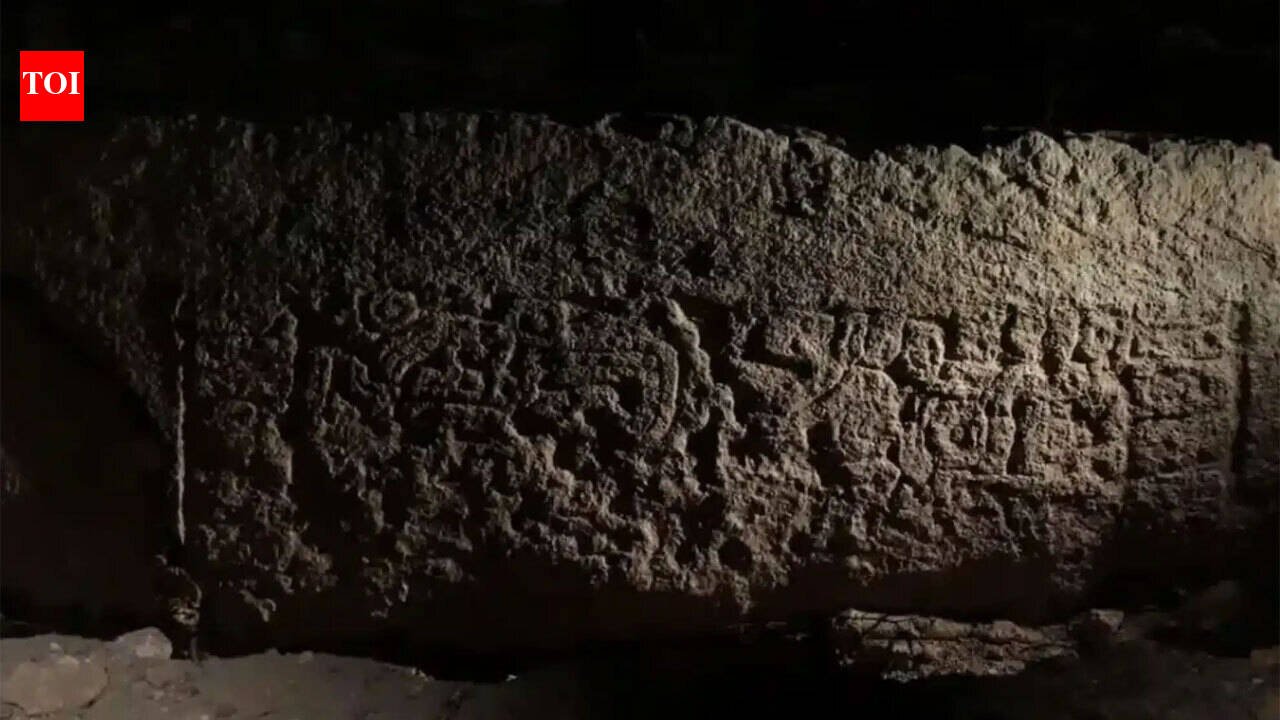
Ancient Maya city in Mexico's jungle may have its original name revealed by a 1,000-year-old inscription (Photo Credit: Octavio Esparza/INAH) An ancient stone step recovered from the Maya city of Ocomtún in southern Mexico has helped researchers identify the possible original name of another archaeological settlement discovered earlier this year.
The settlement, now known as Minanbé, may have been called Sakil by its ancient inhabitants, according to an interpretation of inscriptions by epigrapher Octavio Esparza Olguín of the National Autonomous University of Mexico's (UNAM) Center for Maya Studies.The findings were presented at a conference organised by Mexico's Secretariat of Culture through the National Institute of Anthropology and History's (INAH) Campeche centre.
According to Daily Galaxy, which reported the discovery on November 18, 2026, the inscriptions also offer evidence of possible hostility between Minanbé and neighbouring Ocomtún during the Late Classic period, which lasted from approximately 600 to 900 CE.How was the ancient Maya city of Minanbé discovered?
According to the Daily Galaxy report, Minanbé was discovered in May 2026 in the forest north of the Calakmul Biosphere Reserve in southern Mexico.
The archaeological site covers approximately 15 hectares, or around 37 acres.
The discovery was made as part of the project titled "Expanding the Archaeological Panorama of the Central Maya Lowlands", led by Slovenian archaeologist Ivan Šprajc.
The report noted that the settlement may have previously appeared in LiDAR survey data, which uses airborne laser scanning to identify structures beneath dense forest vegetation.Reaching the site required the archaeological team to establish a camp and clear a path through the vegetation using machetes and chainsaws.
The name Minanbé was formed using Yucatec Maya words meaning "there is no" and "road".
According to the report, Šprajc described it as the first intact archaeological site the team had found in three years.Researchers recorded nearly 20 monuments at the settlement, with at least five containing traces of inscriptions and images.How did a carved stone step reveal the city's possible name?
The identification of the possible ancient name came from comparing inscriptions found at two archaeological sites.According to Daily Galaxy, one important piece of evidence was Stela 7 at Minanbé, a monument that had been cut into three sections, with its upper portion relocated.
Its inscriptions contain the name Suutz', meaning "bat", alongside a title represented by the glyphs sak, meaning "white", and ajaw, meaning "lord".The researchers compared this inscription with Monument 1 at Ocomtún, an archaeological site discovered by the same project in 2023, approximately 40 kilometres northwest of Minanbé.The monument at Ocomtún had been reused as a stone step in Complex B6, although it was originally believed to have formed part of a doorway lintel.
Its carved surface depicts a captive lying face down with his wrists bound beneath an animated mountain.
An inscription identifies the captive as having come from a place called Sakil.Esparza Olguín connected the place name on the Ocomtún monument with the inscription on Minanbé's Stela 7 because of the similarities in their structure.
Recalling the moment of recognition, he said, "When we linked this toponym, I said: Eureka!", as quoted by Daily Galaxy.What do the inscriptions reveal about the Maya ruler?
Another important inscription was found on Altar 6 at Minanbé.
According to the report, the monument contains the ruler's name, Suutz', followed by the title kalo'mte'.The title was used by powerful rulers during the Classic Maya period and is generally translated as "lord who destroys spears".
A text published by UNAM, as cited in the Daily Galaxy report, states that the title first appeared in the early fifth century and became particularly associated with influential rulers during the Late Classic period.The appearance of the title at Minanbé provides additional information about the settlement's political status and its ruler.Join conversation Share your thoughts in the comments Be respectful · TOI community guidelines What is known about the relationship between the two cities?
The inscriptions also point towards a possible conflict between Minanbé and Ocomtún.
The captive depicted on the reused monument at Ocomtún, identified as originating from Sakil, is an important part of the evidence.Speaking about the relationship between the neighbouring cities, Esparza Olguín told researchers that they "were not at all friendly, at least during a stretch of the Late Classic", according to Daily Galaxy.However, the inscriptions have not established which city prevailed in the conflict or how long the hostilities continued.
Esparza Olguín has also proposed possible connections involving other Maya settlements, including Chactún, Tamchén and Lagunita, although these remain theories.Researchers have therefore described Sakil as a possible identification of Minanbé's original name rather than a conclusively established reading.