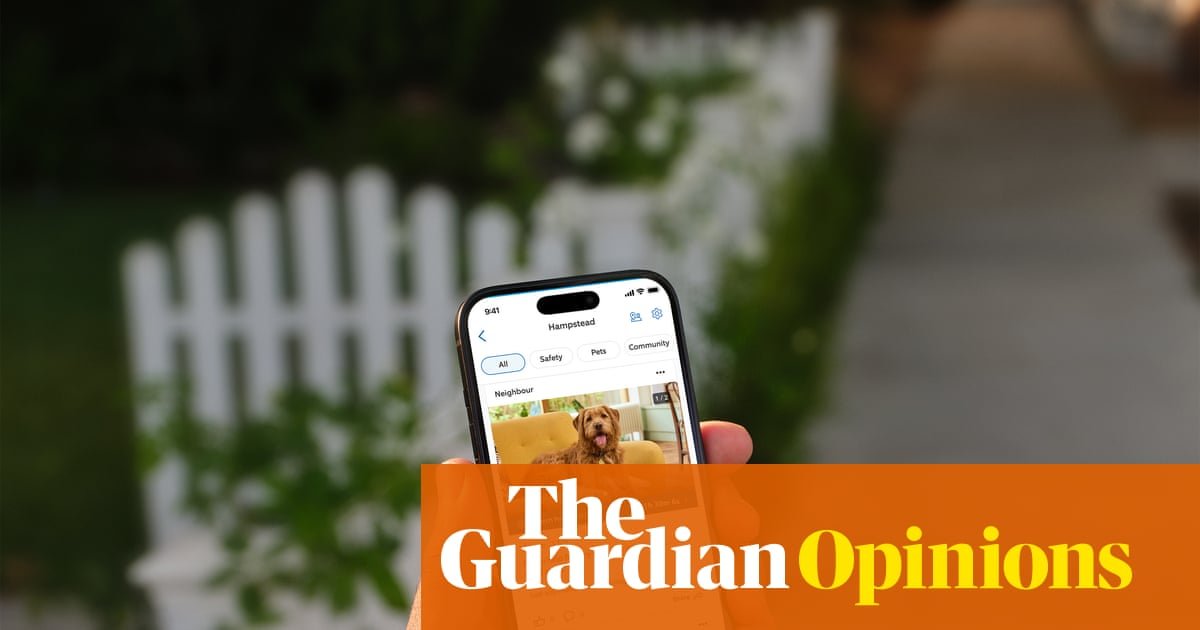
A mock-up of the new Ring Neighbours app.
Composite: Ring A mock-up of the new Ring Neighbours app.
Composite: Ring Amazon’s Ring wants to replace local WhatsApp groups.
It’s a recipe for curtain-twitching disaster Imogen West-Knights Do we really want a slick digital message board overseen by Amazon?
It’s the neighbourhood nonsense we treasure Ring, the Amazon subsidiary of camera-enabled doorbells fame, wants to be an even bigger part of your neighbourhood.
Next month in the UK, it will be launching Neighbours, a community app that seeks to replace the now traditional neighbourhood Facebook or WhatsApp group.
It will be available inside the Ring app, free to everybody, including people without Ring products, and will include a community requests feature wherein the police can ask for footage from residents living near reported crimes, who can then choose whether or not to share it.
My first thought was that this is curtain-twitching culture gone mad.
If you must have a Ring doorbell (and my instinctive feeling as someone without one, a feeling I will no doubt have until I get one and decide it’s great, is that it’s narc-coded behaviour) then: OK.
But does Amazon need to be in charge of a digital village messageboard too?
The selling point, Ring thinks, is that posting will be anonymised, and posters will have to conform to strict guidelines on what they are allowed to post.
It would, in other words, be very unlike the lawless badlands of a neighbourhood WhatsApp.
Maybe people really did want these groups replaced by something more centrally managed.
I asked around people I knew about the WhatsApp communities that they were in, and the kinds of behaviour they had witnessed.
Some of it, naturally, demonstrated an ugly dislike of homeless people, fear and loathing of door-to-door salespeople, racial profiling of local youths, and the view that everyone not personally known to the residents was a criminal in waiting.
Some of what people encountered on these groups was just strange: a north London WhatsApp group of more than 500 people having to disband because someone was giving away a Hewlett-Packard printer and another person said that shouldn’t be allowed because of BDS; a woman forced to recuse herself from a neighbourhood group because she saw a toad get squashed by a car, and was inundated with local volunteers who wanted her to set up and run a toad protection squad in case there were other vulnerable toads in the area; a man with a vendetta against a local couple who were feeding the foxes that went on to rip up his garden taking to his local chat to respond with witty bons mots such as “they are as stubborn as the foxes themselves but lack their intelligence”; repeated reports about a “sick cat” that people familiar with the animal had to confirm was “just ugly”; and this is leaving out the party poopers, bin police and other assorted oddballs.
But then there were the wonderful stories, too: the organisation of a funeral procession for an older woman who died on the street with no immediate family; borrowing laptop chargers and camping equipment; taking in people who had locked themselves out.
And all of these led me to feel a little envious.
I’ve just moved, but for four years before that I lived on a street in south London.
One time, I witnessed something insane happen.
My flatmate was at home one Saturday afternoon and heard an altercation on the street, and looked out the window to see what was going on.
He was, in his way, curtain twitching.
A neighbourhood cat, a friendly local celebrity who always greeted you as you passed, had been mauled to death by an XL bully being walked past the house where it lived.
The cat’s owners were, understandably, furious and upset.
The noise my flatmate heard was them trying to detain the person with the dog so they could be held accountable.
Later that week, signs appeared on trees on the street inviting anybody who knew the departed cat to gather outside the family’s home for drinks.
My flatmate and I looked at this sign and became anxious that nobody would go.
I was moved almost to tears at the image of this grieving family, including two young children, with their trestle table of prosecco and nobody to serve it to.
We needn’t have worried.
Dozens of people showed up, with flowers and wine and stories of giving little pieces of chicken to the cat.
At this memorial, I looked around and thought: God, it is actually quite strange and perhaps reflects poorly on all of us that most of us had never met.
Our street, as far as I know, had no WhatsApp group.
If it had done, I would have known these people already.
Community, especially in big cities, can be hard to come by, and is precious to people when it’s found.
After that cat memorial, we invited two of our newfound neighbours over for drinks.
We’ve since become friends.
I felt, for the first time, part of my local area.
Neighbourhood WhatsApp groups can be a way to create that feeling.
But.
But!
They are also places where people exercise their worst small-time cop impulses, demonstrate their smallmindedness, allow the little annoyances of life to induce them to send people they hardly know crazed screeds about recycling etiquette.
Would you give up the latter if you had to give up the former as well, though? skip past newsletter promotion after newsletter promotion Here’s a comment Dave Ward, Ring’s managing director of international, gave to the Guardian about what they want to do.
“We are going to coach people to make sure they’re creating the right sort of post, asking them if that’s really something they want to write or whether it really needs that descriptive term, to help stop the type of content no one wants to see and make it more community focused.
That’s very different to other places [such as WhatsApp groups].” So Ring wants to streamline things, moderate, vet, polish.
I have worked my way around to feeling, however, that the problem here isn’t just Ring wanting to connect us all up to the police, encouraging the darker side of local message groups, that micro-nation surveillance state tendency, or even it wanting to induct more people into local groups that can so often be irritating.
It’s that the rough edges of these groups are the spice of life.
You don’t have to participate in a neighbourhood WhatsApp group, but if you choose to be in one, the price for the moments of kindness and connection you can find within them is the nonsense.
Imogen West-Knights is a writer and journalist Explore more on these topicsWhatsApp Opinion Social media Amazon Apps comment Share Reuse this content