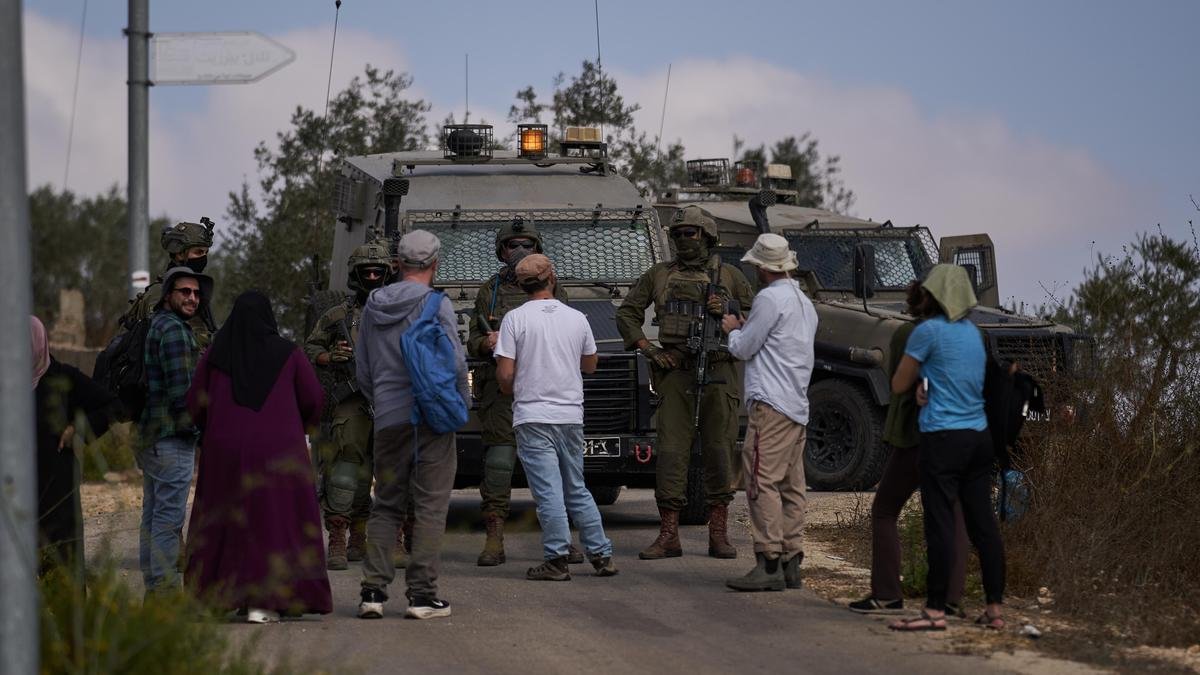
While Israel continues to attack one of Palestine’s two non-contiguous regions, Gaza, it is slowly and violently restructuring the other, West Bank.
Israel’s occupation of Judea and Samaria, the biblical term for West Bank used by the Israeli government, began in 1967 following the Six-Day War.
Despite being considered illegal under international law, Israel has slowly been asserting “sovereignty” over the region with increased restrictions for Palestinians and expansion of Israeli settlements.
And this has only intensified since the October 7, 2023 Hamas attack.
Trade curbs on Israeli settlements in West Bank unlikely to have much bite Nowhere is this clearer than in data on settlements and attacks on Palestinians.
According to Peace Now, an Israeli activist group that tracks settlements, fewer than 5,000 Israelis lived in the West Bank in 1967.
More than half a century later, the region now houses more than five lakh settlers.
That is, around 5% of Israel’s population now live in the occupied West Bank.
On the ground, this has come with significant expansion.
Peace Now data show that the Israeli government officially established more than 140 settlements and went through the full planning process.
While more than 40,000 housing units in West Bank settlements have been put out to tender since 2002, nearly a quarter of these were put out to tender in the past two years.
Tenders refer to proposals issued by the government for the construction of housing units.
However, the tender process is required only in 13 settlements and is not required in others, so the actual number of housing units being constructed could be much higher.
Is a future Palestine state possible? | Explained Further, nearly 430 outposts — Israeli settlements considered illegal even under Israeli law — have been established since the 1990s.
More than 50% of these outposts were established in the past three years alone.
Israeli law also allows “declaration” instead of “confiscation” of privately owned Palestinian land to build settlements.
Through this, Israel has taken over 9,00,000 dunams of West Bank land.
This expansion, which undermines the two-state solution, is happening through Israeli institutions and is closely integrated with its politics.
Months after the October 7 Hamas attack, in July 2024, the Israeli Parliament declared that it was opposed to the establishment of a Palestinian state west of the Jordan River.
A year later, the Knesset voted in favour of a historic declaration that officially supported the application of Israeli sovereignty to ‘Judea and Samaria’.
Though it was a non-binding resolution, the Speaker of the Israeli Knesset, Amir Ohana, then said: “In 1967, the occupation did not start, it ended.
That is the historical truth, and the one and only way to reach genuine peace is from [a position of] power.” With Israel set to go to the polls later this month, the Netanyahu government has been tightening its grip on the West Bank.
Two months before the elections, Israel published tenders for construction of 1,234 Israeli homes as part of its E1 settlement project that aims to create a continuous settlement ‘corridor’ between occupied East Jerusalem and Ma’ale Adumim.
It has also issued open calls for occupation.
The country’s far-right Finance Minister Bezalel Smotrich, on September 27, called for a full-scale war in the occupied West Bank and urged the military to use the tactics employed in Gaza.
“There are very specific communities who support settlement expansion and reject any settlement dismantling.
And that’s most of the right-wing, but the ones who are most committed to it are the firm right...,” said Dahlia Scheindlin, a non-resident Senior Fellow at the Center for International Policy, an American think tank.
“The party of Smotrich, Religious Zionism, is polling at about five, six, even seven parliamentary seats, and many of those are people who really prioritise settlement expansion.
But everybody else who’s voting for any party of the coalition is doing so with the assumption that they will always support settlements and reject any sort of dismantling there,” said Ms.
Scheindlin.
But it is not just the ruling party.
Parties contesting the coming polls seem to share a similar opinion on settlements.
Prominent parties like Gadi Eisenkot-led Yashar have expressed no interest in the evacuation of settlements and have proposed strengthening of the legally established settlements in the West Bank.
Impact on Palestinians Meanwhile, for the nearly three million Palestinians in the West Bank, daily life has been synonymous with navigating the multiple layers of restrictions imposed by the Israeli government, such as checkpoints, road gates and other obstacles.
These restrictions have divided Palestinian communities and limited their movement and access to work, school, healthcare, farmland and even aid organisations.
They have also borne the brunt of settler aggression, which has starkly intensified in the aftermath of the 2023 Hamas attack.
As per the UN OCHA, more than 1,200 settler attacks against Palestinians have been recorded each year since 2023.
Over 1,600 attacks have been reported just between January and August this year.
More than 1,000 Palestinians have been killed in the West Bank in the past four years.
At least 10,000 have been injured during this period.
These attacks have resulted in damage or demolitions to more than 6,000 Palestinian properties and displaced several thousands since 2023.
The UN noted in 2025 that displacement in the West Bank had hit levels not seen since the start of Israel’s occupation nearly 60 years ago.
A year later, the settler attacks resulting in casualties and displacement and open calls for occupation have only surged.
Ms.
Scheindlin said there is “a critical mass” in Israel for cracking down on settler violence, which she said is increasingly being understood as “terror.” Part of the reason, she explained, is that many on the right think the violence harms the image of the settlement project and may draw international attention, and a crackdown will stop pressuring Israel on this issue.
International reaction The mounting settler attacks have drawn sharp criticism from international actors.
For instance, Israel’s decision to publish tenders for its E1 settlement project in the West Bank was met with trade curbs from 12 countries.
The U.K., France, and Canada, along with nine other countries, namely Denmark, Finland, Iceland, Ireland, Norway, Poland, Portugal, Spain and Sweden, issued a joint statement on September 8, 2026, confirming their intention to introduce new restrictions on trade with illegal Israeli settlements in the West Bank.
Only two months ago, the United Nations OHCHR spokesperson Ravina Shamdasani expressed concern over the Israeli government’s announcement to further increase the number of settlements and open calls by Israeli leaders for revenge and collective punishment against Palestinian communities, accompanied by threats to turn the West Bank into another Gaza.