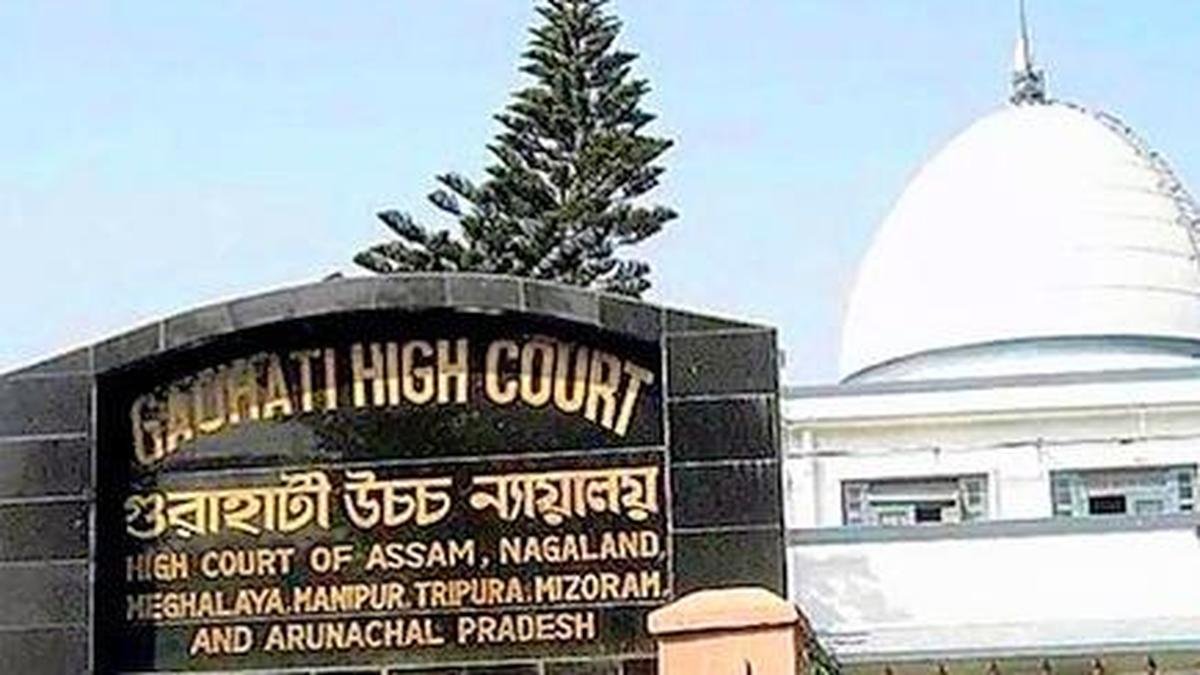
Days after the External Affairs Ministry clarified that a passport was not proof of citizenship, a 38-year-old resident of Assam could not convince the Gauhati High Court that 15 other documents he possessed were sufficient to establish him as an Indian, not a foreigner.
On June 30, the bench of Justice Kalyan Rai Surana and Justice Shamima Jahan upheld an order of a Foreigners’ Tribunal (FT) declaring Aminul Hoque a non-citizen, citing inconsistencies in the documents he produced to claim his Indian citizenship.
If a passport is not proof of citizenship, then what is? | Explained The court held that the 15 documents he submitted did not help him “establish that he has been able to discharge his burden”, as required by Section 9 of the Foreigners Act of 1946.
This Section states that the responsibility of proving citizenship lies on the person whose status as an Indian is in doubt.
The Guwahati-based FT No.
4 of Kamrup (Metropolitan) district adjudged Mr.
Hoque, a daily-wage labourer, as a foreigner in an order on February 28, 2019.
He challenged the order in the high court, producing several documents.
These included a copy of the 1951 National Register of Citizens (NRC) featuring his father and grandparents, voter identity cards, a permanent account number, a school certificate, and an original land purchase deed of 1973, to claim that he was an Indian.
Passport is not a citizenship document: senior MEA official Appearing in court, Mr.
Hoque’s father identified the petitioner as his son.
However, the court held that mere filing of a written statement and oral testimony, without “admissible and relevant” documentary evidence, were insufficient in a proceeding under the Foreigners Act.
Referring to a previous judgement, the court said that an NRC extract produced to prove domicile in India is inadmissible in evidence.
It observed that the copy of the 1951 NRC produced by Mr.
Hoque was only a computer-generated printout without a certificate, as required under Section 65B of the Evidence Act, 1872.
The court further observed that the sale deed of the land purchased by the petitioner’s projected grandfather was discarded by the tribunal, as there was no explanation of whether the land existed and why it did not devolve on the legal heirs of the petitioner’s grandfather.
It held that the petitioner failed to establish that the tribunal had committed any patent error in appreciating the pleadings and evidence on record.
ALSO WATCH If not a passport, what proves you’re an Indian citizen?
“…the court finds no material to hold that the opinion assailed in this writ petition is bad on facts or in law.
The petitioner could not show that the said opinion was perverse on any count whatsoever.
Therefore, this challenge fails, and consequently, this writ petition is dismissed,” the court’s order read.
The quasi-judicial FTs have been deciding the fates of suspected foreigners based on the cut-off date – March 24, 1971 – for citizenship prescribed by the Assam Accord of 1985, which ended a six-year agitation against “illegal immigrants”, primarily from the newly-created Bangladesh.
In 2025, the Bharatiya Janata Party-led Assam government began using provisions of a 1950 law, the Immigrants (Expulsion from Assam) Act, to bypass the FTs and “push back” those deemed to be “foreigners” to Bangladesh.