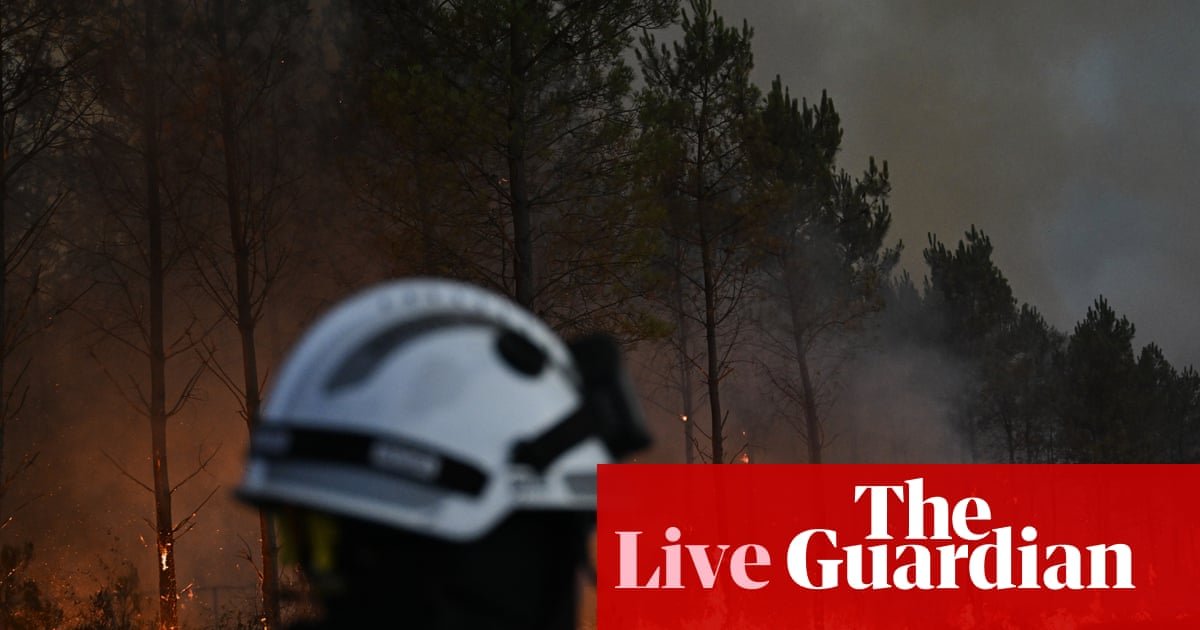
A Chinook helicopter equipped with a 11,300-litre water tank and a support aircraft would be deployed, alongside 24 skilled aerial and ground crew from the New South Wales Rural Fire Service. Follow live
Get our breaking news email, free app or daily news podcast
24m agoAcclaimed rock music journalist Glenn Baker dead at 74
1h agoParents of Australian facing possible death penalty in Syria disappointed with government action so far
2h agoGovernor general warns of ‘growing catastrophe’ that threatens to undermine democracy in Australia
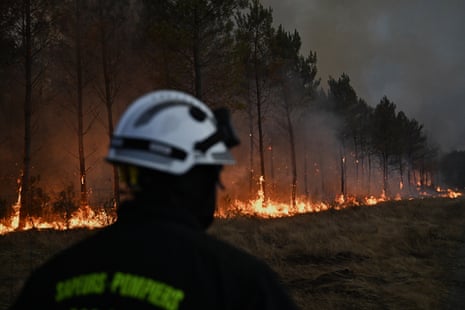
2h agoAustralia sends France 24 firefighters and two aircraft to tackle wildfires
3h agoIndigenous community rejects $150m Fortescue payout
3h agoFederal, state and territories meet over reform of working with children checks
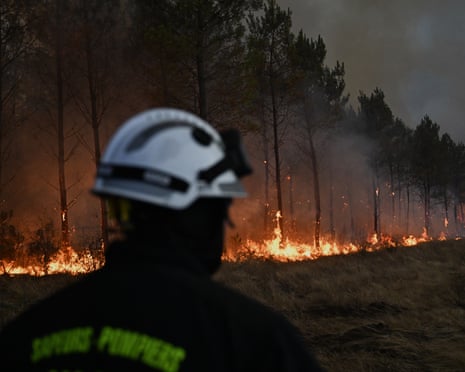
Australia is sending firefighting teams to support rescue efforts in France, amid raging wildfires in Europe.
The government said a Chinook helicopter equipped with a 11,300-litre water tank and a support aircraft would be deployed, alongside 24 skilled aerial and ground crew from the New South Wales Rural Fire Service.
Officials said in a statement:
Together, they will support around-the-clock firefighting operations, providing much-needed relief to emergency services responding on the ground. The wildfires in France are among the worst the country has experienced in decades, driven by multiple active fire fronts and a prolonged summer heatwave. The NSW RFS is internationally recognised as an expert in bushfire management and represents the very best of Australian emergency management capability.
Together, they will support around-the-clock firefighting operations, providing much-needed relief to emergency services responding on the ground.
The wildfires in France are among the worst the country has experienced in decades, driven by multiple active fire fronts and a prolonged summer heatwave.
The NSW RFS is internationally recognised as an expert in bushfire management and represents the very best of Australian emergency management capability.
Proposal to add area almost 10 times size of Tasmania to two remote marine parks
The Albanese government wants to ban fishing and mining from an extra 671,500 square kilometres of ocean around Norfolk Island and Lord Howe Island – an area almost 10 times the size of Tasmania.
The proposal is part of a review of 44 marine parks and, if it survives the current consultation period unscathed, would see the government reach its target to have at least 30% of Australia’s ocean estate in highly protected marine park zones by 2030.
The government said the two marine parks, hundreds of kilometres off Australia’s east coast, were ecologically significant as they supported a mix of cool and tropical marine habitats and were important corridors for migratory seabirds, cetaceans, fish and sharks.
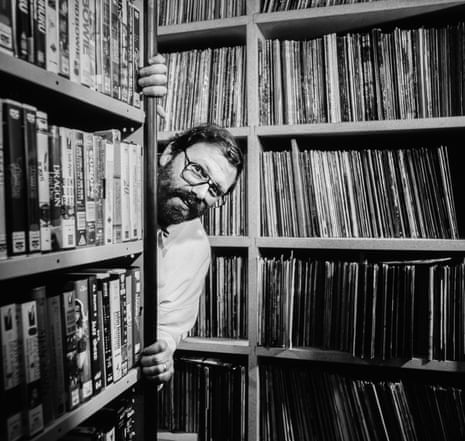
Glenn Baker, an Australian music journalist and rock historian, has died at the age of 74, his longtime friend and collaborator said this morning.
A tribute posted to Baker’s Facebook page this morning reads:
Glenn’s contribution to the Australian rock ’n’ roll music landscape was immense, but his family remembers him as a loving father of six and grandfather of thirteen. Glenn’s passion for music, travel, food and his family (still not entirely sure of the order) was, like his personality, larger than life.
Baker’s son, Orson, told The Sydney Morning Herald this morning his father had an “amazing life”.
He was so deeply involved in the music industry that we are talking about a man who absolutely had a life fully lived.
Rose Davies makes history in Australian 5,000m one-two at Commonwealth Games
In the fading Glasgow light, the two fluorescent yellow figures powered around the final bend of the 5,000m at the Commonwealth Games, leaving the rest of the field behind.
Megan Keith, the young Scot who had broken the field apart with a mile to go, could not keep up. Behind her was Kenya’s last hope of making it six 5,000m women’s golds in a row, Caroline Nyaga, as well as Ugandan Esther Chebet and England’s Hannah Nuttall. All of them, now irrelevant.
Australian Rose Davies had stayed within this leading group for the entire race, before surging past Keith with 200m to go. History was in her grasp: a woman had never done the 10,000m-5,000m double at the Commonwealth Games.