Follow the day’s news live
Get our breaking news email, free app or daily news podcast
19m agoLower migration levels would ‘trash the economy’, Tony Burke says
28m agoNew ballot systems for second and third years of working holiday visas
39m ago‘If you no longer have a valid visa, you should leave Australia’: Burke
1h agoBurke rubbishes ‘absurd’ claims of ‘mass migration’ in Australia
1h agoLabor to cut visas for international students’ families; new conditions on visitor visas
1h agoBig Build royal commission ‘toughest’ in Victoria's history, premier says
2h agoGreens accuse government of failing to fix aged care algorithm
2h agoNet overseas migration falls to 292,000 in the year to March
2h agoHanson scolds reporter for asking about ‘racism’ accusation from Payman
3h agoRockhampton’s Fitzroy River endorsed for 2032 Olympics by world rowing and paddle bodies
3h ago‘Have a beer’: Lambie celebrates veterans allied health cap backdown but defends Keogh
4h agoJacqui Lambie welcomes government’s allied health cap backdown
4h ago‘He has let them down’: Coalition push for no-confidence vote on Matt Keogh
5h agoLabor backs down on $5,000 allied healthcare cap for defence veterans
5h ago‘Welcome to politics’: Canavan defends Brethren church involvement in election
6h agoJoyce says Labor’s migration plan almost ‘exact replication’ of One Nation's
6h agoPeople with child support debts to be banned from leaving Australia
7h agoAlbanese government to improve safety in child support system
7h agoAustralia breaks into top 10 global gender gap rankings
7h agoLong-anticipated immigration changes drop today
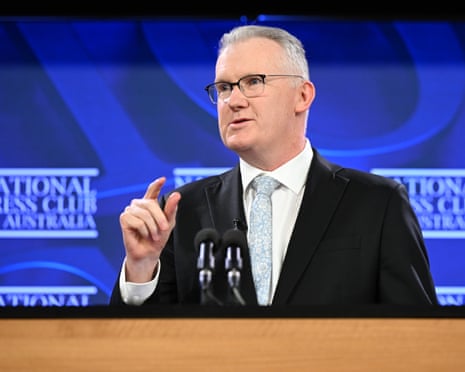
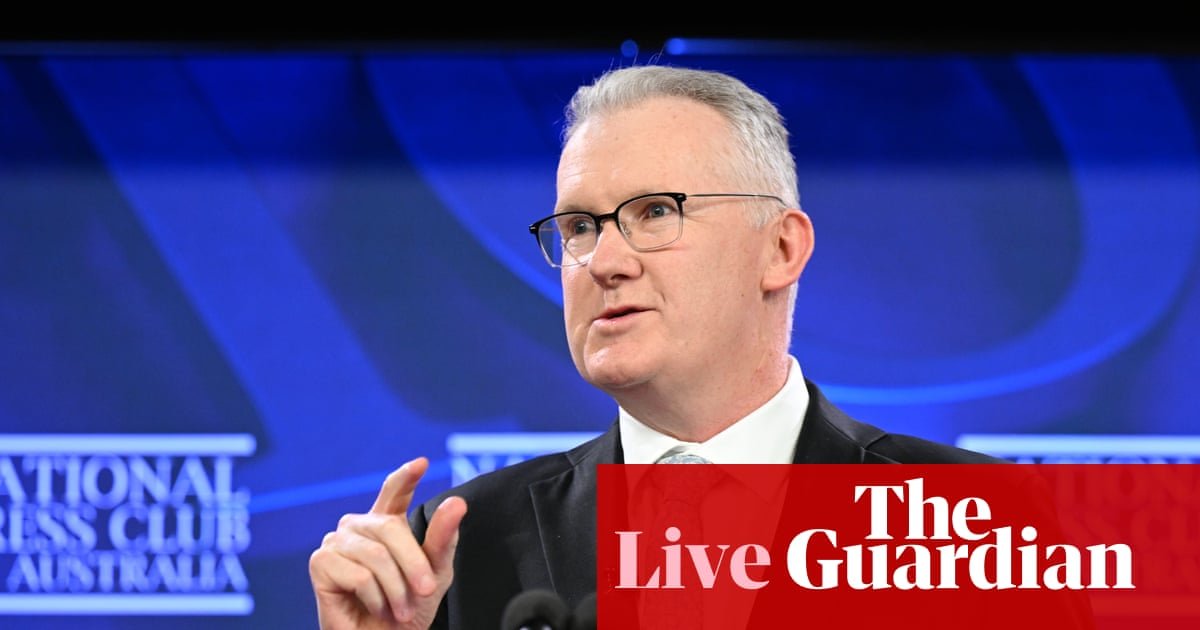
Tony Burke starts his address trying to dispel some of the most “absurd” claims in the migration debate – starting with the claim that Australia is a nation of “mass migration”.
Burke tells the National Press Club that there’s one simple fact to counter that:
Before the pandemic, the intergenerational report had the projections for where Australia’s population would be by 2030–31. When we get to that point, we’ll be 700,000 people smaller than what had been projected before the pandemic.
He then takes aim at claims that backpacker and Palm scheme visas don’t form part of the net migration number – most of them do. He said last year backpackers made up 48,000 of the net overseas migration figure.
There’s almost an approach, sort of the Nom version of nimbyism – I won’t try to invent the ‘nombyism’ word. It’s a concept where people say they want immigration numbers to go down, but they don’t want to mention this visa class and they immediately want to rule out all the ones that they would rely on.
Despite international students being targeted by the government in its migration changes, Burke acknowledges that the cohort are incredibly important to the economy.
He doesn’t say One Nation, but he’s clearly having a crack at their policy.
There’s a whole section of the economy in the cities that is only there because we have an important export industry in international students. Drastic cuts, wherever you make them, hurt the economy in every part, in every area. And what we need to make sure of is anything we do to temper migration needs to take account of the economic costs.
Everything is hunky dory with the PM and the treasurer, Burke says
Tony Burke says that the prime minister did not intervene last month when he was first due to unveil the migration plan at the press club.
He says the first reports of his speech being cancelled came a day after he’d discussed the decision with Anthony Albanese:
It was a bit hard for me to go back and say ‘I’m upset that you’re not agreeing to something that he had agreed to yesterday’, but journalists were saying he hadn’t.
Things are also all good with Jim Chalmers, Burke stresses, following reports the two weren’t seeing eye to eye on the policy.
This morning other cabinet ministers sought to play down any tensions in the cabinet over the plan.
Asked, “are you still mates?”, Burke says:
Yeah, absolutely. Add that to the list of things I’ve read that have surprised me about myself! I’ve had all sorts of arguments that I wasn’t aware of, as I’ve watch the news over the last six weeks.
Migration plan ‘improving supply and reducing demand’ in housing, says Burke
Burke is asked whether the policies will help put downward pressure on housing and rental costs.
At the beginning of his address, the home affairs minister tried to rubbish claims that migration is the leading cause of housing unaffordability.
He said a huge change from the last century is that less people are living in a home together, and more people are living by themselves, meaning you need way more housing stock to accommodate those choices.
He tells the press club these measures will help bring in more trade and construction workers to build more housing while decreasing the total number of migrants competing for housing.
It’s never going to be the only issue. But obviously anything you do that improves supply, you know, we’re both here, we’re both improving supply and reducing demand. We’re doing the two things that should help with exactly what you’ve described.
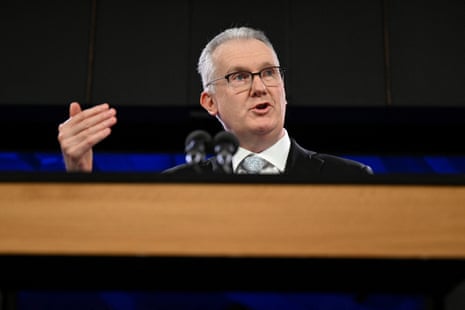
Tony Burke says it would be an “own goal” for the country to drop migration numbers further than what the government is planning over the next few years.
The budget anticipates net overseas migration will drop to 225,000 in 2027-28.
He says any more than that risks critical industries.
He tells the press club that other parties (One Nation) are proposing to stop temporary skilled workers being able to bring their families which would stop many of them coming and “will trash Australian services and trash the Australian economy.”
How many doctors at the moment, the proportion of doctors who come to Australia, come with family attached to their application? 50%. How many construction workers come with family attached to their application? 50%. How many nurses and aged care workers come with family attached to their application? Two–thirds … Imagine half of the construction workers who we have to build the houses that we need, not coming. Imagine two–thirds of the people who we rely on in aged care or nursing not coming. That’s the impact of those policies. That’s what those lower numbers do. And if that’s the debate I’m walking into, I am all in.
How many doctors at the moment, the proportion of doctors who come to Australia, come with family attached to their application? 50%.
How many construction workers come with family attached to their application? 50%.
How many nurses and aged care workers come with family attached to their application? Two–thirds …
Imagine half of the construction workers who we have to build the houses that we need, not coming.
Imagine two–thirds of the people who we rely on in aged care or nursing not coming. That’s the impact of those policies.
That’s what those lower numbers do. And if that’s the debate I’m walking into, I am all in.
‘Some of what’s been written is very wrong’: Burke on humanitarian visa reports
We’re onto questions now and Tony Burke is asked about media reports that the government was considering stripping working rights for asylum seekers or that an individual would only have three months to apply for asylum.
Burke says, don’t believe everything you read.
This is the problem we want to solve, but we will insist on solving it in a way that doesn’t undermine the decency of us as a country and doesn’t undermine the fact that we do believe – and the government does believe – for example, the classic one was those [Iranian] footballers, where they came to Australia, they were completely honest about the visa they applied for, they intended to go back, circumstances changed when they were here, and we were a good and decent country. We should continue this. I don’t think there’s much public appetite for people who know they don’t have a valid claim, being able to game the system. There are ways of working through that. I’m not going to go any deeper than that.
This is the problem we want to solve, but we will insist on solving it in a way that doesn’t undermine the decency of us as a country and doesn’t undermine the fact that we do believe – and the government does believe – for example, the classic one was those [Iranian] footballers, where they came to Australia, they were completely honest about the visa they applied for, they intended to go back, circumstances changed when they were here, and we were a good and decent country. We should continue this.
I don’t think there’s much public appetite for people who know they don’t have a valid claim, being able to game the system. There are ways of working through that. I’m not going to go any deeper than that.
There are some pretty significant changes to the backpackers’ visas that Burke is announcing today.
Right now you have to do 88 days of regional work to qualify for a second year of the working holidaymaker visa.
Under the new changes, that only gets you into a ballot to then get a chance of remaining here for the second year. Then there will be a further ballot for the third year, for those who have spent six months of their second year working in a regional area.
This is where the government will be cutting down a lot of visa places.
What you will be qualifying for is a ballot. Not everybody will get through because we need to have some control and certainty of what those numbers are. The ballot for year two will be limited to 45,000. For reference, last year there were 57,000 people who qualified. Year three, with the exception of the UK, is something that is not part of any free trade agreement, that third year, it was something that was introduced not that long ago. We will be seriously limiting year three down to a ballot system of 5,000. Now, last year, there were 31,000 in this group.
What you will be qualifying for is a ballot. Not everybody will get through because we need to have some control and certainty of what those numbers are. The ballot for year two will be limited to 45,000. For reference, last year there were 57,000 people who qualified.
Year three, with the exception of the UK, is something that is not part of any free trade agreement, that third year, it was something that was introduced not that long ago. We will be seriously limiting year three down to a ballot system of 5,000. Now, last year, there were 31,000 in this group.
As Burke notes there – this won’t affect the free trade agreement signed with the UK.
Burke says the government will hire 100 compliance officers and pursue extra detention centres to deal with tens of thousands of individuals who have remained in Australia without a valid visa – but stresses it won’t be an ICE-style crackdown seen in the US.
He says before 2015 anyone who overstayed their visa would be sent to a detention centre and they pretty quickly booked themselves a flight out of Australia.
But in 2015, after mandatory visa cancellation was introduced, the detention centres were filled with people who had come from prisons.
There are many compounds there where there is no way I would share an overstayer with that particular caseload, and it’s meant that the resources of the department have been had to be used in a very different way.
Burke says now the government is looking to return to that previous system.
What we will do is simply go back to what Australia always did before 2015. This is not the sort of operation that some people have seen on TV happening in other countries … We already have different alternative places of detention near airports that are available – but we’re also having a look at the former quarantine facility in Melbourne to see how that might be able to be repurposed as well.
What we will do is simply go back to what Australia always did before 2015. This is not the sort of operation that some people have seen on TV happening in other countries …
We already have different alternative places of detention near airports that are available – but we’re also having a look at the former quarantine facility in Melbourne to see how that might be able to be repurposed as well.
Burke outlines crackdown on visa-hopping
There are quite a few changes in store for future international students, including that students will no longer automatically be able to bring their family on a visa with them.
But students from Pacific and Asean nations, as well as students studying PhDs, will still be allowed to bring family.
There will also be changes to the points allocated for certain Tafe or university courses. Normally Tafe courses attract fewer points that are required to study in Australia, but Burke says now construction trades will get the same number of points as a university degree to “make sure that we are getting the construction trades that we desperately need”.
What we’ll be doing is updating that and adding to the priority list, construction, agriculture, fisheries and teaching.
The government will also be cracking down on so-called visa-hopping. Burke says:
Someone finishes their course and where do they go to next? And one of the classic areas of visa hopping is people finish a course, hop to the next course, hop to the next, and one of the worst examples is they transfer down to a not-so-legitimate educational provider who is able to say to them, ‘Study with me. It will cost you less. We’re not very demanding on whether you attend anything. And you’ll be able to go for your life and get out there and work.’ And where this is being used effectively to drive a migration outcome, not an educational outcome.
Someone finishes their course and where do they go to next? And one of the classic areas of visa hopping is people finish a course, hop to the next course, hop to the next, and one of the worst examples is they transfer down to a not-so-legitimate educational provider who is able to say to them, ‘Study with me. It will cost you less. We’re not very demanding on whether you attend anything. And you’ll be able to go for your life and get out there and work.’
And where this is being used effectively to drive a migration outcome, not an educational outcome.
Burke says to combat this a student will be allowed to change courses “up the qualification scale” but not down.
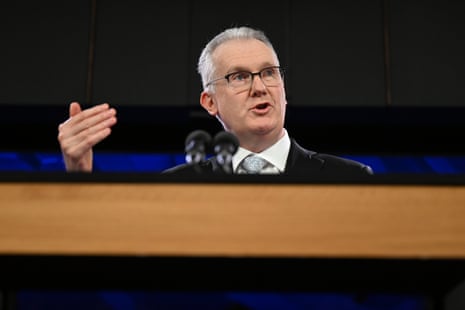
Burke denies migration plan in response to One Nation threat
Tony Burke says the government has been working on the migration plan since last year – ie refuting the claim that it’s been done in response to One Nation.
It’s simply demonstrably wrong to [suggest] that somehow this is a recent bit of work done to deal with a political climate. It’s not.
But he does say that the reforms don’t go as far as he’d like them to because of the political climate.
He says to go harder and use more “levers” to control migration, legislation is needed, and he knows he’ll struggle to get support from the Coalition or the Greens to do that.
They are not as comprehensive as I would like them to be. Effectively, to be able to add all the levers that I talked about, particularly with respect to the problem of the demand-driven system that we have – you can’t do that without legislation.
The government will cut off pathways for international students to remain in Australia, and crack down on individuals living in Australia without a visa, under its new migration plan.
Tony Burke is unveiling the plan – which won’t decrease the current targets for net overseas migration but will help the government ensure that the numbers won’t go above the target.
Burke says the government will enforce new compliance messages to make sure people without valid visas leave the country, as well prevent international students visa hopping, and restrict their ability to bring family over to Australia while they study.
Dodgy migration agents who support visa applications without merit will also be targeted.
There will also be changes to the working holidaymaker visa, which will see a ballot system introduced for the years two and three where there will be a requirement to work in regional areas.
Students should stay in school, not go to Hanson protest, Carroll says
The Victorian premier, Ben Carroll, was also asked about this afternoon’s national student walkout against Pauline Hanson.
Students want to change the world. The best place is to be in school – and getting an education, coming out and following it through is the best way you can change the world. I’m hurt by Pauline Hanson’s comments. At least Andrew Hastie calls out her comments. Jess Wilson is still to call out any comments that Pauline Hanson’s made. And whether its family violence, the prime minister’s mother, the attack on Indigenous Australians, leadership is calling out the awful, hurtful comments that Pauline Hanson has made.
The Victorian premier, Ben Carroll, has held a press conference with the head of the police union, Wayne Gatt, to announce that if Labor is re-elected, it will invest $10m in Bluehub, a mental health service for police officers.
Carroll has spent much of the week spruiking crime-related election commitments, including opening a new police academy in the western suburbs and introducing Jack’s Law, which will give police powers to stop and search anyone for knives using handheld metal detectors.
But most of the questions this morning focused on the royal commission into allegations of corruption on Big Build sites, which will hold its first public hearing next week. Carroll described the inquiry as the “toughest royal commission in Victoria’s history”. He went on:
Nobody and nothing is off limits – the power to compel people, the power to compel information. Also working alongside the royal commission, a special prosecutor, not waiting for a report, doing the work they need to do straight away for any criminality that is aired, and that is what we will focus on.
Asked whether a witness list would soon be published, he said that was “totally up to the royal commissioner”.
Carroll also said the matter of whether the government would cover current or previous MPs’ legal bills was being “worked through”.
Those decisions will be taken and made in appropriate course of time and action.
Got a question for us?
As we settle down at the National Press Club to shortly hear from the home affairs minister, Tony Burke, we want to hear from you.
Do you have a burning question about Labor’s migration plan or any other political issue?
Send your questions to Politicsreally@theguardian.com and we’ll be answering them in tomorrow’s newsletter.
And don’t forget to sign up to the Politics, really newsletter here.
Labor ‘still doesn’t understand how badly this has gone wrong’: Greens
Continued from our last post …
On Tuesday night the government circulated an amendment to the Aboriginal and Torres Strait Islander Aged Care Commissioner Bill to establish an “escalation pathway” for the mistakes made by the tool’s algorithm.
A statement from Greens senator Penny Allman-Payne said this change “is not to change the broken algorithm, or restore the ability for clinicians to override its mistakes. The amendment merely provides for an additional review pathway to the department to alter decisions”.
This tool was deployed without adequate testing or consultation, and yet was immediately given absolute power to decide older people’s care needs. The implementation of the tool has been a disaster, but this amendment shows Labor still doesn’t understand how badly this has gone wrong. Simply adding another review pathway is a wholly inadequate response by the minister to address an assessment tool that is fundamentally unfit for purpose.
The Greens have slammed the government’s proposed fix to an aged care assessment tool that is driven by an algorithm, and which has been revealed to be systemically under-assessing the support at home needs of older Australians.
Guardian Australia revealed through freedom of information that within days of the algorithm being rolled out as part of the Integrated Assessment Tool (IAT), state and territory health departments were logging hundreds of cases of under-assessment old older Australians and sharing concerns about the impact this was having on hospital discharge times and the deterioration of health conditions.
On Thursday Guardian Australia reported that after months of assurances to aged care assessment organisations that if the algorithm got a funding decision wrong, clinicians would have the power and discretion to correct the outcome, the department went back on its word at the 11th hour leading to internal turmoil.
Asylum seeker work restrictions ‘manufacture humanitarian crisis overnight’
The Asylum Seeker Resource Centre (ASRC) has warned that Labor’s proposed restrictions on asylum seekers’ work rights would “manufacture a humanitarian crisis overnight”.
The warning comes amid reports the government is considering new limits on the work rights of asylum seekers on temporary visas, including those appealing visa refusals.
According to modelling by the ASRC, removing work rights in Victoria alone could create at least $1m a week in additional support needs for asylum support organisations.
In a statement, ASRC head of advocacy Ogy Simic said:
Taking away work rights means taking people who are working, paying rent and supporting their families, stripping away their income and forcing them to rely on charities that are already stretched just to survive. You cannot tell someone they are allowed to remain in Australia while their case is reviewed, but deny them the ability to earn enough to eat or keep a roof over their head. That is a recipe for poverty, homelessness and exploitation. People seeking safety should not have their lives and livelihoods used as political footballs. Playing politics with people’s ability to work, feed their families and keep a roof over their heads has devastating real-world consequences. The answer is simple: let people work, support themselves and contribute to their communities.
Taking away work rights means taking people who are working, paying rent and supporting their families, stripping away their income and forcing them to rely on charities that are already stretched just to survive.
You cannot tell someone they are allowed to remain in Australia while their case is reviewed, but deny them the ability to earn enough to eat or keep a roof over their head. That is a recipe for poverty, homelessness and exploitation.
People seeking safety should not have their lives and livelihoods used as political footballs. Playing politics with people’s ability to work, feed their families and keep a roof over their heads has devastating real-world consequences.
The answer is simple: let people work, support themselves and contribute to their communities.
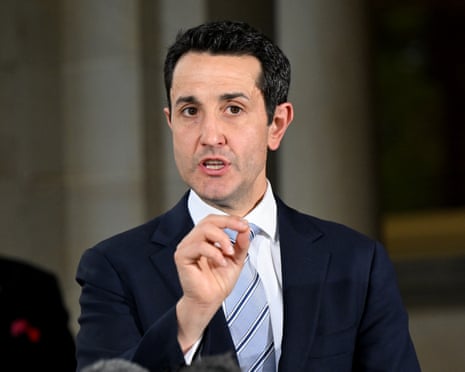
Queensland government pressed for power impact of datacentre deal
Queensland’s premier has refused to release any modelling done about the power impact of its new datacentre deal with AI giant Anthropic.
The company – which develops the large language model Claude – yesterday announced it would invest in the first stage of a $31bn planned datacentre west of Dalby, advertised as the country’s largest.
The opposition leader, Steven Miles, used question time this morning to press David Crisafulli for any modelling done on the project’s effect on household prices.
Crisafulli said the government’s “carve out” from commonwealth rules requiring datacentre developers to invest in new renewable power generation and to instead use the state’s ageing coal fleet would mean “that they don’t suck up power, and that they actually drive down electricity prices”.
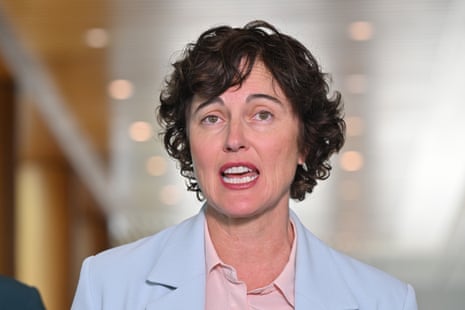
Force big tech to report AI incidents, says Kate Chaney
Kate Chaney has called for the government to force AI companies to share information on their advanced frontier models and report critical incidents.
Chaney and other crossbenchers are also calling for a tenfold increase in funding for the government’ AI safety institute so it can have a bigger role in local regulation and global negotiations. She told reporters in Canberra:
I have spoken to the government about it and they have not dismissed it out of hand … If we want to be taken seriously as a voice at that table, we just need to scale up.
She’ll be making more recommendations from the parliament’s joint committee on AI, which closed for submissions today. It will have six Labor members, four from the Coalition, Chaney and David Pocock but no Greens members. Greens senator David Shoebridge, who has been calling for a pause on datacentre development, said the party’s exclusion was “deeply disappointing”.
Net overseas migration eased to 292,000 in the year to March, from 299,000 in December, according to new figures from the Australian Bureau of Statistics.
The data comes less than an hour out from a major address by Tony Burke, the minister for home affairs, at the National Press Club, where he will release Labor’s migration plan amid an increasingly heated debate about the number of people arriving and staying in the country, mostly on temporary visas.
Net overseas migration, or Nom, surged following the end of Covid-era lockdowns, peaking at an annual pace of 556,000 people in September 2023 after turning negative two years earlier.
While well down on those peaks, Nom remains above the roughly 250,000 run rate leading into the pandemic, and above the government’s target of 225,000.
Australian politics live with Krishani Dhanji