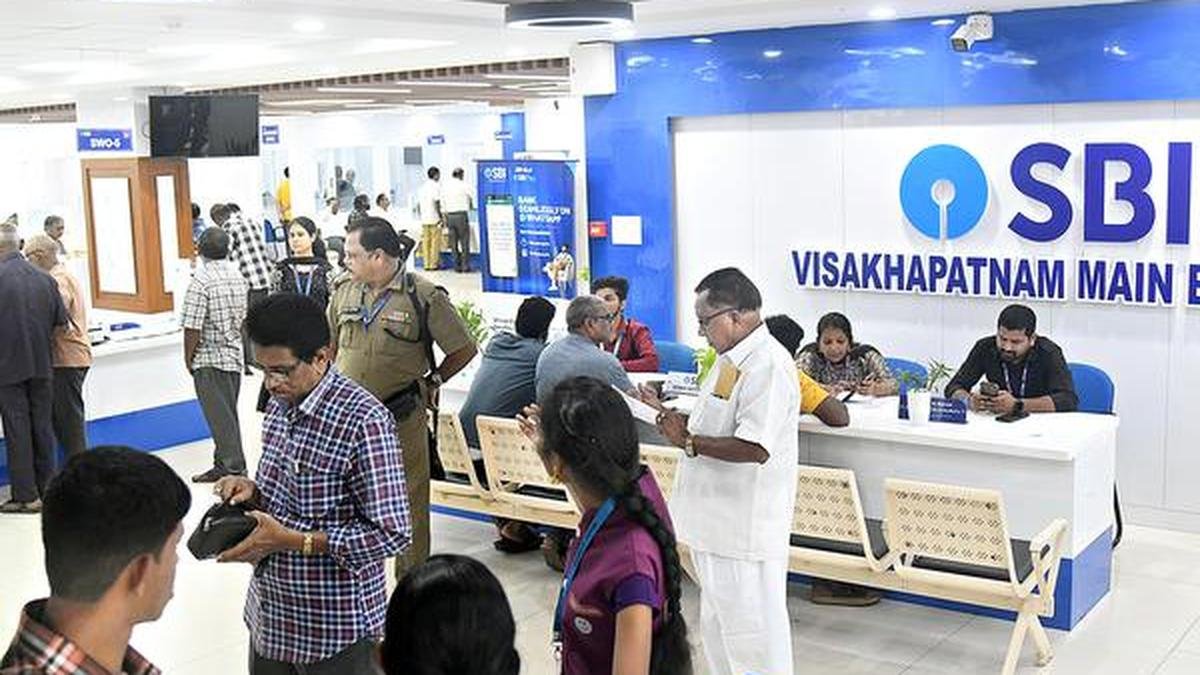
Bank unions on Sunday (September 27, 2026) deferred their proposed three-day nationwide strike following a meeting with bank managements.
The United Forum of Bank Unions (UFBU) issued a circular late on Sunday night, announcing that an understanding had been reached with the Indian Banks’ Association (IBA).
UFBU defers bank union strike The UFBU had called for a three-day strike from September 28 to September 30, 2026, over four key demands: implementation of the agreed five-day banking week, keeping the unilateral Performance Linked Incentive (PLI) scheme in abeyance, bilateral modification of the PLI framework, and settlement of long-pending residual issues.
The UFBU, an umbrella body representing seven bank employees’ and officers’ unions, had also threatened to go on an indefinite strike from October 26, 2026, if its demands were not met.
However, the forum decided to defer the proposed strike following progress in discussions with the IBA.
The strike has not been cancelled, as the demands are yet to be met, with the IBA agreeing to constitute a high-level committee to examine the issues raised by the unions.
No commitment given to bank unions on five-day work week by Finance Ministry: report Committee for 5-day work week demand One of the UFBU’s main demands is the implementation of a five-day working week in the banking sector, with all Saturdays declared bank holidays.
In 2024, bank employees had suggested increasing daily working hours by 40 minutes to ensure that the total number of working hours per week remained unchanged.
The proposal has been pending with the government.
The unions have argued that a five-day working week is already followed by several government and financial institutions.
In a significant development, a consensus has now been reached on the immediate constitution of a high-level committee comprising representatives of the IBA and the UFBU to specifically examine the demand for declaring Saturdays as holidays.
Why are bank employees going on strike even after govt withdrew PLI scheme?
“A high-level committee of the IBA and UFBU will be formed immediately to deliberate on the issue of declaring the remaining Saturdays as holidays.
This committee will explore all possible alternatives, discuss with all the stakeholders, and work out a solution acceptable to all the stakeholders, more importantly, the customers,” the UFBU said in a statement.
PLI scheme kept in abeyance Apart from the demand for five-day banking, the unions have sought the withdrawal of the PLI scheme announced by the Department of Financial Services in November 2024 and applicable for the financial year 2025-26.
The revised PLI scheme was applicable only to officers in Scale IV and above, which became a major point of contention.
Under the scheme, senior officers could receive PLI of up to 365 days of Basic Pay based on individual performance.
According to the employees’ unions, the scheme was discriminatory as it marked a significant departure from the uniform formula of 15 days’ Basic Pay plus Dearness Allowance applicable to the rest of the workforce.
The revised PLI scheme was also a departure from the agreement reached between the unions and the Indian Banks’ Association in 2020, under which the incentive was to be linked to the overall performance of individual banks and applied uniformly to employees and officers.
There has also been substantial progress on the Performance Linked Incentive issue.
The Finance Ministry earlier this month said the scheme had been kept in abeyance following detailed discussions, addressing one of the unions’ main demands.
“As regards the PLI Scheme for Scale IV and above officers, the discussions can start with Indian Banks’ Association (IBA) to propose modifications to the Government in the scheme to address the observations of the Unions/ Associations.
The residual issues as listed in the minutes dated 8.3.2024 will be discussed between the parties for expeditious resolution,” the UFBU circular said.
Nationwide bank strike: State-Level Bankers’ Committee advises customers to plan banking transactions in advance MoU for residual issues Other UFBU demands include the updation and improvement of pension benefits, a uniform dearness allowance formula for all pensioners, and an option for employees covered under the National Pension System (NPS) to switch to the Old Pension Scheme (OPS).
The UFBU’s demands also include issues such as LTC/LFC monetisation, fitment anomalies, grid holidays and regulated working hours for officers, apart from common issues concerning pension, PLI, medical benefits and welfare.
“The proposed MoU now records that these residual issues will be taken up between the parties for expeditious resolution,” the UFBU circular said.