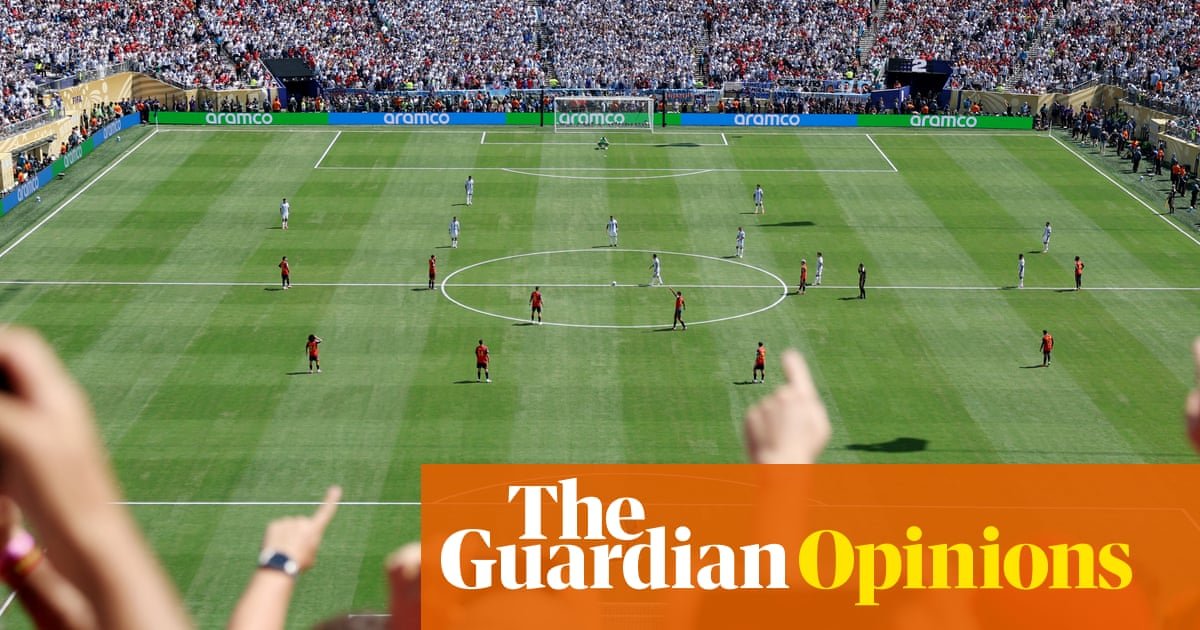
The 2026 edition of the tournament brought in untold amounts of money to Gianni Infantino’s governing body
The total hasn’t entirely stopped rising yet, still clicking away towards a final tally. Still, Fifa has already announced that it surpassed its own lofty revenue projections for the 2026 World Cup, bringing in $15bn, significantly more than anticipated. It appears that a third of that total – $5bn – came from ticket sales and hospitality alone, per reporting from the Times.
That would mean direct income from the matchgoing fans came in five times as high in the United States, Canada and Mexico as it did at the last World Cup, in Qatar in 2022, when the total stood at $929m. While 2026’s expanded World Cup added 40 games to the schedule, the takings nevertheless went from an average of about $14.5m per match to about $48m.
Which is to say that Fifa, and by extension its all-controlling president Gianni Infantino, was right.
Wrong, mind you, about what it believes anybody with a modicum of taste would think is cool and enjoyable. Like putting Robbie Williams in everything; or cramming Madonna, and BTS, and Shakira, and Justin Bieber, and Ted Lasso, and the Muppets into a World Cup final half-time show that catered to the appetites of the lobotomized; or setting up a pre-final speech on greatness by Tom Cruise.
Wrong, too, about mandatory hydration breaks, and suspending red cards, and stretching the aforementioned, accursed half-time show to 27 minutes in violation of Fifa’s own rules.
But right about all the things Fifa cares about. Which can be neatly reduced to money.
Right that exposing ticket sales – and even parking – to dynamic pricing, driving their prices far out of reach of your average fan, would pay off. Right that it could annex the secondary ticket market and take a hefty cut of resales. Right that the PR hit of cozying up to Donald Trump – who was already deeply unpopular, especially among America’s left-leaning soccer crowd – would not be mortal and, in fact, would not even cost Fifa any money at all. That tolerating the excesses of the Trump government – the disgraceful treatment of the Iranian team, its bluster about potential ICE action around stadiums and its denial of visas to fans and journalists hoping to attend the tournament – would be worth it in order to safeguard the money gusher. (These things may all yet be investigated, among about a million other things, but Fifa’s money is made all the same.)
Right, in the end, that the World Cup is too big to fail. That the decadence and cravenness of the World Cup’s organizers will, in the end, be redeemed by the tournament itself. That the World Cup is unfuckupable.
As things stand, it looks like Infantino may very well survive the fallout of his foolhardy and utterly tone-deaf attempt to quickly and unilaterally sell a chunk of the World Cup’s commercial rights to private equity. That was a bridge too far even in the world’s most cynical sport, but the tournament’s profits appear to have consolidated his power in spite of it all. Infantino has an election to get through in March, but a great many of his ardent supporters are apparently unmoved by the scandal and stand resolutely behind him. While he can’t quite do whatever he wants, it appears he also can’t commit an act grievous enough to be dislodged from power.
As Fifa pointed out to the Athletic, the World Cup’s attendance of 6.8 million was unprecedented – the previous record, from the 1994 World Cup in the United States, was just under 3.6 million. And hat means bigger payouts for Fifa’s 211 member associations, each of which has a presidential-election vote.
This, and only this, is why there is no reforming Fifa until the money stream is somehow slowed. The real power in soccer lies with the money – everything and everyone else is just a figurehead. The sport is organized and optimized to facilitate only the flow of money. We were reminded of this same truth just last week when comments emerged of Kylian Mbappé making light of a meme involving himself and China’s former leader Mao Zedong. The Real Madrid star quickly lost several endorsement deals in China, and scurried to apologize faster than he’s ever loped after a through ball.
Infantino understands this innately and behaves accordingly. And for all his blundering behavior, for all the ugliness and moral insolvency of his grubby masterpiece, the final takeaway from the 2026 World Cup is that, actually, this is all fine. It worked. Pandering to politicians? Proof, meet pudding. The money poured in at an unprecedented flow rate, a rapids of revenue. So, you know, carry on.
And that, to use a term from these lands that have made Fifa even wealthier, sucks.
Leander Schaerlaeckens is the author of The Long Game: U.S. Men’s Soccer and Its Savage, Four-Decade Journey to the Top, or Thereabouts, which is out now. He teaches at Marist University.