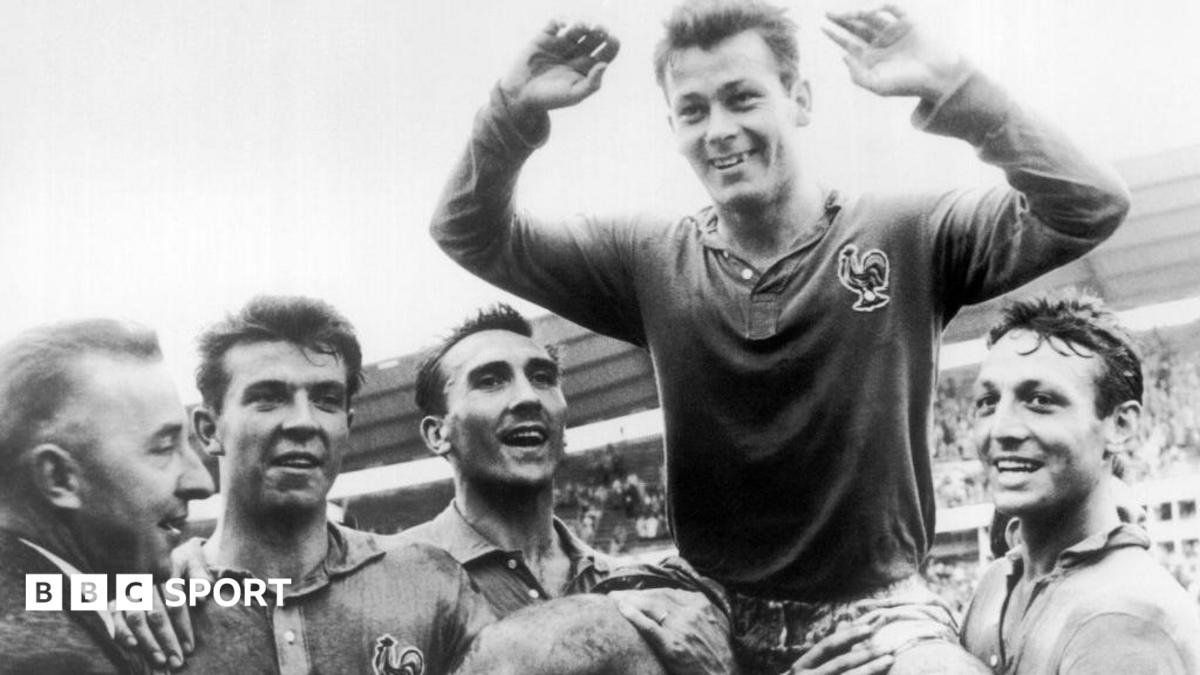
ByEmma SmithBBC Sport journalist Just Fontaine's record 13 goals at a single World Cup is remarkable in itself.
Now consider that he wasn't wearing his own boots, and wasn't supposed to be starting France's games.
He didn't even get a Golden Boot trophy for being the 1958 tournament's top scorer - instead he was awarded an air rifle by a Swedish newspaper for being a "sharp shooter".
His name comes up every four years as the benchmark for the latest crop of players - but for the rest of the time he is a great pub quiz answer.
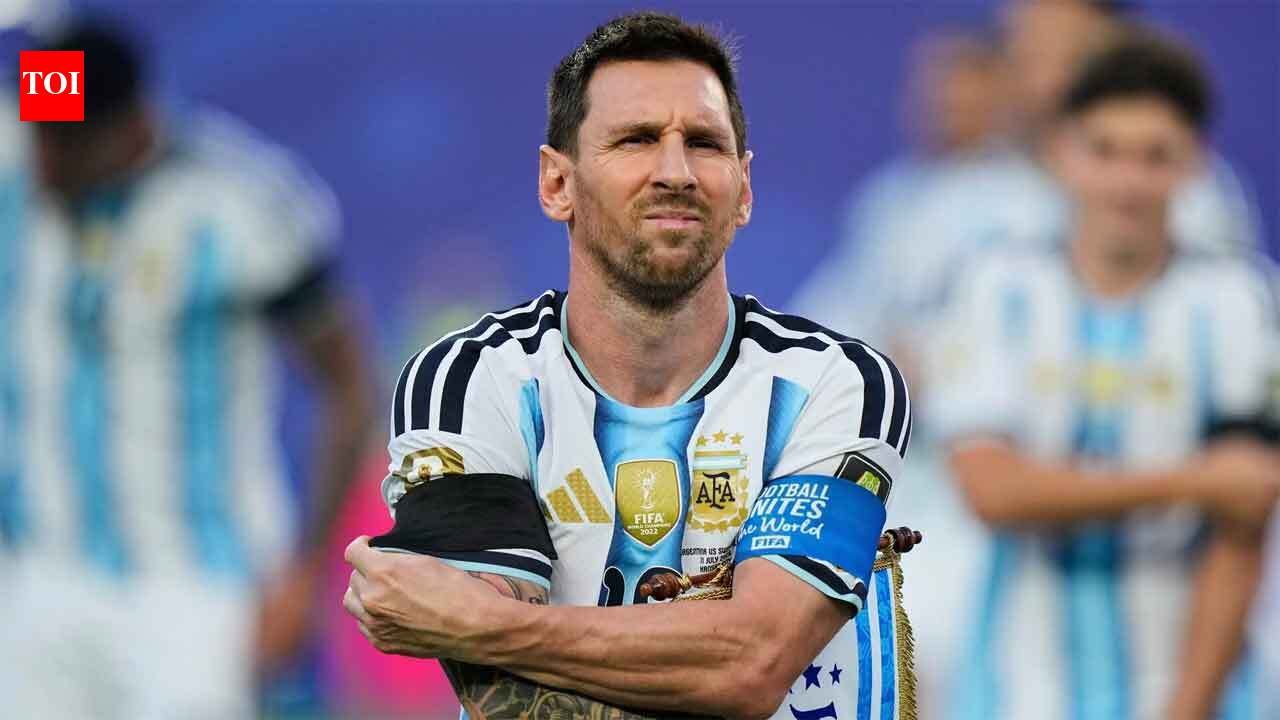
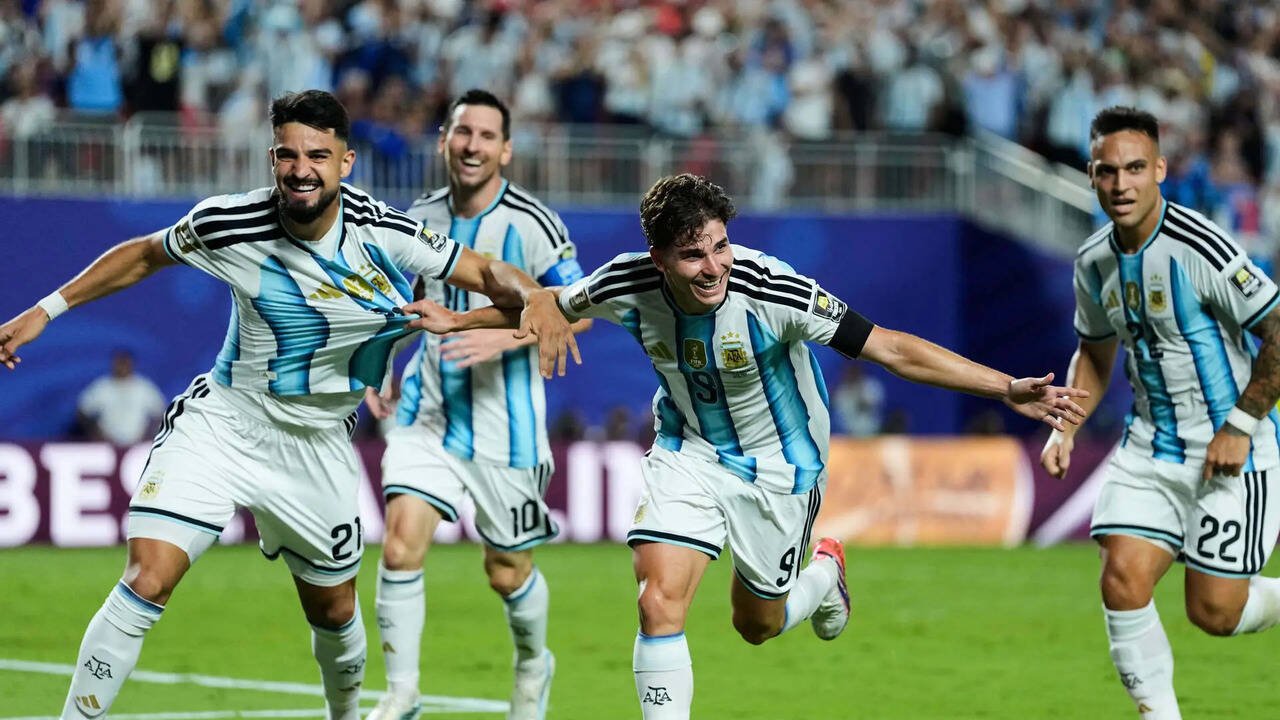
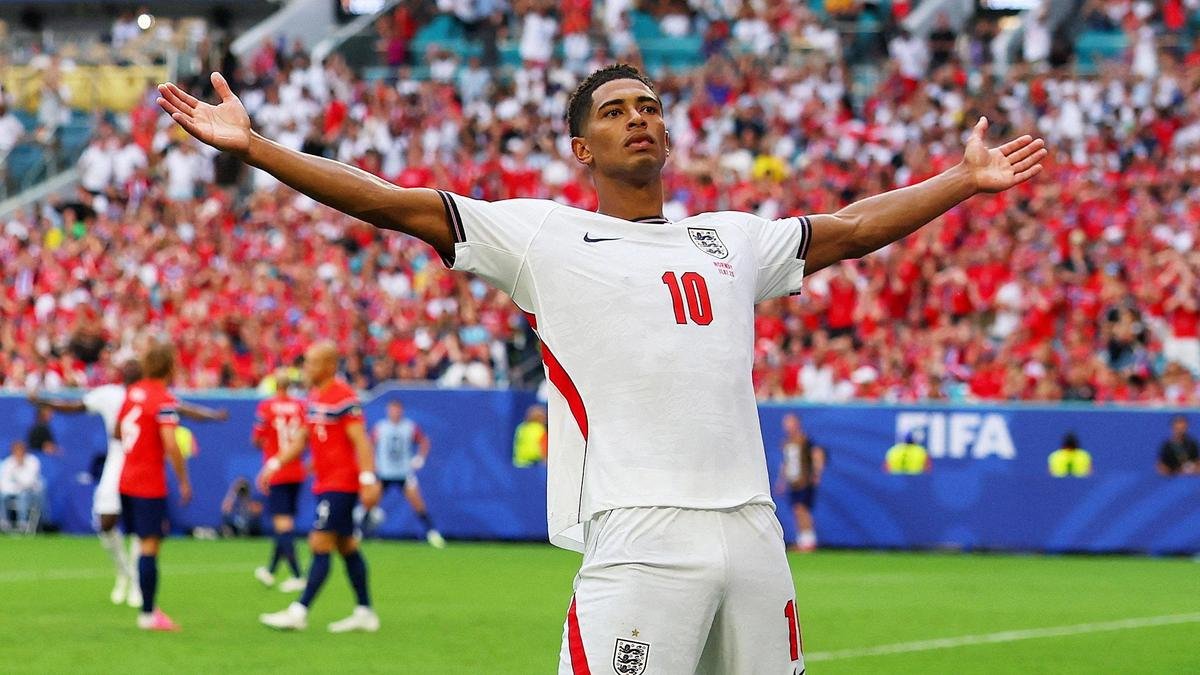
At the 2026 World Cup some of the best goalscorers on the planet are getting closer to him than others have managed in many decades since, with Lionel Messi, Kylian Mbappe, Erling Haaland and Harry Kane locked in a fearsome battle for the Golden Boot.
Since 1970, only three times has the World Cup top scorer bagged more than six goals at a tournament.
Mbappe has eight already, while Messi and Haaland have seven with Kane and Jude Bellingham one behind.
Of course, an extra round of matches for the 48-team tournament will help these strikers as their teams go deep into the competition.
But even with that leg up, they are currently still some way behind the man who set the record in just six matches.
In spotlight but shunning limelight - Olise's unique rise to top Published 4 July Project Mbappe - the road to becoming France's record scorer Published 16 June How Cornish miners brought football to Mexico Published 2 June Compared to those who have vainly chased his tournament record for the past 68 years, Fontaine is a relative unknown to modern audiences.
While Pele, Messi et al are rightly regarded as the best male players ever, Fontaine is now a piece of trivia.
But that is to play down the remarkable life and career of Fontaine - who, if he were playing in the modern day, would have represented a different country.
The 2026 quarter-final between France and Morocco was the Just Fontaine derby.
He was born in Marrakesh in August 1933 - at the time, Morocco was a French protectorate.
Morocco gained independence two years before the 1958 World Cup, but by that time Fontaine was an established international footballer playing in the French leagues - so he represented Les Bleus.
And, as sports journalist and historian Philip Barker explained to BBC Sport, had all gone to plan for France, Fontaine would not have been starting games at the World Cup in Sweden at all.
"He was not actually first choice - a team-mate [Rene Bliard] got injured in a warm-up game," explains Barker.
"It was such a last-minute change, he had to borrow boots [from team-mate Stephane Bruey] for the opening game as he didn't have any to fit him.
"Imagine something like that now, so very different to what we have today.
"Fontaine had an operation on his meniscus [cartilage in his knee] during the season, so he had been a doubt for the tournament.
But it meant he came to the tournament fresh - a lot of the other players had had a long hard season." Figure caption, Fontaine sets World Cup scoring record Fontaine only had five caps for France when he was promoted to the starting XI by manager Albert Batteux, but he was hardly an unknown.
Speaking to the BBC in April 2002, Fontaine says he never thought about becoming top scorer.
"In those days there was not so much pressure on us," Fontaine said.
"Only two journalists followed the team around.
"Our team bosses were so convinced we would be knocked out that they only gave us three shirts each, so we were totally free from pressure.
"My mind was not on the goals record at all.
I even turned down the chance to take a penalty in the third-place game!" Image source, BBC Sport He played for Reims, who in 1957-58 won the French league and cup double.
It was one of four Ligue 1 titles Fontaine won - one with previous club Nice, three with Reims.
A year after the World Cup, Fontaine would help fire Reims to the European Cup final - which they lost to Real Madrid - top scoring in the 1958-59 tournament with 10 goals.
And he was held in high regard by team-mates, including Raymond Kopa - the star of the French team who went on to win the 1958 Ballon d'Or, in which Fontaine came third.
"Fontaine shared a room with Kopa on international duty, this legendary player for Real Madrid," said Barker.
"They spoke about their understanding of the game.
"So he came into the team, and took to it like a duck to water." Fontaine scored a hat-trick in a remarkable 7-3 victory over Paraguay in France's Group Two opener, and that lit the blue touch-paper.
He scored in every match, including the semi-final, when France were beaten 5-2 by the unstoppable Brazil side featuring 17-year-old Pele.
The third-place play-off offered Fontaine one last chance to fill his borrowed boots - and he took it, with four goals in a 6-3 thumping of West Germany.
Image caption, Fontaine equalised for France against Brazil in their 1958 semi-final but Brazil went on to win 5-2 What is most striking about these goals is not only the number, but also the quality.
Fontaine was no bruiser on black-and-white TV, when the balls were heavy leather and keepers unprotected from assault from forwards.
Watching highlights of him from 1958, Fontaine looks like he would thrive in the modern day.
Against Paraguay, he profits from late runs into the box, breaking the offside trap and placing shots into the corner.
"Fontaine looks like a modern striker, he has so much pace," says Barker.
"He was a leader of the attack in the English style, said [newspaper] L'Equipe - courageous, combative, stubborn.
"Then scoring a hat-trick in your first game of the tournament, that must give you so much confidence." His hat-trick goal against the Germans is a particular beauty - picking up the ball on the halfway line, outpacing defenders and tucking into the far corner, it is reminiscent of Michael Owen for England against Argentina in 1998.
Image caption, Fontaine scores his third of the game, and 12th of the tournament, in the 1958 third-place play-off against West Germany Fontaine's free scoring fitted the 1958 World Cup, at which 126 goals were scored - the second most in a 16-team tournament, behind 1954.
France were the top scoring team, with 23.
With players like Fontaine and Kopa, Barker thinks the 1958 vintage can stand alongside the best French sides - including the modern one.
"The 1958 tournament was the last real goal-fest tournament.
You had the emerging Brazil team with Pele, but also the French team were all-time greats," he said.
"We talk about the 1998 and 2018 teams, but this was the first great French team.
The front five scored 22 goals, that shows how powerful they were.
"Yes, the defences are a bit slow, but the way France move the ball, they would score against any team.
Fontaine was also setting up goals for Kopa, they are such a slick team.
"France were only stopped by 1958 Brazil, one of the greatest teams of all time.
We are not talking school five-a-side, these are real standards." Image source, Getty Images Image caption, Fontainewas given an air rifle by a Swedish newspaper in honour of his scoring exploits Despite being revered as World Cup top scorer in 1958, Fontaine never got a Golden Boot - the award was not introduced until 1982.
In 2014, he was presented with a unique platinum boot by Fifa in recognition of his unmatched achievement.
"There wasn't a Golden Boot award or anything like that in 1958, so no one thought about it," Fontaine said.
"That probably gave me an advantage.
"Nowadays, as soon as a striker scores three goals, everyone starts asking him about it.
"As soon as he thinks about the record, he's finished.
The secret is to put it out of your mind." Only Gerd Muller in 1970 has scored double figures at a men's World Cup since - and he was three short of Fontaine's total.
So why is Fontaine not regarded as an all-time great?
The answer is injury.
In March 1960, Fontaine suffered a broken leg during a French league game.
The injury was aggravated during several attempted comebacks, before Fontaine was forced to call time on his career in 1962.
He was only 28.
Fontaine's final international stats: 21 senior caps for France, 30 goals.
Image caption, Fontaine examines the x-ray of his broken leg while in hospital in 1962.
The injury would force his retirement from playing football the following year As a result, Fontaine never returned to the World Cup stage.
One wonders what France might have achieved in 1962 or 1966 had they been able to call on such a fearsome striker.
After retiring from playing, Fontaine stayed in football.
He helped form the French player's union the UNFP, becoming its first president in 1961.
He also had spells in management, including two games in charge of France in 1967.
He later coached PSG and Toulouse, before two years with Morocco - the country of his birth.
"He set up the union, he coached, he ran a couple of sports shops.
From time to time, people would ask who the World Cup record holder was, and he would still relish the fact people would remember him," says Barker.
"Fontaine used to joke that if he came back in 200 years, his record would still be going.
L'Equipe called it 'unbeatable'." Fontaine died on March 1, 2023, at the age of 89.
He saw France win the World Cup twice, and the emergence of current spearhead Mbappe - one of the men who could take his iconic record.
"How appropriate it would be if Mbappe beats him?" says Barker.
"But 13 is such a number.