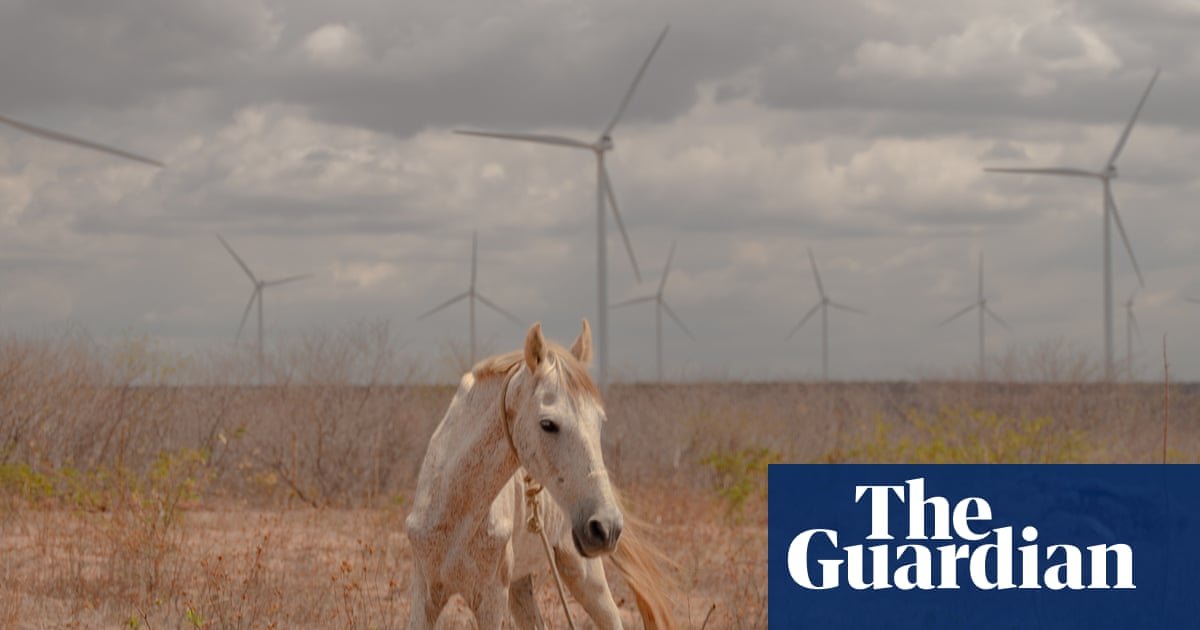
Brazil has about 35GW of onshore wind capacity in commercial operation, the fifth largest in the world A local farmer’s horse stands in a field next to one of Serra do Mel’s windfarms in Rio Grande do Norte state.
Brazil has about 35GW of onshore wind capacity in commercial operation, the fifth largest in the world Brazil’s wind farms have been a huge success.
So why isn’t everybody reaping the benefits?
While the country’s ambition is to be the ‘Saudi Arabia of green energy’, communities in the north-east are bearing the cost in diminished health and livelihoods Beneath the power lines cutting across Antonio de Souza’s property in Serra do Mel, in north-east Brazil’s Rio Grande do Norte state, rows of cashew trees once stood – until the clean energy company ordered them to be cut down.
De Souza cannot plant crops in the affected area and the tractor cannot be driven through it in bad weather, as the driver risks an electric shock.
Cattle, another source of local income, are forbidden from grazing near the cables.
The contract says the infrastructure occupies one hectare (2.5 acres); yet, the farmer counters, four hectares have become wasteland on a 50-hectare plot that was the family’s livelihood.
The story of Serra do Mel is one often heard in places where wind has provided energy and development, a model now moving offshore.
But still rarely discussed is how the benefits can also harm local communities’ health and livelihoods.
Wind turbines in Serra do Mel, Brazil Brazil has about 35GW of onshore wind capacity in commercial operation, the fifth largest in the world, according to the Brazilian Association of Wind Energy and New Technologies (ABEEólica) and the Global Wind Energy Council.
In November 2023, in Riyadh, Brazil’s president, Luiz Inácio Lula da Silva, summed up the nation’s ambition: within 10 years, Brazil would be known as the “Saudi Arabia of green energy”.
Nine in 10 of Brazil’s wind turbines are in the north-east, thanks to the constantly strong winds, which engineers often describe as the “best in the world”.
It is also among the regions with Brazil’s worst social indicators.
This convergence could have resulted in a historic redistribution of wealth, but those in the turbines’ shadow tell a different story.
José Cristino da Cruz on his farm in Serra do Mel – he is one of those involved in a community-led lawsuit against Voltalia “If I’d known it would be like this – that I’d be prevented from planting and harvesting – I wouldn’t have signed that contract with them,” says De Souza, who adds that he is not opposed to wind power.
When representatives of the French renewable energy multinational Voltalia arrived in his village after a year of drought, De Souza signed the contract, as did almost everyone in the area.
The promise was a monthly income of 3,000 to 5,000 reais (£430-£720), adjusted annually like a salary, without harming crops.
A decade later, the farmer is leading a public civil lawsuit against Voltalia, filed in May 2025 by three rural workers’ organisations, with a favourable assessment from the public prosecutor’s office and the public defender’s office, which provides legal aid, monitors human rights and has an ombudsman role.
The people of Serra do Mel are not calling for the company to leave but they do want to know how much the energy generated on their land yields and to receive what they say was promised to them.
They also want to regain the right to retire as farmers, which is at risk because they can no longer work their holdings – land the Brazilian state granted to needy farmers 50 years ago is now leased to a multinational for another 50.
The payments, hard to audit, are 1.55% of turnover, which will depend on where the energy is sold.
Data from the National Electricity Agency (Aneel), compiled by the Lavoro Institute, shows that 17 of the Serra do Mel power stations sell all of their electricity on the open market.
Most of it goes to Brazil’s south-east and central-west regions, at prices negotiated directly with large consumers.
Brazilian farmers describe what it’s like living next to wind turbines – video The paradox is that electricity generated in Serra do Mel is sold cheaply to people the residents have never met, while the power that lights their homes costs twice as much.
A Voltalia windfarm in Serra do Mel celebrated Brazil passing the 10GW power milestone in 2016.
But 10 years on, most streets in the municipality remain unpaved and families have no mains water.
One day, Edvaldo Bessa, then 75, returned to his plot of land and got an electric shock from the steel cables of the metering tower, which lacked insulation.
Power lines in Serra do Mel carry electricity generated by wind turbines to Brazil’s national grid.
Farmers are not allowed to cultivate within 50 metres of each pylon Data from the Primary Healthcare Information System (Sisab), compiled in the Lavoro Institute’s report, shows a significant rise of people in Serra do Mel complaining of anxiety and panic disorders, sleep disorders and hearing problems from 2022 onwards – when most of the municipality’s 36 windfarms came into operation.
In Poço Branco – a municipality similar across all indicators except the turbines – the trend moves the opposite way.
Relvani de Brito near her land in Serra do Mel.
Since her late father signed a 50-year lease with an energy firm for a solar and windfarm on the farm, Brito has not been allowed on her land Brazil has no federal regulation stipulating a minimum distance between turbines and people’s homes.
While France requires such equipment to be at least 500 metres from houses, Relvani de Brito lives 250 metres away from a turbine.
This is what the “Brazilian windpower miracle” is built on.
“During the day, you can barely hear it,” says De Brito.
“At night it’s worse because everything is quiet, and that’s when the racket starts.
“I take medication for anxiety.
I don’t sleep at night; I wake up at one o’clock, right on the dot,” she says.
In July 2024, at a packed meeting, hundreds of farmers voted to take legal action against the company.
The civil class action, filed in May 2025 by a coalition of three workers’ organisations, seeks compensation for collective non-pecuniary damage for health problems or unfair contracts; the suspension of the four windfarms still under construction; the relocation of existing turbines; and a corrective environmental impact assessment, with community participation.
It also calls for a review of the contracts, limiting the transfer of rights to 50% of the plot, restoring the farmers’ status as “special insured persons”.
This means that farmers should not be able to sign over their entire plot to the energy company. skip past newsletter promotion after newsletter promotion By law, if a farmer transfers up to 50%, they do not lose their insurance rights, provided they continue to work the land.
The “special insured person” status is a category within the Brazilian social security system created for rural workers on family-run farms.
Approached after the lawsuit was filed, Voltalia said it had not been served, that it complied “strictly … with Brazilian legislation” and adopted “a collective, participatory and transparent contractual construction process”, with a “commitment to the social development of the communities”.
It denied that the projects caused damage.
In a statement to the Guardian, Voltalia said it valued “sustainable development” and “dialogue with local communities … from local in-person assistance to digital channels such as the Ombudsman, as well as regular meetings, and social and environmental initiatives.” Regarding contracts, the company said it “developed the agreements in collaboration with local landowners and diligently addresses any matters concerning these agreements through the appropriate channels.” It added that its windfarms were “managed in accordance with applicable regulatory, social, environmental, and health and safety requirements”.
Just over 18 miles (30km) from Serra do Mel, the wind blows towards Areia Branca beach, where boys are playing football.
Behind the goal, onshore turbines already form a white fence.
Now, what almost no one saw coming has been licensed to be built right in front of them, but this time offshore.
Cristovão, in the Areia Branca region, is the first site in Brazil licensed for an offshore windfarm In June 2025, Ibama, the federal agency responsible for environmental enforcement, issued Brazil’s first preliminary licence for an offshore wind energy project, which will have far greater capacity than onshore turbines.
It will be installed off Areia Branca, near the terminal that is the main distribution point for Brazilian salt.
The developer is the National Industrial Training Service (Senai-RN), with all the energy supplying the port itself, a test site under a recently enacted law from 2025.
At Ibama, more than 100 offshore windfarm licence applications are waiting to be processed.
“The way this process is conducted sets a precedent for all others to follow,” says Giovanna Ferreira, an activist monitoring the case on behalf of the Semi-Arid Region Human Rights Reference Centre (CRDH).
Giovanna Ferreira, a researcher and activist, in her office.
The banner behind her reads ‘Energy justice starts with participation’ When the CRDH visited the surrounding fishing communities, it found that the people most affected were unaware of what was about to happen.
Senai claims the chosen area is in shallow waters far from traditional fishing grounds but the fishers say the towers will be erected where they work.
First there were coalmines, then came the windfarms.