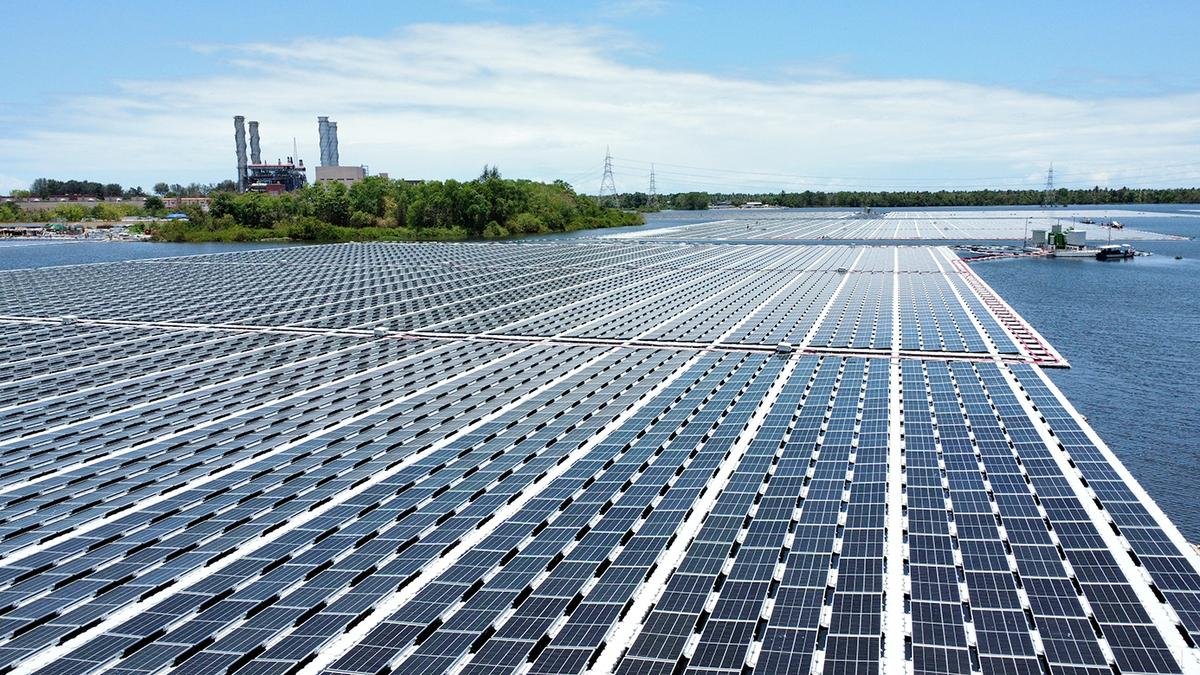
The story so far: The Union Cabinet has cleared the Pradhan Mantri Surya Sarovar Yojana (PM-SSY), a central-sector scheme to build 5,000 MW of floating solar photovoltaic (FSPV) capacity on India’s reservoirs and waterbodies.
It carries a total outlay of ₹5,070 crore and offers Central Financial Assistance (CFA) of up to ₹1 crore per MW, released only after a plant is commissioned.
Every project must be paired with an energy storage system of at least two hours, collectively 10,000 MWh in all, so that States can use the stored power to meet peak demand.
The Solar Energy Corporation of India (SECI) will implement the scheme, which the government expects to draw about ₹28,500 crore in investment.
India currently has an installed floating solar capacity of about ~0.7 GW against a potential of 102 GW.
India’s reservoirs can host 102 GW of floating solar, says first national assessment What is a floating solar plant?
It is a solar array that floats on a water surface and consists of a reservoir, irrigation tank, industrial pond or hydropower lake instead of on land.
Modular blocks of panels are assembled onshore, floated out, and held in place by anchors and mooring lines built to withstand wind, waves and shifting water levels.
Inverters sit on the floats or on the bank, and cables run over the floats to a substation.
India already has close to 100 GW of solar and often curtails output.
Why add a new source?
The constraint is not sunlight but suitable land.
As ground-mounted solar has scaled up, a June 2026 potential assessment by the National Institute of Solar Energy (NISE) — the Ministry of New and Renewable Energy’s technical arm — frames land availability as the critical bottleneck, especially where farming, cities and forests compete for the same ground.
Floating solar sidesteps this by using water surfaces States already own, and it spreads generation to States that are not rich in renewables but have large reservoirs.
Because each plant carries mandatory storage, its electricity can be shifted to the evening peak rather than dumped at midday, which could help with the ‘curtailment problem.’ Curtailment refers to solar power output intentionally being suppressed, for want of battery storage, to keep thermal plants running and keeping the grid stable.
Explained | Harnessing the power of the Sun through floating solar plants Why is the land question so pressing?
Utility-scale solar needs large, contiguous parcels, and acquiring them has grown slower and more contested as prime sites fill up.
Land acquisition triggers disputes over compensation, displacement and change of use, and competes with agriculture.
FSPV avoids most of this: it needs land only for the cabling that evacuates power to the grid.
Why is the Centre paying for feasibility studies?
To de-risk a technology, States have little experience with.
The scheme offers advance CFA of up to ₹30 lakh — rising to ₹50 lakh per site — to fund bathymetry and hydrography surveys, studies of the impact on the waterbody’s ecology, and a detailed solar-yield assessment, with the feasibility report due within nine months.
By absorbing this upfront cost and technical burden, the Centre hopes the barrier will be low enough for State Governments to come forward with projects.
Here’s what experts say on the perils of putting solar panels on lakes How do the plants work, and are they safe?
Panels convert sunlight to electricity exactly as on land; the difference is the flotation-and-mooring system beneath them.
Water cooling can lift energy yield, while shading cuts evaporation and algae growth.
There are trade-offs, which are mechanical.
These include continuous motion wears floats, joints and cables.
The report records that “occasional DC cable breakage was reported by all developers,” and flags slippery walkways and restricted monsoon access as safety concerns that demand trained crews and stringent protocols.
What does global experience show?
Floating solar has moved from niche to mainstream in about a decade.
The report puts cumulative global capacity at roughly 9.6 GW by 2024, with 1–1.2 GW added each year across more than 500 completed projects — over 90% of them in Asia.
China leads, trailed by countries such as India, South Korea and Japan, where land scarcity, supportive policy and abundant reservoirs have driven adoption.
Europe is a smaller but expanding market, its installations rising from 10 MW in 2017 to nearly 270 MW by 2022, with the Netherlands alone accounting for about three-quarters of the continent’s capacity; Israel, Brazil, Chile, Ghana and Australia are emerging players.
The World Bank has estimated that using even part of the world’s man-made reservoirs could support several terawatts of solar.
Three-tier mechanism for implementing floating solar projects in Kerala What happens if a reservoir loses draft?
Falling water levels are an operational risk.
The report warns that “changes in water level alter mooring line tensions and movement envelopes,” which affects array stability over time; sites with rapid or unpredictable fluctuations need adaptive mooring designs.
Will it cost more?
Yes.
The Renewable Energy Ministry estimates ground-mounted solar at about ₹3.9–4.2 crore per MW and FSPV at ₹4.9–5.2 crore — roughly 25% higher — owing to the floats, anchors and moorings a water-based system needs.
The mandatory battery adds a further ₹0.9–1.2 crore per MWh.
Which States have the most potential?
Maharashtra (16.28 GWp) and Madhya Pradesh (14.89 GWp) lead, followed by Karnataka, Odisha, Telangana and Gujarat.
Several are not renewables-rich, so the scheme doubles as a tool for decentralised solar deployment.
What exists today?
India’s floating fleet so far is small and battery-storage-free.
The Omkareshwar park in Madhya Pradesh runs as two plants, and another is under construction in Jharkhand — none of them paired with a battery, the very feature PM-SSY now makes compulsory.
How does this feed India’s climate committments?
The 5,000 MW adds to the non-fossil capacity underpinning India’s climate pledges — its updated Nationally Determined Contribution and the Panchamrit goals of 500 GW non-fossil power by 2030 and net-zero by 2070.
The government estimates the scheme will “abate around 10 million tonnes of CO₂ emissions annually,” while generating 16,000–17,000 jobs across the value chain.