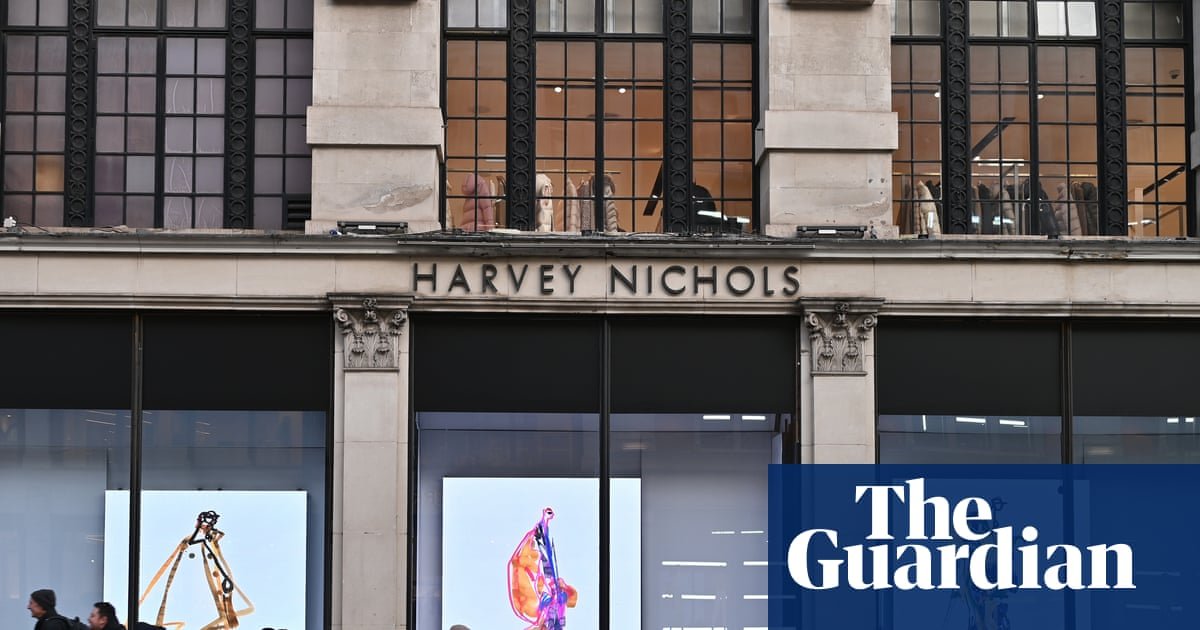
Harvey Nichols has tried to revive its bricks and mortar offering recently, particularly its London Knightsbridge store.
Mike Ashley says it’s in a ‘death spiral’ but a refocus on design could be what the department store needs Such was the buzz around Harvey Nichols in its 90s heyday that the department store was regularly name-checked in Absolutely Fabulous, with Edina and Patsy’s frequent retail therapy trips to the store reflecting its position at the heart of the fashion industry at the time.
How times change.
These days Harvey Nichols is a business in trouble, one that has not turned a profit since the pandemic.
Pre-tax losses were £35.3m in 2024.
The retail chain – comprising the the original store in Knightsbridge, London, plus stores in cities including Bristol, Leeds and Manchester – was put up for sale in June by its current owner, Sir Dickson Poon, with Mike Ashley’s Frasers Group and Next bidding to take control.
Ashley commented this week that Harvey Nichols is in what he called “a death spiral”.
Speaking to the Financial Times about his potential bid, he said taking it over would be a “huge challenge”.
Harvey Nichols is reported to be seeking £50m-£60m for the business, while Ashley said he thought the figure would be closer to £40m in order for a deal to happen.
All that is a far cry from the 90s, when Tony Glenville, who worked as a fashion journalist at the time, recalls: “It was glamorous.
It had the marvellous bar up on the fifth floor so the whole thing was that you went shopping and you had a drink.” Thirty years on, retail experts suggest that, if not a death spiral, the store no longer has the same cachet.
“It’s a brand that has lost its identity,” says Jonathan De Mello, founder of JDM Retail Consulting.
“It’s very similar to other department stores in the sense that it provides fashion that you can get from Selfridges or Harrods.
It’s not got the point of difference.” Jennifer Saunders and Joanna Lumley as Edina and Patsy in the Absolutely Fabulous.
It was taken over by Debenhams in 1920 and became part of the Burton Group in 1985, with Poon purchasing the retailer six years later and beginning its expansion outside London with a Leeds opening in 1996.
“It was always changing,” remembers Glenville.
“If a designer came along and was hot that season, they would immediately want to be in Harvey Nichols and Harvey Nichols would then stock them.” Fast forward three decades and other stores have come for this territory, with London’s Dover Street Market and Selfridges more likely destinations for emerging brands.
De Mello argues, however, that there could still be mileage in this strategy.
“They had a strong design forward focus … and they need to do more [of that],” he says.
“If you can’t get [a brand] anywhere else and you have to go to Harvey Nichols, then it becomes something interesting again.
At the moment, you walk past it and say ‘Why bother going in?’” However, De Mello says Harvey Nichols’s digital presence needs work.
“The majority of retailers that succeed in today’s marketplace do so with a variety of different channels to interface with the consumer,” he argues.
“So they can essentially experience the brand wherever they might be or whatever they might be doing.” If digital is still a work in progress, Harvey Nichols has attempted to revive its bricks and mortar offering recently, particularlyits Knightsbridge store.
Julia Goddard, previously at Alexander McQueen, has been chief executive since 2024, with highly respected fashion editor Kate Phelan becoming creative director.
The Harvey Nichols Christmas shop window display in Leeds city centre.
In a press release, Phelan described it as a “statement of intent.
We’re creating an experience that feels relevant, exciting and, above all, individual.
This is just the beginning of what’s to come.” The retailer declined to comment for this article.
Buzz-wise, Glenville believes the team should remain in place whoever buys the retailer, and given time to turn things around.
“The [recent] windows with the illustrations were absolutely great,” he says “[but] I think they weren’t sure what to follow that with.
It’s unfortunate that anything takes time.
You can’t do it all in five minutes.” Explore more on these topicsRetail industry Mike Ashley Frasers Group features Share Reuse this content