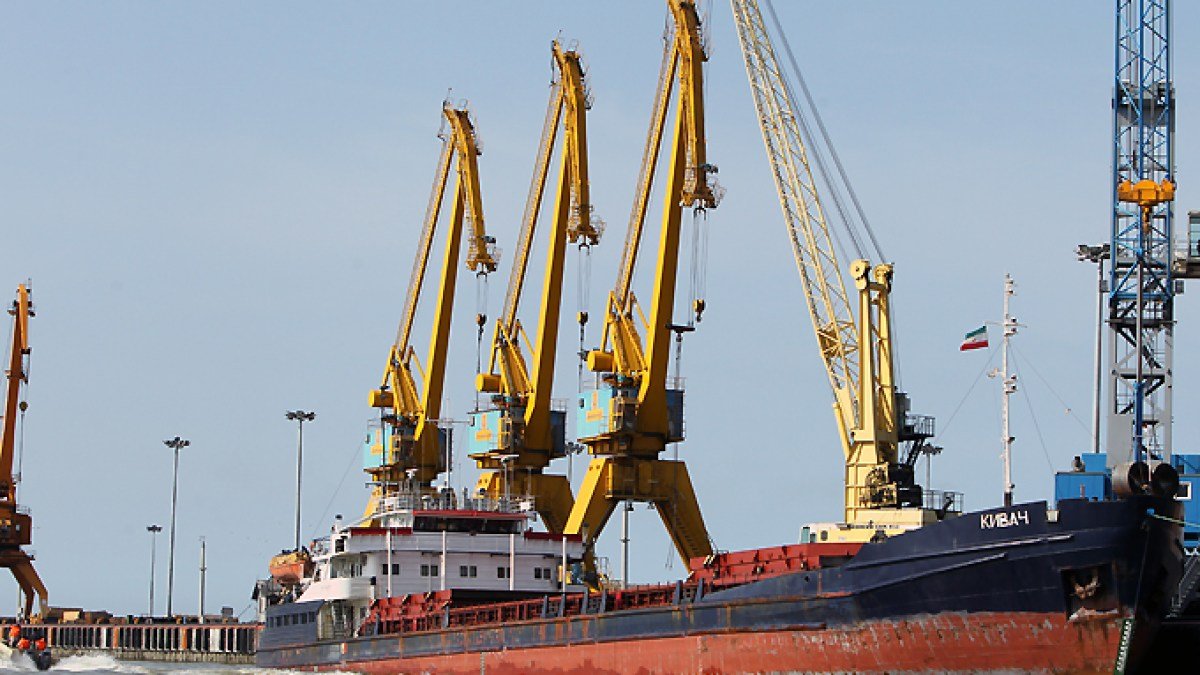
A cargo ship docks at the port in Anzali, Iran, in the Caspian Sea province of Gilan [File: Abedin Taherkenareh/EPA] By Maziar Motamedi Published On 27 Sep 202627 Sep 2026 Tehran, Iran ?
With Iran?s southern ports subject to a United States naval blockade, Tehran is looking for alternatives to export oil and import goods.
The Caspian Sea on Iran?s northern coast is seen as one portal for Iran to the outside world.
Recent efforts at the United Nations to end the deadlock between Iran and the US appear to have failed as US President Donald Trump said Tehran?s offer to reopen the Strait of Hormuz was unacceptable.
With no breakthrough in sight on ending the war launched by the US and Israel on Iran on February 28, Tehran is making adjustments to export oil and import essential goods.
But maritime trade via the Caspian Sea has its own logistical challenges, experts said.
Caspian challenges The Caspian Sea, the world?s largest landlocked body of water, is shared by Iran, Russia, Azerbaijan, Kazakhstan and Turkmenistan.
Shipping on the sea has been increasingly challenged by declining water levels in recent years.
In April, UN Environment Programme Executive Director Inger Andersen said Caspian water levels had dropped by about 2 metres (6.6ft) since the 1990s.
Sea levels are projected to recede by an additional 8 to 21 metres (26ft to 69ft) by the end of the century.
Shahram Fadakar, director general of the Iranian Department of Environment?s Office for Coastal and Marine Ecosystem Protection, told local media last week that water levels have been dropping by more than 20cm (7.9 inches) annually over the past two to three years.
This could affect trade between all Caspian countries, including Iran.
Advertisement This month, Masoud Polmeh, secretary-general of the Shipping Association of Iran, told state-linked media that Iran?s northern ports could once handle berth vessels weighing up to 6,000 tonnes.
Due to reduced water levels, they can now handle only 4,000-tonne vessels.
Iranian ships entering the Caspian Sea via Russia?s Volga River have become stuck due to low water levels, sometimes remaining stationary for days and weeks at a time before their crews are rescued. ?Fortunately, that hasn?t happened in our ports,?
Polmeh added.
Northern bound The vast majority of Iran?s maritime trade has been conducted via its southern ports, but the US naval embargo and air strikes on infrastructure are forcing Tehran to shift trade to the Caspian Sea and its land borders.
While there are currently no active military attacks against interests in the north, Vali Kaleji, an independent writer and researcher in Iran on Russia, Central Asia and the Caucasus, said changes in logistical operations have put huge strains on Iran?s land borders.
At the Norduz border crossing with Armenia, as many as 1,800 trucks queue for several days at a time to enter Iran.
At other terminals, wait times range from 10 to 15 days to enter Iran although Kaleji said this is not due solely to freight shifting to Iran?s roads. ?Limited terminal capacity, customs procedures, road infrastructure and ongoing construction projects have also contributed to the congestion.
Meanwhile, sanctions on Iranian airlines and the resulting influx of passengers towards Iran?s land borders with Armenia and Turkey have further exacerbated problems at the border terminals,?
Kaleji told Al Jazeera.
The eastern Caspian rail route provides a connection for transporting Iranian cargo to Turkmenistan, Kazakhstan and China.
But Iran?s rail freight connections with the South Caucasus region, which were severed during the First Nagorno-Karabakh War from 1988 to 1994, remain closed. ?The revival of the Julfa-Nakhchivan railway route, part of the Soviet-era railway network in the South Caucasus, also depends on the peace process between Armenia and Azerbaijan, particularly the implementation of the TRIPP project,?
Kaleji said, referring to a US-supported transit corridor in the region. ?Since a major share of transit and trade along the western route of the North-South Transport Corridor takes place through this route, the absence of a railway connection between Iran and the South Caucasus remains a major obstacle to accelerating and increasing the volume of trade and transit, particularly under conditions of intensified maritime blockade in the south.?
Advertisement Trade obstacles Iranian authorities have not provided details on which commodities and at what volume trade has been directed northwards, including to the Caspian ports of Anzali, Amirabad and Nowshahr.
But there have been indications of such a shift, particularly with the import of essential goods, such as food.
Last month, Ports and Maritime Organization chief Mohammad Shakibi-Nasab told state-linked media that Iran?s total nominal port capacity was 300 million tonnes, only 30 million tonnes of which is linked to its northern ports.
The northern ports? share of essential goods transport has gone up from 18 percent in the years before the US-Israel war on Iran to 30 percent today.
There are stark differences between maximum loads carried by vessels using Iran?s northern and southern ports, he said.
One vessel in the south could potentially carry the cargo of 20 ships travelling on the Caspian Sea.
In early September, Hadi Haghshenas, the governor of the northern province of Gilan, said container arrivals at Caspian ports had increased by 50 percent year-on-year during the five Iranian calendar months that ended on August 22.
He also said, unlike the Port of Shahid Rajaei in southern Iran, the northern ports were closer to major cities in central Iran, such as Tehran, Isfahan and Arak.
That proximity could help bring down land transport costs for imports reaching end users.
The China-Aktau-northern Iran route, which takes cargo by rail from China across Kazakhstan to Aktau, then by ship to Caspian ports and into Iran by road, could expand regional trade, Haghshenas added.
The Iranian government is trying to complete the missing sections of the Rasht-Astara railway, a strategically important project with Russia.
This would complete the western rail branch of the International North-South Transport Corridor, which passes through Iran, Azerbaijan and Russia. ?
Ships are seen anchored in the Strait of Hormuz on August 10, 2026, off Bandar Abbas, Iran [Ali Saeedi/Getty Images] Russian reliance Tehran?s northwards shift risks an overreliance on Russia as a trading partner and exposure to the vulnerabilities of sanctions that have come with Moscow?s war on Ukraine.
US media have reported that Russia has sent drone components and explosives to Iran via the Caspian Sea.
There have also been claims that some transferred Russian technology may be aimed at helping Iran develop advanced supersonic cruise missiles.
Iranian and Russian authorities have said they want to expand their military cooperation but did not comment on the latest media reports.
While Iran?s Caspian region has been less heavily targeted in US-Israeli attacks, Ukraine did attack what Tehran said was an Iranian fishing vessel in July, killing one civilian.
Ukraine said it was a Russian military ship carrying military cargo to Iran.
The fact that both Russia and Iran are sanctioned and at war could complicate trade between the two countries via the Caspian route. ?Integration with Russian infrastructure adds disruption problems because it is being targeted by Ukraine, and that includes civilian retailers,?
Ezana Tedla, an analyst at the Bourse & Bazaar Foundation, told Al Jazeera.
Advertisement ?Beyond the existing infrastructure, there?s also the well-established diaspora and personal networks throughout southern routes, especially in the UAE, that help Iran?s trade take place.? ?
Urmia Lake in northwestern Iran nearly dried up last year due to drought and ecological mismanagement, such as dam construction [File: Kaveh Kazemi/Getty Images] ?
With imports essentially blocked via Iran?s southern ports, authorities said barley, maize, wheat and oilseeds are priorities for northern ports.
Tedla said most of Iran?s northern-bound exports are light goods like processed food and packaging materials.
Iran does not possess the port infrastructure and vessels to significantly step up imports via the Caspian.
While there was a small increase in the share of northern-bound exports in past years, this trend has plateaued since 2023. ?Iran?s valuable exports are directed towards the south and are in heavy, bulk commodities like mineral fuels and oils and iron ore, which are the easiest to convert to hard currency,?
Tedla said. ?Finally, it is not clear that even if the port infrastructure was expanded, the market would be there as Iran?s northern neighbours have their own hydrocarbon and metal industries that will overlap.?