Good morning, and welcome to our rolling coverage of the global economy, the financial markets, the eurozone and business.
The Canadian dollar fell after the country’s trade talks with the US collapsed on Friday and Washington imposed 50% tariffs on $20bn of Canadian goods, prompting Canada to retaliate.
The Canadian dollar dipped 0.2% to C$1.3798 per US dollar, retreating from a three-month high. It had been strengthening on hopes of a trade deal with the US. The two sides appeared close to an agreement on Friday to lower tariffs on steel, aluminium and cars, but the deal fell apart at the last minute.
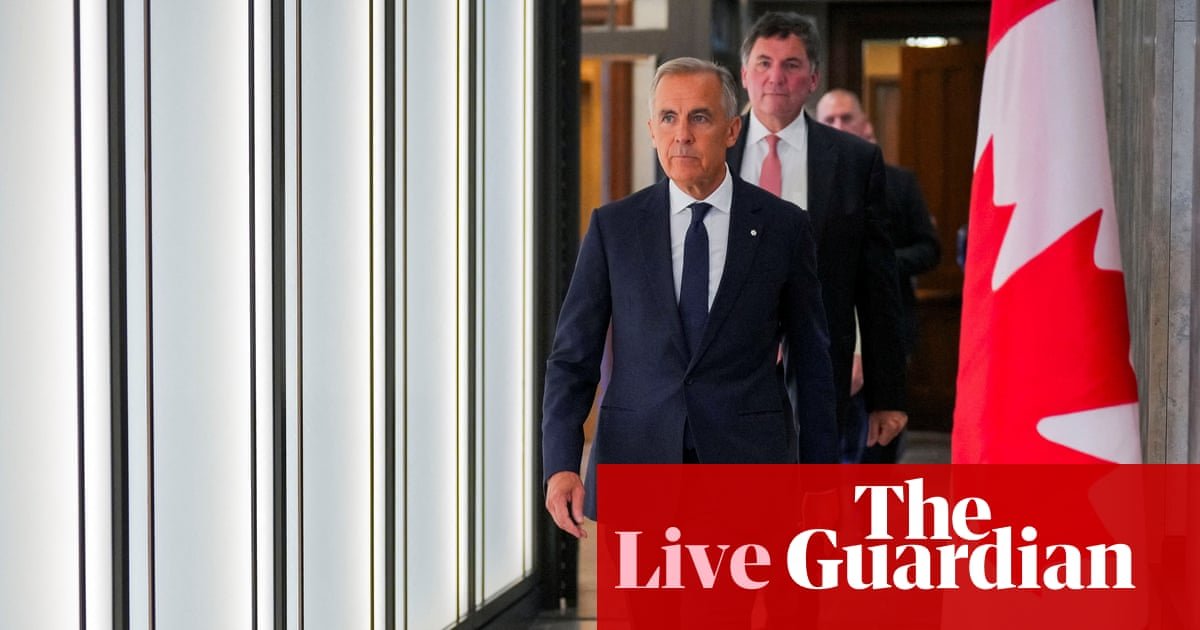
Mark Carney, Canada’s prime minister, said they were “walking away from a bad deal”, and would now “match Washington’s new tariffs dollar for dollar”. So that means Canada will face 50% new tariffs on goods including wine, furniture, dairy products, cement, clothing, fishing rods and hockey sticks, covering around 5% of Canada’s exports to the US.
Carney said that their own retaliatory tariffs on US steel, electronics, dairy, appliances, agricultural equipment, pulp and paper and other products would take effect on 8 September. The new US tariffs come on top of existing levies on cars, aluminium, steel and lumber.
Over in the US, president Donald Trump posted that “Canada wants the benefits of being a State, without being one!!! They have also charged our great farmers, for many years, massive amounts of Tariffs. No more!!!”
Analysts at Deutsche Bank led by Jim Reid said:
There’s already been a market reaction this morning to the breakdown of the talks, with the Canadian dollar weakening against every other G10 currency, including a -0.26% fall against the US dollar. Otherwise, Bloomberg also reported overnight that Canada saw little chance of the talks resuming before the midterm elections.
Asian stock markets declined while oil prices also fell as markets waited for details of threatened US sanctions on Iran due later on Monday.
Japan’s Nikkei fell nearly 0.7%, Hong Kong’s Hang Seng dropped 1.9% and South Korea’s Kospi tumbled 3.2%.
China’s Alibaba shares slumped in Hong Kong after it launched a $10.2bn share sale at a sharp discount to fund development of chips, AI infrastructure and models.
Brent crude, the global oil benchmark, lost 1.6% to $92.81 a barrel.
Later this week, the annual Jackson Hole conference kicks off in Wyoming, and the new US Federal Reserve chair, Kevin Warsh, is due to speak on Friday.
His speech comes at a critical time, amid anxiety in government bond markets over inflation and Donald Trump’s tax and spending plans that helped push the national debt to over $40 trillion.
Analysts said bond traders would be looking for signals from Warsh over its commitment to fighting inflation.
The Trump-appointed head of the US central bank has previously signalled reluctance to “spoon-feed” financial markets over how it plans to set interest rates to keep fast-rising prices in check.
However, anxiety over Trump’s handling of the economy and investor fears that his war with Iran is stoking inflation have rocked global financial markets amid a dramatic sell-off in US government bonds.
1pm BST: Mexico GDP for second quarter (final)
1.30pm BST: US Chicago Fed national activity index for July