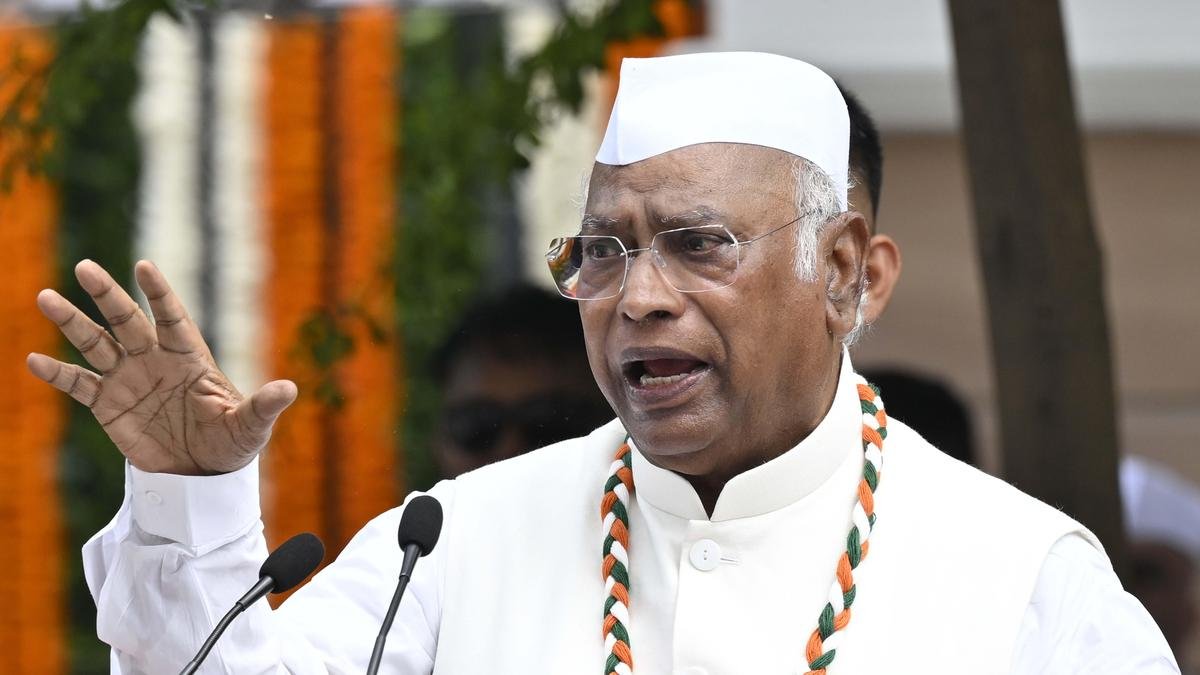
The Congress on Monday (August 24, 2026) accused the Narendra Modi government of seeking to undermine reservation through what it termed a “back door” route, citing more than 8.2 lakh sanctioned posts lying vacant across civilian Central government establishments.
Mallikarjun Kharge slams Centre over denial of travel permission to Telangana Chief Minister Revanth Reddy The figures showed that the Bharatiya Janata Party (BJP) government’s policy of “conspiring to end” the constitutional rights of disadvantaged communities had been exposed, Congress president Mallikarjun Kharge said.
The charge came amid the ongoing “reservation hatao” (remove reservation) campaign, seeking to end caste-based reservations in government jobs and educational institutions.
Sharing a Ministry-wise breakup of the vacancies on social media platform X, Mr.
Kharge said the number had risen from 4.21 lakh in 2015 to 8.24 lakh in 2024.
Those against reservation should be booked for sedition: Union Minister Ramdas Athawale According to the figures cited by him, the Railways had 2.40 lakh vacant posts, while the Defence Ministry had 2.41 lakh vacancies.
The Home Ministry had another 1.10 lakh vacant posts, Mr.
Kharge said.
He also alleged that 5.1 lakh permanent jobs had been eliminated in public sector undertakings, while the share of contractual workers had increased from 19% to 49%.
“The question is not just about employment, but about social justice,” Mr.
He argued that keeping government posts vacant would effectively deny reserved-category candidates opportunities, while the sale of PSUs and increasing contractual employment would further shrink the availability of jobs covered by reservation.
“To end reservations, it is not necessary to amend the Constitution — just eliminating jobs with reservations is enough,” he said.
The Congress president alleged that the BJP’s approach was aimed at weakening the constitutional safeguards for Scheduled Castes, Scheduled Tribes, Other Backward Classes, and Economically Weaker Sections.
The Congress has sought to frame vacancies and changes in public employment as part of a wider question of social justice.