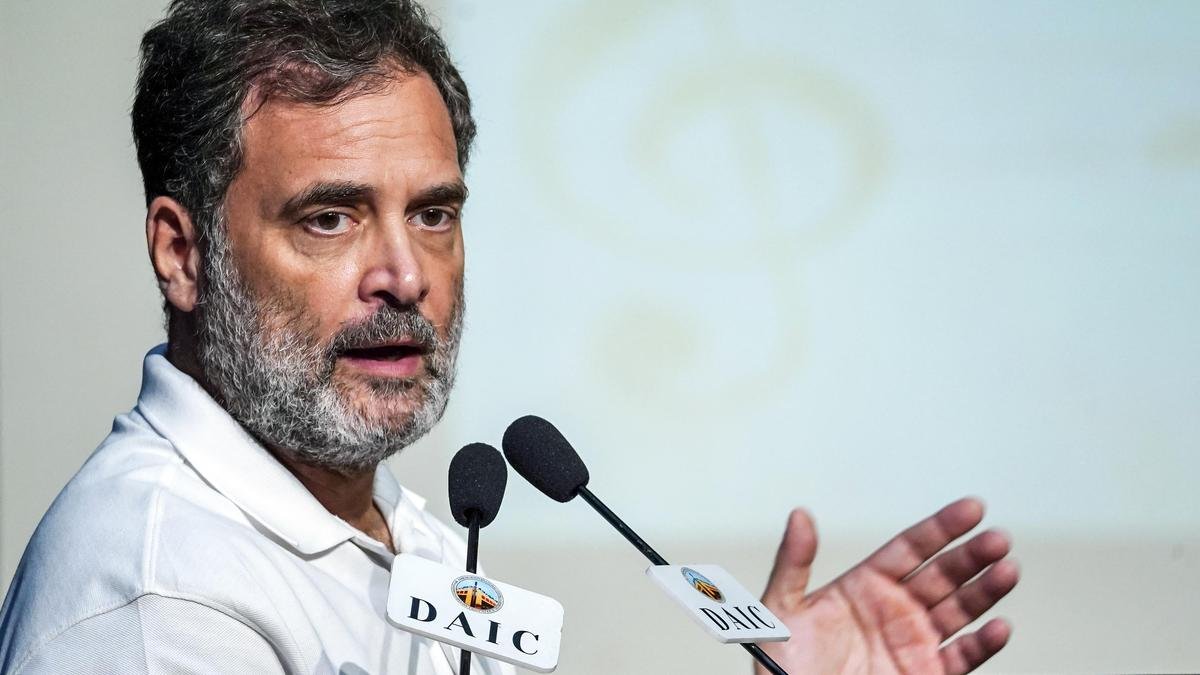
Congress leader Rahul Gandhi on Tuesday (September 15, 2026) alleged that the Modi government has quietly paved the way for imposing fees on UPI transactions and that a "compromised" Prime Minister Narendra Modi was "once again surrendering" to American pressure.
The Congress raised questions over the government's notification on UPI transactions, claiming that the stage is clearly being set for people to pay a fee for such transactions and asking whether this is being done to open digital payments for American firms to "appease" U.S.
President Donald Trump.
No charges on UPI transactions up to Rs 2,000; govt yet to decide on MDR for higher-value payments In a post in Hindi on X, Mr.
Gandhi alleged that the Modi government has quietly paved the way for imposing fees on UPI.
"Now, MDR can be levied on merchant UPI transactions above ₹2,000.
Even if these transactions account for just 5% of the volume, they make up nearly 65% of UPI's total transaction value," Mr.
Gandhi said.
"The government says no fees will be charged to customers.
But where will the fees imposed on shopkeepers ultimately come from?
Added to the prices, straight out of the customer's pocket," the Leader of Opposition in the Lok Sabha said.
American payment companies have long opposed India's zero-MDR policy, Mr.
Now, the Modi government has opened the path to changing the policy in exactly that direction, Mr.
Gandhi claimed.
Pay wall: On a charge on UPI transactions "Just like with the U.S.
Trade Deal, Compromised PM Modi is once again surrendering to American pressure," the former Congress chief alleged.
The Congress alleged that the government has yet again shown complete lack of honesty and transparency and has broken the trust of users.
The Opposition party's attack came after the government directed banks and payment system providers not to levy charges on Unified Payments Interface (UPI) transactions of up to ₹2,000 or on payments made through RuPay debit cards.
However, the government has not specified whether charges would be applicable to transactions above ₹2,000, to be paid by merchants.
So far, there has been no charge on UPI transactions, irrespective of the amount.
Why UPI surcharges are a bad idea Reacting to it, Congress general secretary in-charge communications Jairam Ramesh said, "Just as we warned on August 6, 2026 to which the Hon'ble FM herself had deemed it fit to respond, the Modi Government is now using new laws bulldozed through Parliament to start the process of charging for UPI." "A notification has just been issued under the amended Payment and Settlement Systems Act, 2007, that prohibits banks and providers from charging only for UPI transactions under ₹2000.
But there is NO explicit protection for any transaction above this cap," Mr.
Ramesh said on X.
The stage is clearly being set for all of us to pay a fee for UPI transactions, he claimed.
"Tomorrow the cap itself might be changed with another such notification - there is no longer a guarantee in the law.
For all we know, the government can introduce a charge for daily person-to-person transactions as well," Mr.
Ramesh said.
UPI will remain free for consumers, Nirmala Sitharaman tells Rajya Sabha "The Modi government has yet again shown complete lack of honesty and transparency and has broken the trust of users.
Is all of this being done to open digital payments for American companies to appease President Trump?" the Congress general secretary said.
As per a gazette notification dated September 14, no bank or system provider would impose, whether directly or indirectly, any charge on a person making or receiving a payment through RuPay debit card or UPI transaction of up to ₹2,000.
The notification follows an amendment to section 10 A of the Payment and Settlement Systems Act, 2007, which provides an enabling framework for imposing a Merchant Discount Rate (MDR) on payments through UPI and other notified electronic payment modes.
The amendment Bill was passed by Parliament during the Monsoon Session, which concluded on August 13, 2026.
Following the passage of the Bill, the government had said the UPI and Services Steering Committee, headed by the National Payments Corporation of India (NPCI), would decide on the MDR rates.
Even as government considers MDR charge on UPI, data shows cash usage quickening in economy Explaining the rationale for imposing charges, the government, in a statement, said, with exponential transaction volumes, the system requires significant and continuous upgrades in cybersecurity, fraud prevention, and infrastructure.
Charges were required for market expansion and self sustainability, it had said.
It is necessary to increase competition by encouraging more companies to expand their operations, which requires a self-sustaining revenue model, it had said.
Reliance on subsidies alone is not viable for the next wave of growth, it had said, adding that a balanced framework is required to ensure that UPI remains robust, inclusive, and future-ready.
UPI is operated by the National Payments Corporation of India (NPCI), an initiative of the Reserve Bank of India (RBI) and the Indian Banks' Association.
UPI stays free for users, vast majority of transactions to remain free for merchants as well, says government Last month, the Congress had attacked the government over the Taxation and Other Laws (Amendment) Bill before it was passed, asking whether Prime Minister Narendra Modi is seeking to dilute UPI and open the digital payments sector to American businesses "under pressure" from his "good friend Donald Trump".
Mr.
Ramesh had said the Modi government's latest bill removes the statutory guarantee that keeps UPI transactions free.
It opens the door to Merchant Discount Rate (MDR) charges, which can easily be expanded to all payments in the future, Mr.
Ramesh had said.
The cost will inevitably be borne by ordinary people who will now have to pay to use UPI transactions, he had said.
Finance Minister Nirmala Sitharaman had said the Merchant Discount Rate on digital transactions applies to merchants and not to customers, and the MDR charge would support banks and fintech companies to invest more on infrastructure and security.
Hitting out at Mr.
Ramesh over his remark that ordinary people may have to pay more for using UPI, Ms.
Sitharaman had said the UPI and Services Steering Committee headed by NPCI is yet to decide on the MDR, which would happen only after Parliament passes the Taxation and Other Laws (Amendment) Bill, 2026.
Replying to Mr.
Ramesh, Ms.
Sitharaman had said, "Before spreading a canard, @Jairam_Ramesh ji, please consider this: Merchant Discount Rate (MDR) applies only on the merchants and not on the end users/customers.
It will support the Banks & Fintech to invest more on infrastructure, innovation & security.
All users of UPI will reap the benefits of this investment."