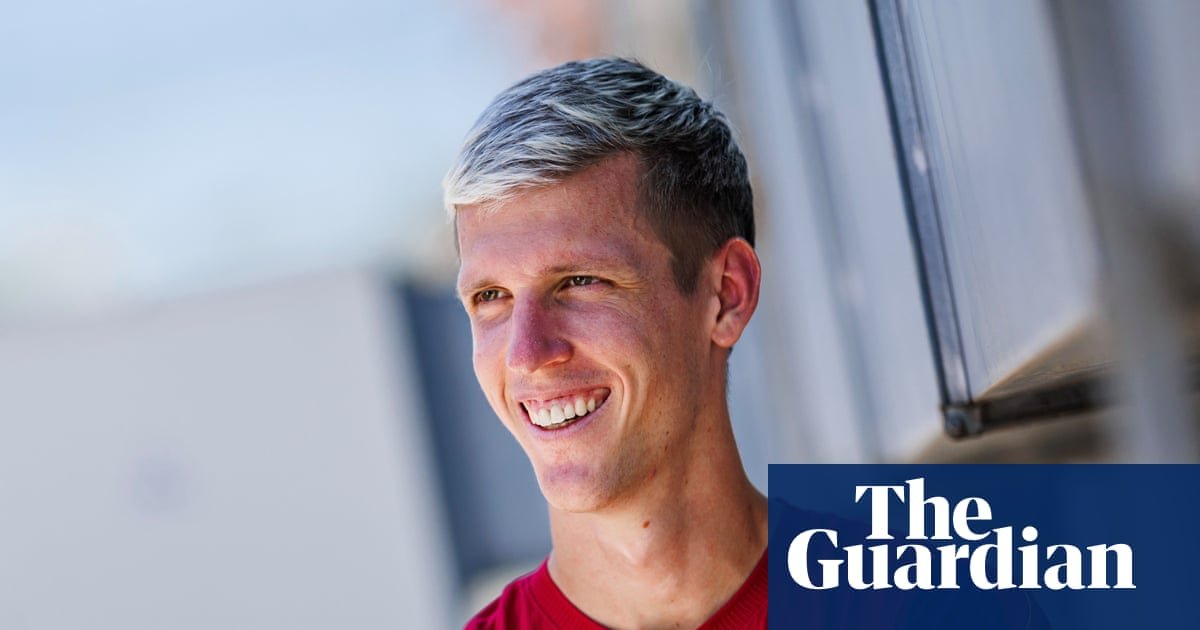
One of Barcelona’s eight World Cup winners reflects on how Spain’s triumph is inspiring them in the Champions League
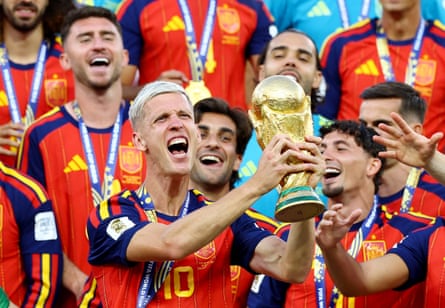
Dani Olmo nods towards his right arm. “Look: goosebumps,” he says. The Spain midfielder is sitting in a back room at Barcelona’s Joan Gamper training ground trying to pinpoint the moment he knew he was a world champion. “There’s an image in my mind with Ferran [Torres]’s mum: hugging her, the two of us in tears,” he says. “‘What your son just did … what we all did … this is historic.’ And that’s when you start to feel it. In those final minutes of the game it’s impossible, impossible, but when the referee blows, the thought enters your head: ‘Have we done it?’ ‘Are we …?’ There, you feel it a little bit. When you lift the cup, a little bit more. And then when you see the families, when I see the reaction from my brother, my partner, my dad. I’m not one to cry, but …”
But then Olmo knew, felt it: Spain were world champions. It was 19 July in New Jersey and it was real: Spain had beaten Argentina and nothing would be the same again.
“It changes you, changes your life,” Olmo says. “I’m not sure we grasp it still. You realise when you’re [applauded] at other grounds, but we’ll truly realise with time. It’s like you’ve entered another dimension, a very select group. As a kid, I held 2010 up there. [Andrés] Iniesta, Xavi, [Sergio] Busquets, Xabi Alonso, [David] Villa … legends. We held on to the past, longed for that generation, how happy they made us. Now it’s like, ‘You’re there, too.’”
So now it’s time to, well, to get back to work, another generation to emulate. Twenty-three days after victory in the US, Olmo was back where he sits now, another session complete, another European season about to start. His club coach was waiting.
What did Hansi Flick say? “‘You’re a champion of the world, Dani.’” “‘I know, mister.’” Olmo laughs at what came next. “And now [we have to do it] with Barcelona,” he says.
Eight of Spain’s 26-man squad were Barcelona players and although Maria’s son Ferran has departed for Paris Saint German, Rodri has joined from Manchester City. What they have done with their country can infuse club success, Olmo believes, just as what they do with their club infused success with the country. Winning the World Cup changes your life; it can also reinforce an idea, and while Olmo analyses the differences between Spain and Barcelona, Flick and Luis de la Fuente, this is the triumph of an idea, continuity and commitment.
“We came from a very successful year; winning the league, the Super Cup … the World Cup was the finishing touch,” Olmo says. “Having that Barcelona base, players with a great level, competitive and ambitious, that know how to win and also good people – and I think we are – helps the national team. Whether you play a lot or a little, you’re a team. This is a winning generation at Barcelona, too. We’ve shown that in Spain; in Europe, we’re competing for the highest prize.”
That’s what drives them: for 11 years the Champions League has evaded them, an entire generation gone. No one is left from when Barcelona last lifted the trophy in June 2015; Olmo had just turned 17. Having departed the academy he first joined at nine and set out alone the previous summer, he had made five substitute appearances for Dynamo Zagreb’s first team – the determined, bold beginning of a journey that would eventually bring him back, via RB Leipzig, in 2024.
In his first season back, he helped Barcelona to a domestic treble. Last year, they were champions again. In Europe, though, they were defeated by Inter and Atlético Madrid in the semi-finals and quarter-finals respectively. On Wednesday night another campaign begins against Feyenoord at Camp Nou. It ends, they hope, at the Metropolitano in Madrid on 5 June. Lessons have been learned, in success and failure. The World Cup can bring them ever closer, Olmo believes. “You can feel that extra confidence,” he says. “The Champions League is decided by small details that haven’t gone our way but the last two years were experiences for the future. We were a young team.”
Were? “Still are,” Olmo concedes. Against Athletic Bilbao last month, Barcelona fielded their youngest starting XI at Camp Nou, with an average age of 23.18 years. This is a special generation; it is also one given opportunities Olmo wasn’t sure would be open when he set off at 16. “I’m still young … I think,” says the 28-year-old. “But I feel like a veteran. La Masia is more alive than ever. Exceptional players have always emerged but it can be hard to find space. Thiago [Alcântara] had incredible quality and had to go to Bayern to play at the highest level.”
“In my opinion, Barcelona have the best academy in the world; [Marc] Bernal, Lamine [Yamal] and now Xavi Espart. Pedri is still young and he’s been at the highest level for six, seven years. We have that experience now. What was lacking? The first year against Inter was, pfff, it was hard [to take]. We could see ourselves in the final. Last year against Atlético … the first game weighed too heavily on us; there were moments when we let it slip from us. We’re a young team, maybe you think there’s no problem, nothing can go wrong. I think we’ve learned that every detail, every minute, every sprint, every run is important. ‘Hey, 90 minutes, 120, do or die.’ We have to minimise the risk.”
Yet Barcelona live with risk, embrace it. It is here, in fact, where they most differ from Spain. If there’s a shared idea, transferable lessons, it’s not exactly the same, Olmo explains. He also insists that “risk” should come in speech marks: it’s been successful after all, critical talk of high lines and defensive weakness too simplistic at times. “Flick gives us confidence, always,” he says. “We believe in the idea and we will keep doing that because it has brought titles and shown us we can compete in the Champions League.
“In the seleccion we don’t have the line so high, that’s true. De la Fuente demands pressure and intensity from us, but it is also true that we can live more in a mid block or a mid-low block when we have to grit our teeth. Here we always try to step forward without the ball, look for fast transitions. They’re similar coaches, close to the players, their doors open if there’s anything you need. They’re both motivators; maybe Luis a little bit more. Hansi can look a bit more serious but sometimes lets go, cracks a joke. And the ideas are similar: attacking, possession.”
In regards to lessons being learned, certainly from the semi-final against Inter where Barcelona scored six and didn’t go through, Olmo says: “Every year there are nuances, tweaks, adaptations. We’re doing good work to ensure opponents don’t do us damage. We want to go forward but if someone’s late to close, we can keep calm. We can’t leave ourselves exposed because one player doesn’t get there. I think we have that experience now.”
They also have Rodri, who perhaps embodies that control, that understanding, better than anyone, a Barcelona player without having been there. While they have lost Robert Lewandowski as well as Torres and been unable to sign Julián Alvarez, this is not, Olmo insists, an insurmountable problem. “There’s no one like Robert in history,” he says. “But we’re playing with Raphinha at No 9. Gabriel Jesus has come. Hamza [Abdelkarim] is doing really well. The manager knows he also has that wildcard of putting me or Fermin [López] there, which is a position I feel comfortable in. So he has solutions.”
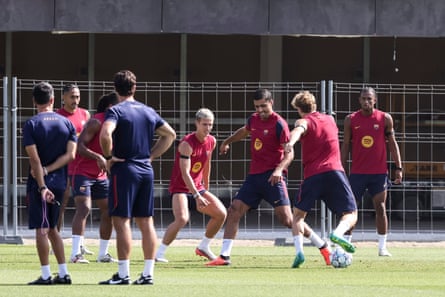
“The club has done an incredible job,” Olmo adds. “Rodri, Gabriel Jesus, Karim [Adeyemi], [Anthony] Gordon give us so much. Anthony and Karim are so fast which helps our idea in attack, but most important is without the ball, which the manager really values: pressing, defending as one. And Rodri is the player who is most like Busquets.”
Did Olmo spend the summer encouraging him to come? There’s a grin. “Erm, it was all very fast,” he says. “It’s not like we wanted to talk about signings during the World Cup. But when the rumours started, we might have sent a little message or something. He decided and we’re so happy. . He fits perfectly in our play, our system, our idea, which is similar to the seleccion. He’s positional, brings balance, which will give me more freedom to interpret where the spaces are. He sustains the structure. We know the system is risky at times but we have the experience and knowledge to judge when to go and when not to, when to cover our backs. Rodri gives us that too.”
When Barcelona won the league in 2025, four players celebrated by taking out city bikes and cycling up the Diagonal. It started with Torres, who they visited in hospital where he was recovering from an appendicitis and, although Olmo says it was just the easiest way to get there, something had started. In New York they again set off in the saddle: he, Torres and Eric García pedalling away to the sound of sirens, which sounds a little risky in the final days before the game of their lives. Olmo laughs. “We would have waited until after to post the images,” he says. “But we were very careful and it was fine.”
The tradition was maintained and another trophy lifted; just one to go. From Barcelona to New York. And Madrid? Olmo smiles. Incognito in a mask and helmet, perhaps. “Maybe we’ll have to