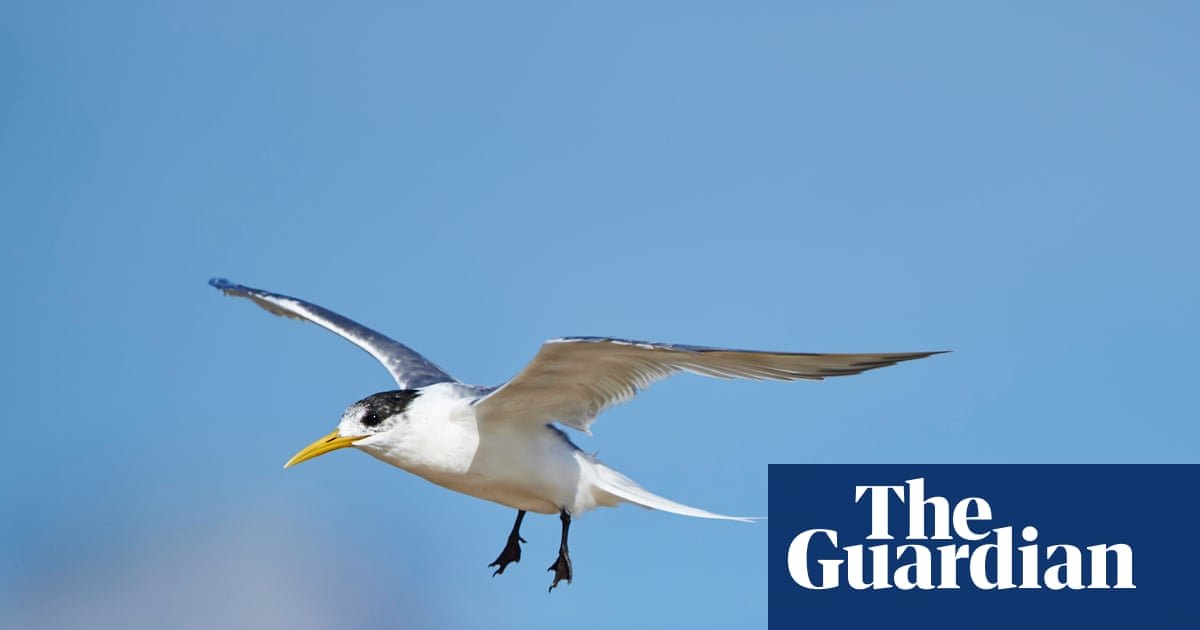
Native greater crested tern – a common coastal bird – tests positive for disease after being discovered at Robe on SA’s Limestone Coast
Follow our Australia news live blog for latest updates
Get our breaking news email, free app or daily news podcast
The first case of deadly H5 bird flu in local wildlife has been recorded in a bird found on the South Australian coast, with experts saying the discovery is an escalation of the disease’s arrival in the country.
Separately, tests on a young fur seal found on the New South Wales Central Coast returned a negative result for H5 bird flu on Friday night. The animal was found at Blue Bay and died on Thursday with tests undertaken as a precaution, the NSW government said on Friday
The federal agriculture minister, Julie Collins, said on Friday that a greater crested tern – a common coastal bird – had tested positive for the disease. The dead bird was found at Robe on SA’s Limestone Coast by a member of the public.
“While this, of course, is a concerning development, it is not unexpected and is another sign that our strong biosecurity system is working,” Collins said.
Until Friday, cases of bird flu had been detected in migratory subantarctic seabirds, mostly giant petrels, found on the coasts of SA, Western Australia and NSW.
Environment groups said the development marked a possible turning point for the disease in Australia.
Collins said the South Australian government was leading the response to the discovery of the greater crested tern by conducting extra surveillance to help establish whether there had been further spread in local wildlife.
“What we do know is that this is a coastal seabird that has an overlapping coastal range with migratory seabirds that have previously tested positive for H5,” she said.
Earlier this week, the SA government said it had completed the largest aerial survey of the state’s coastline, islands and reefs in 40 years and found “no widespread evidence of sick or dead seabirds or seals”.
In a statement on Friday, the government said the greater crested tern was found dead by a member of the public at Robe Marina on Tuesday. They reported it to the emergency animal disease hotline. The government said the bird was collected for testing the same day.
Chris Purnell, the wetland and migratory shorebird program manager at BirdLife Australia, said the detection was “very concerning” and represented a “paradigm shift” in the development of the disease in Australia.
All previous confirmed detections had been in migratory birds that had likely brought the disease from the subantarctic, but the greater crested tern was an Australian resident seabird.
“Those earlier detections were like little spot fires, but this suggests transmission has occurred on or near our beaches. We consider this to be a local transmission point.”
Purnell said greater crested terns lived in large “mixed flocks” with other species, which would generate opportunities for the disease to spread.
“This is only one bird, but it is very, very concerning, but not a surprise,” he said.
The location of the bird – close to a network of coastal lakes with many birds – was also a concern, Purnell said.
BirdLife Australia was particularly worried about the eastern hooded plover – a species listed as vulnerable and with populations living close to where the tern was found.
Terns as a group of species had been heavily affected globally by the disease, Purnell said. In France, hundreds and potentially thousands of sandwich terns died within days of the first reports of dead birds.
Jack Gough, the chief executive of the Invasive Species Council, said international experience showed H5 could spread quickly and at greater distances than expected.
“This is a very serious moment because it’s the first time we’ve seen local transmission of the virus rather than sick pelagic seabirds arriving on the beaches from the Southern Ocean,” he said.
“I’m concerned that if we get persistent spread to Australian wildlife, this could quickly turn up all over the Australian continent.”