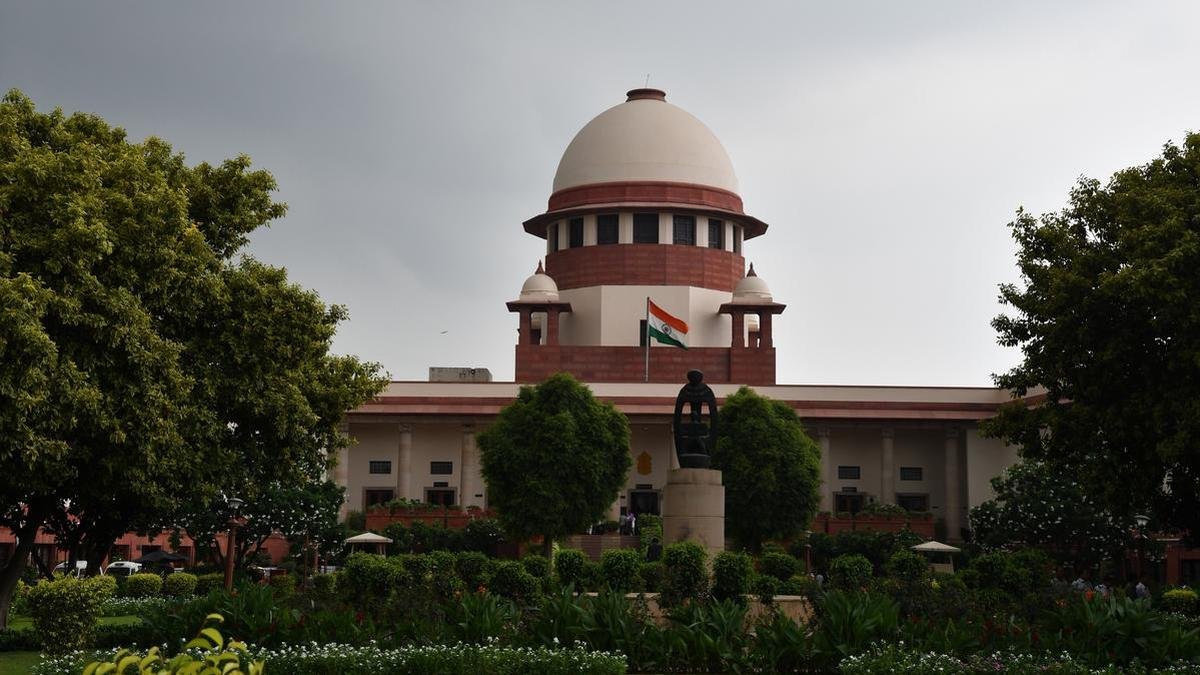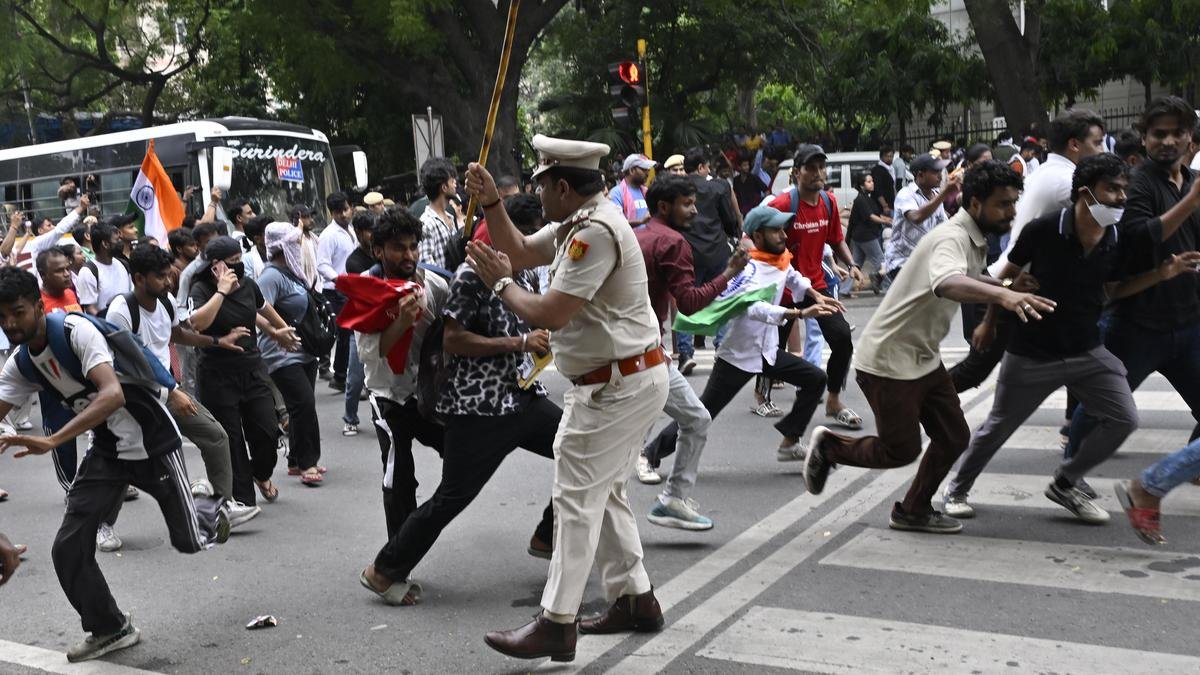
The Supreme Court on Monday (July 27, 2026) observed that the constitutional right to peaceful protest must be protected and indicated that it may consider framing uniform guidelines to regulate police conduct during large-scale demonstrations.
A Bench led by Chief Justice of India (CJI) Surya Kant said it was equally concerned about injuries suffered by both protesters and police personnel during such protests, and stressed that “self-imposed discipline” on the part of both citizens and law enforcement was essential to the functioning of a democracy.
“The right to peaceful protest is absolutely guaranteed under the Constitution.
So long as it is a peaceful agitation, merely because there is agitation, there cannot be [police excesses]...
If there is police excess committed, it should be independently examined.
Merely because there is agitation, it does not mean there should be a lathi charge.
Discipline is integral to the democratic process,” the Chief Justice orally remarked.
The oral observations came as multiple petitions concerning the nationwide protests over examination paper leaks were mentioned before the Bench, which also comprised Justices Joymalya Bagchi and V.
Mohana.
These included petitions alleging police excesses during the July 20 Parliament march led by the Cockroach Janta Party (CJP), as well as those concerning the alleged “aerial firing” by police personnel in Bihar’s Siwan during the Bihar bandh on Saturday (July 25, 2026), called by the All India Students’ Association (AISA) over the NEET paper leak.
Following the protests, which spread across several States and snowballed into a major political crisis for the Narendra Modi government, Dharmendra Pradhan resigned as the Union Education Minister on Saturday (July 25, 2026).
Union Minister Pralhad Joshi assumed charge as the new Education Minister on Sunday (July 26, 2026).
Meanwhile, in a move to strengthen the anti-cheating law, the Union government proposed the Public Examinations (Prevention of Unfair Means) Amendment Bill, 2026, which seeks to increase the punishment for those involved in unfair means, including the leaking of question papers for public examinations, from three to five years’ imprisonment to five to 10 years.
It also proposes to enhance the maximum fine from ₹10 lakh to ₹50 lakh.
A copy of the Bill was circulated among Members of Parliament on Saturday.
Mentioning one of the petitions for urgent listing, advocate Fauzia Shakil, appearing for Rajya Sabha member Manoj Jha, told the court that a comprehensive writ petition had been filed placing on record material relating to the police action, including the alleged firing on protesters in Bihar’s Siwan district.
Supreme Court to seek Nilekani-led exam reform task force’s inputs on online NEET exam “We have filed a writ petition with comprehensive information, including Bihar firing...
There was use of AK-47 in Siwan... we have filed data,” Ms.
Shakil submitted.
The Chief Justice said the court was already seized of a petition seeking all-India guidelines to regulate protests.
“There is a petition seeking all-India guidelines for protests etc.
There is a right to peaceful protest.
It is allowed,” he remarked, after senior advocate Gopal Sankaranarayanan, appearing for petitioner-advocate Shailesh Mani Tripathi, submitted that his plea presses for such guidelines.
‘Police literally lynched’ On Monday (July 27, 2026), senior advocate Sreedhar Pottaraju brought to the notice of the Bench that a petition had been filed on behalf of the families of police personnel allegedly assaulted during the July 20 Parliament march.
Seeking to intervene in the proceedings, he submitted, “I represent the families of policemen who have been brutally beaten.
We would like to participate, My Lords, and present our perspective.
Protect the police as well in uniform.” The right to protest and the limits of police power | Explained Mr.
Pottaraju added that while there was “no question of defending excesses”, the rights of police personnel in uniform also deserved protection.
“There are videos circulating.
They have been kicked, literally lynched,” he submitted.
Responding to the submission, Justice Bagchi said the court’s concern extended equally to the injuries allegedly suffered by police personnel.
He observed that the state authorities would be called upon to explain whether adequate protective gear and safety equipment had been provided to officers deployed to manage large crowds.
“Injuries to all individuals, be it policemen or anyone else, are of equal concern to us.
We may call upon the state to explain why adequate safety gear, guards, helmets etc. were not provided to police personnel,” the Judge remarked.
‘Uniform protocol’ Senior advocate Vikas Singh urged the court to frame uniform guidelines governing police action during protests, pointing out that allegations of police excesses were not confined to Delhi but had surfaced across the country.
“There have to be pan-India guidelines and some kind of balancing,” he said.
The Chief Justice agreed that a standard operating protocol appeared necessary.
“There has to be a protocol in place.
Everyone has a right to protest so long as it is with due permission and at designated places.
But if some anti-social elements have done anything, that can also be looked into,” he remarked.
Pleas to be heard on July 28 Noting that the issues raised extended beyond any single State, the CJI said all pending petitions would be heard together on Tuesday (July 28, 2026).
He also assuaged the petitioners, saying that the court would examine allegations of disproportionate use of force by the police as well as incidents of violence during the protests.
“We will list all the matters tomorrow.
Do not take it adversely.
If there are excesses committed, that can be looked into dispassionately... who has done it, etc.
It can also not be that violence occurs during these protests”, CJI Kant said.
Are pellet guns legal for crowd control in India? | Explained Solicitor General Tushar Mehta, appearing for the Delhi Police, said the police had no objection to all the petitions being heard together.
“We are not taking it adversely.
Let all the matters be taken up together,” he submitted.
The Bench thereafter directed that all pending petitions be listed together for hearing on Tuesday (July 28, 2026).
On July 24, 2026, the apex court had agreed to hear on Monday two freshly instituted petitions alleging police excesses during the July 20 crackdown on student protesters in the national capital.
The development came hours after the Chief Justice clarified in open court that “no petition” had previously been filed on the issue and criticised “reckless” reports suggesting that the court had refused to list such a matter.
The observations came two days after the court declined to initiate suo motu proceedings on an oral request made by advocate Narendra Mishra to take cognisance of the alleged police brutality during the July 20 Parliament march organised by the CJP.
Meanwhile, after The Hindu reported that two unarmed protesters were struck by pellets allegedly fired by Rapid Action Force (RAF) personnel, the Central Reserve Police Force (CRPF) said on Friday (July 24, 2026) that it was “verifying the media reports”.
A CRPF official said no action has been taken so far, as the veracity is still being ascertained.
Earlier, the Delhi Police had denied using pellet guns against the protesters.
The RAF, a specialised anti-riot force, had been deployed under the overall control of the Delhi Police during the July 20 operation.
One of the injured protesters, 19-year-old Sahil Lochab, risks losing vision in his right eye after a pellet pierced his pupil.