Incumbent Sullivan is running for third term while Peltola is fighting to flip seat and aid Democrats retake control of Congress
Democratic socialist Angie Nixon clinches surprise win in Florida
Sign up for the US Breaking News email
42m agoBusinesses call for resolution after announcement of three-day pause on 50% tariffs on Canadian trade
2h agoTrump-backed Byron Donalds to face Democrat David Jolly in race to succeed Florida governor DeSantis
2h agoRepublican senator Dan Sullivan and Democrat Mary Peltola advance in Alaska Senate primary
2h agoRevealed: FCC chair Brendan Carr’s close ties to White House and rightwing media
4h agoWho is Natalie Harp? Trump’s closest and most devoted aide is in the spotlight
6h agoDemocrat Mary Peltola and incumbent Dan Sullivan lead in Alaska primary for US Senate
Hello and welcome to our live coverage of US politics.
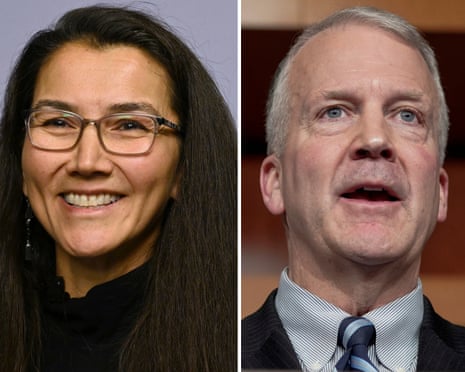
We are still awaiting the full election results from Alaska, where it appears Mary Peltola is leading for the Democrats and Dan S Sullivan is leading for the Republicans in the contest for US Senate.
Incumbent Sullivan is running for a third term while Peltola is fighting to flip the seat and aid Democrats in their quest to retake control of Congress. The Tuesday vote in the non-partisan primary will see four candidates advance to the general election for the seat in November.
Peltola became the first Alaska Native and the first woman to represent Alaska in the House of Representatives when she won her bid for the state’s sole seat in 2022. Sullivan, on the other hand, faces the unique challenge of running against … Dan Sullivan. Dan J Sullivan is a retired schoolteacher and US Forest Service employee. Though Republicans argued that the 70-year-old challenger Dan Sullivan had only filed his candidacy as an interference tactic against Senator Sullivan, the state supreme court ruled in June that was qualified to run for the seat and ordered election officials to place him on the primary ballot.
With 66% of votes counted, Peltola is leading with 46.8% of the vote with the incumbent Sullivan trailing closely behind with 44.4% of the vote. Dan J Sullivan is in third with 2.4% of the vote.
Progressive Aisha Wahab is currently leading with 51% of the vote in the special runoff election to fill former representative Eric Swalwell’s seat in California. This comes after super Pacs tied to the American Israel Public Affairs Committee (Aipac) spent millions supporting Wahab’s closest competitor, Democrat Melissa Hernandez. According to the Associated Press, 62% of votes have been counted.
In Wyoming, the Trump-backed Harriet Hageman is leading the Republican primary for US Senate. Hageman, a conservative lawyer with a passion for thwarting environmentalists, had previously beat Liz Cheney for the thinly populated western state’s solitary seat in the US House of Representatives.
Byron Donalds won the Republican nomination and David Jolly the Democratic nomination for Florida governor. Donalds was endorsed by Donald Trump and will become Florida’s first Black governor if elected in November. Jolly is a former Republican who joined the Democratic party last year.
Progressive Angie Nixon won the Democratic nomination for Florida’s open Senate seat, defeating the heavily favored Alex Vindman, a retired army lieutenant colonel and an impeachment witness against Trump during the president’s first term of office. If elected in November, Nixon would be the state’s first Black senator. Nixon will compete against Republican Ashley Moody in November for the Senate seat Marco Rubio won in 2022.
Results in the runoff election for a temporary successor to US congressman Eric Swalwell in California remain too close to call on Wednesday morning. State Sen. Aisha Wahab has a 51-49 lead of about 1,400 votes over Bay Area Rapid Transit Board President and former Dublin Mayor Melissa Hernandez, with about two-thirds of the vote counted according to the Associated Press.
Both Wahab and Hernandez are Democrats; California uses a “jungle” primary system for elections in which the top two vote-getters advance to a runoff. Wahab and Hernandez will again face each other again in the November general election for a full two-year term.
Outside spending amplified a race that pitted a relative progressive in Wahab against a centrist Democrat in Hernandez. The United Democracy Project, AIPAC’s political spending arm, contributed at least $1.2m in support of Hernandez, as well as $2.1m from Bold America Pac, which has received significant financial backing from the United Democracy Project, according to Politico.
An announcement of a three-day pause to the start of 50% tariffs on Canadian trade has left business and economic leaders thirsting for a resolution.
“Let’s be clear: the tariff delay provides relief on both sides of the border,” said Candace Laing, president and CEO of the Canadian Chamber of Commerce. “Businesses may not be closing up shop with this news, but an extension doesn’t bring the certainty that a signed interim deal would. We know that stability is in short supply and businesses will take any ounce they can get. This limbo state is not anyone’s preferred outcome – time is of the essence.
“We commend the negotiating team for their work and sense of urgency this week, and call on them to keep it up: ultimately, a resilient and integrated North American economy would be a stronger one for all.”
“The additional time is welcome, but the continued threat of tariffs leaves manufacturers and their workers facing the same damaging uncertainty,” said Dennis Darby, president and CEO of trade group Canadian Manufacturers and Exporters, in a statement.
“Businesses cannot confidently make long-term decisions about production, hiring, technology adoption and capital investment without knowing the conditions under which they will trade with their largest market. Delay may buy time, but it does not remove the damage caused by uncertainty.”
President Donald Trump posted late on Tuesday on social media that he had paused the tariffs for three days “based on the fact that Canada and the USA, subject to the finalization of documents, have a DEAL!”
Trump has made a point of antagonizing Canada throughout his second term. Retailers in Canada have responded in kind, ridding their shelves of American goods, particularly alcohol. In March 2025, every province of Canada banned the import and distribution of American alcohol. Only Alberta and Saskatchewan have subsequently lifted their bans.
Though the US supreme court struck down much of Trump’s tariff regime earlier this year, the White House announced a 50% tariff on Canadian exports including wine and hockey sticks in July, saying that it sought to hold Canada accountable for discrimination against US-produced cars, alcohol and dairy products.
Most Canadians oppose offering concessions to the United States as part of a trade deal. Almost 70 percent of Canadians want a ban on American alcohol to continue.
Byron Donalds, a congressman backed by Donald Trump, won the Republican nomination for governor on Tuesday in the race to succeed Ron DeSantis.
Donalds, who has represented south-west Florida since 2021, trounced three reasonably prominent Republican rivals, including Jay Collins, DeSantis’s handpicked lieutenant governor.
If he wins the November election, as he is expected to do in the conservative stronghold, Donalds would become the first Black governor in any southern US state.
So confident was Donalds of victory that his television advertisements in the weeks leading to the primary ignored his Republican challengers and focused on former Republican congressman David Jolly, who secured the Democratic party’s nomination on Tuesday.
With 80% of the vote counted, incumbent Republican senator Dan Sullivan and former Democratic congresswoman Mary Peltola will be moving forward from Alaska’s open primaries to the general election.
Peltola is currently leading with 48% of the vote with Sullivan following at 42.8%. The other Dan Sullivan – a retired schoolteacher and US Forest Service employee who infuriated his namesake senator by running as a long-shot Republican candidate – is in a distant third place with 2.4% of the vote, followed by Democrat David Leslie and Republican Gerald Heikes, each with about 1.1%.
This election is yet another contest that could tilt the scale in the Democrats’ favor and help them retake control of Congress.
The Guardian’s Chris Stein has more:
Brendan Carr was very firm.
“As a general rule, we don’t get into any discussions that happen with the White House or don’t happen with the White House,” Carr, the chair of the Federal Communications Commission (FCC), told Politico’s Dasha Burns in a recent interview. Burns had pressed Carr to explain how exactly he came to issue a highly unprecedented order forcing ABC to apply early to renew its eight local broadcast licenses just one day after the man who appointed Carr, Donald Trump, and his wife Melania called for ABC to be punished for a joke made by late-night host Jimmy Kimmel.
“Did you get a call or talk to the president either before or after you made that announcement?” Burns had asked. Later in the interview, Carr repeated his policy: “As a general matter, I don’t speak publicly about conversations with the White House, or whether they happen or don’t happen.”
While Carr may not be keen to detail his relations with the Trump administration, a trove of FCC documents – obtained via a Freedom of Information Act request and lawsuit filed by the advocacy group Democracy Forward, and provided to the Guardian – shed light on the close working relationship between Carr, his top staffers and members of Trump’s White House team.
Between 12 March 2025 and 11 February 2026, Carr attended at least eight meetings at the White House, according to the records, and had at least three scheduled calls with administration officials, including two conversations with chief of staff Susie Wiles. He also spoke by phone with administration officials such as controversial health secretary Robert F Kennedy Jr.
In addition, the files provide insight into Carr’s media strategy, including communications with producers at Fox News, and make public previously undisclosed meetings he has held with media titans such as Fox Corp chief executive Lachlan Murdoch and Sinclair Broadcast Group chair David Smith.
Those unfamiliar with Alaska politics are likely raising an eyebrow at some repeated names.
No, we’re not talking about Dan S Sullivan and Dan J Sullivan, two Republicans with the same name running for US Senate – an issue that went to the state supreme court earlier this summer. We’re talking about the Begiches. Nick Begich III, a Republican, is currently leading the race to represent Alaska in the US House of Representatives for a second term while Tom Begich, a Democrat, is advancing to the general election for governor in November.
Further confusing matters, Nick Begich III won his seat from Mary Peltola, a Democrat who is leading the primary for US Senate alongside incumbent Republican senator Dan S Sullivan, who had defeated first-term Democratic senator Mark Begich for his seat in 2014.
The Begiches come from a long line of politicians that started with Nick Begich Sr, a Democrat elected to represent Alaska in the House of Representatives in 1970. His sons are Tom Begich and Mark Begich. Their nephew – and Nick Begich Sr’s grandson – is Nick Begich III.
Two Democrats are currently leading the all-party primary for Alaska governor.
Jonathan Kreiss-Tomkins and Tom Begich will advance to the general election for the seat in November, with Kreiss-Tomkins, a state representative, receiving 21.7% of the vote so far and Begich, a former state senator, receiving 20.1%.
The two Democrats are trailed by three Republicans. Business owner Bernadette Wilson has 10.5% of the vote so far, followed by former Anchorage mayor Dave Bronson with 8.4% of the vote and former state attorney general Treg Taylor with 7.5%.
In other primary news, Republican congressman Nick Begich III is leading the race to represent Alaska in the US House of Representatives for a second term.
Like the US Senate primary in Alaska, this election is a non-partisan primary that will see four candidates advance to the general election for the seat in November.
Begich, who narrowly defeated Democrat Mary Peltola, the current frontrunner in the senate primary in Alaska, for his current seat in the House of Representatives, has so far received 46.2% of the votes cast in Tuesday’s race. He is followed by independent Bill Hill with 31.1% of the vote.
Matt Schultz, a Democrat, is coming in third with 8.1% of the vote, with Democrat Eric Hafner coming in fourth with 3.8%. John Williams, another Democrat, currently has 2.5% of the vote.
According to the Associated Press, 77% of the vote has been counted.
Wearing shoulder-length blonde hair, gold earrings and a red dress, cancer survivor Natalie Harp introduced herself to the 2020 Republican national convention as “a formerly forgotten American from California” and compared Donald Trump with George Bailey, the everyman hero played by James Stewart in the classic film It’s a Wonderful Life.
“George Bailey’s father was right,” smiled Harp, her voice echoing in the Andrew W Mellon auditorium in pandemic-hit Washington. “All you can take with you is that which you’ve given away. Mr President, that makes you the richest man in the world.”
Six years later, Harp is now one of Trump’s closest and most devoted aides. Her official job title is special assistant to the president and executive assistant to the president on an annual salary of $150,000.
Her unofficial job title is the “human printer” for supplying him with print-outs of information. And for years she has only been a minor character in the Trump Cinematic Universe.
But all that changed this week when Jon Ossoff, a Democratic senator and possible 2028 presidential contender, accused Trump in a campaign speech of wanting to “build his ballroom and travel with Natalie” instead of doing his job.