
People say they’ve been secretly filmed in their own home, at concerts and at work. Are the wildly popular smartglasses the final nail in the coffin of personal privacy?
“I’ve had one person who told me that their intentions were creepy,” a man tells me over a video call, on condition of anonymity. He’s based in Los Angeles, and while we speak, he eats what appears to be tuna directly out of the can. “He said: ‘I go to strip clubs, and I want to record the strippers … Normally I put my phone in my chest pocket, but the glasses are more convenient.’”
The man I’m talking to runs a business called Ghost Metas. He’s one of hundreds of vendors, easily discoverable online, who specialise in disabling the flashing LED light embedded in Meta’s smartglasses that blinks when wearers capture photos, videos and audio. After Ghost Metas disables the LED, it’s impossible for someone to know they’re being filmed.
He flips his camera over to show me his work bench, revealing painter’s tape, a drill, a hole puncher, a dental pick and a tube of resin. He says he’s worked on about 100 pairs of glasses, and that one pair only takes him about 15 to 20 minutes.
“In public, I don’t think we have privacy any more, period,” he says, when I ask whether what he’s doing feels wrong. “My argument is if you’re really worried about your privacy, don’t go outside.”
The success of Ghost Metas is parallel to the runaway success of Meta Glasses, designed in partnership with established glasses brands Ray-Ban and Oakley. Meta said that it sold roughly 7 million pairs in 2025 alone, practically tripling combined sales numbers from 2023 and 2024. Influencers, athletes and global celebrities such as Chris Hemsworth and Teyana Taylor have embraced the tech in sponsored posts and buzzy ads. The glasses mark a turnaround for a company that made big missteps by overinvesting in virtual reality “metaverses” and trailing behind in the AI race.
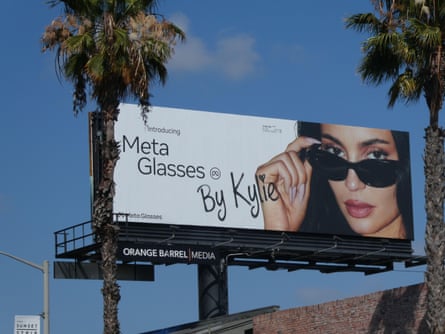
The most notable endorser has been Kylie Jenner who, in June, collaborated with Meta on her own line of AI glasses. “Hey Meta – take a picture,” Jenner commands her $399 Starfire glasses in an advertisement for the collab. Meta promises that users can ask Kylie’s glasses any question, and the AI will issue “every response in Kylie’s voice”.
The reality of how people are using the glasses has been less benign. They have been widely used for exploitation and privacy violations, much of which has been bragged about on social media by bad actors themselves. Online creators – primarily men – have used the glasses to troll boardwalks, college campuses, and streets outside bars in search of women to hit on, and then post the interactions. Some men have recorded overtly racist videos in which they enter massage parlors staffed by Asian women and ask for “happy ending” massages. Others have used the glasses to record bathing suit-clad women at the beach.
I’ve spoken with people who say Meta Glasses have been used to secretly record their private interactions, with one source describing an incident inside her house that she felt endangered her children.
Many of these videos are captured and posted online without the consent of their subjects, often by influencers who want to humiliate the subjects they’ve filmed.
To protect against this, on every pair of glasses there’s an LED light that’s supposed to let people know the glasses are recording. Meta makes assurances that the glasses won’t record when the LED light is blocked or obscured. But the man behind Ghost Metas says it’s easy to modify the glasses to block the light without triggering the refusal failsafe.
He acknowledges that the overwhelming majority of his clients have been men but he doesn’t agree that the glasses are only being used for spying. Many of his customers are parents, who he says tell him: “‘I want to record my kid, but every time the light’s on, the kid just keeps looking at the light.’” He also said he’s done several pairs for food delivery drivers and others with similar jobs, who have told him that they want to protect themselves from false claims of undelivered orders or unwanted harassment.
What Ghost Metas is doing clearly breaks the terms of service of Meta Glasses. But could Meta argue it’s an inversion of their appeal? Meta’s CEO, Mark Zuckerberg, who has positioned the glasses as a smartphone killer, said in September 2025 that “the promise of glasses is to preserve this sense of presence that you have with other people”. Smartglasses bring the functionality of smartphones, cameras included, into every moment. Several people I spoke to say that even when the LED is functioning as intended it can be subtle and difficult to spot from far away, especially if you aren’t aware of how smartglasses work. Others shared that they sought out the glasses to capture more “natural” footage of those around them, explicitly because people act differently when they know they’re being recorded. As Meta themselves put in their advertising materials: “Record life as you live it – every detail, every angle.”
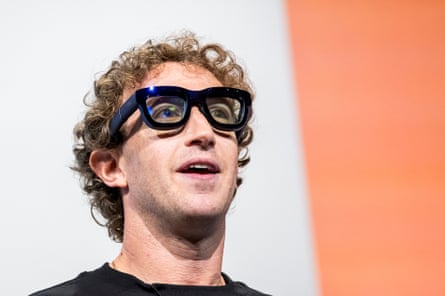
Other tech giants have tried – and failed – to successfully market smartglasses. In 2013, Google released Google Glass, but discontinued them in 2015 amid backlash that resulted in a journalist getting assaulted in the street for wearing a pair. Snapchat tried for years to push Spectacles, first released in 2016, to no avail. (It’s now slated to release augmented-reality glasses called Specs later this year, though between their awkwardly bulbous appearance and $2,195 price tag, they may be dead on arrival). Apple’s Vision Pro, meanwhile, has seen disappointing sales since its release in early 2024. Beyond headwear, there have been products like an always-listening version of Amazon’s Halo Band bracelet, which the Washington Post once called “the most invasive tech we’ve ever tested”. Amazon scrapped the always-on microphone in 2021, again in response to people finding the update wildly creepy, and the Halo line was discontinued entirely by 2023.
So why did Meta Glasses succeed when so many of their competitors were deemed creepy and ugly? One big answer seems to be fashion.
Unlike their predecessors, Meta Glasses have familiar designer names behind them. EssilorLuxottica, the Italian corporation that owns Ray-Ban and Oakley, is an eyewear titan that raked in about $33.8bn in 2025, with about 12% of its overall sales to Ray-Ban.
“Ray-Ban is fashionable in a perennial sort of way, not a fleeting sort of way,” said Amy Odell, fashion journalist and author of the Back Row newsletter. Zuckerberg, she added, “is right that in order to get these things to sell, they do have to be great glasses first. And you really can’t go wrong by going to the most iconic sunglasses brand.”
Meta also makes a number of privacy assurances about the glasses, promising users they are “designed for privacy” and that Meta doesn’t have access to recordings made by using the glasses. However, a joint investigation by the Swedish newspapers Svenska Dagbladet and Göteborgs-Posten revealed that Meta was, in fact, storing recordings made by glasses wearers. The papers interviewed Kenyan whistleblowers working for the controversial content moderation sweatshop Sama, which is subcontracted by Meta to sort through and annotate content that may be fed into Meta’s AI models.
“In some videos you can see someone going to the toilet, or getting undressed,” one contractor told the Swedish newspapers. “I don’t think they know, because if they knew they wouldn’t be recording.” Other Sama employees shared stories of reviewing content collected while glasses wearers were having sex, looking at their or their partner’s naked body, or viewing sensitive documents that revealed personal identifying information. The reporting quickly prompted a class action lawsuit in San Francisco federal court, which alleges that Meta engaged in false advertising in relation to its privacy assurances.
In a statement, Meta said that “unless users choose to share media they’ve captured with Meta or others, that media stays on the user’s device. When people share content with Meta AI, we sometimes use contractors to review this data for the purpose of improving people’s experience … we take steps to filter this data to protect people’s privacy.”
The lawyers bringing the class action disagree. “These products aren’t designed for user control and privacy,” said Ryan Clarkson, whose firm filed the suit. “In my opinion, they’re designed to maximise profits, and to turn every person who buys one into a Trojan horse of surveillance.”
‘I felt extremely violated’
Nonconsensual recordings can happen to anyone, anywhere. People have been secretly recorded in their workplace; one lawyer told the Guardian that he was covertly filmed by potential clients during a free consultation. Some Meta Glasses wearers have recorded videos of trips to hospitals and children’s dentist offices and shared them online.
You could even be covertly recorded in your own home – as was the case for Brek Mettra, a mother of two in Utah who was secretly filmed in her house during a transaction with a local vintage clothing seller. After the pair connected on Facebook Marketplace (also run by Meta), the seller met Mettra at her home to buy a T-shirt. Unbeknownst to her, he had used Meta Glasses to record their exchange, which he then uploaded to social media as content to promote his business.
Mettra said it wasn’t until a “random guy” in Philadelphia contacted her to inquire about a T-shirt he had seen in the clip that she knew the video even existed.
In the video, a copy of which was reviewed by the Guardian, Mettra’s face is visible, as are the faces of her two very young children. Though Mettra wasn’t tagged, the video revealed her identifying information: the vintage seller had paid Mettra using Venmo, and her full name was visible on her Venmo profile, which was how the stranger in Philly found her. “I honestly felt extremely violated,” said Mettra, who added that she does not remember seeing an LED light on the glasses.
After making multiple requests for him to take the video down, the seller deleted the post once Mettra warned him that she had contacted Instagram. “Please, for my children and myself I really hope you delete it,” Mettra pleaded in one message to the seller, which was reviewed by the Guardian. The seller didn’t respond to a request for comment but he has posted several similar recordings across multiple Instagram and TikTok accounts, with a tag included in his Instagram captions noting that the videos have been recorded with “Ray-Ban Meta glasses”.
Others say they’ve been harassed by Meta Glasses wearers in spaces they had previously felt safe in. Karina and Kyle, a young couple who asked to be identified by their first names to protect their privacy, are avid ravers who, earlier this year, had a disturbing encounter with a man who was using Meta Glasses to record young women’s bodies at a large EDM festival in Las Vegas.
The couple initially bumped into the man on the dancefloor, where they caught him leering at Karina’s breasts through a pair of Ray-Bans. They were close enough to notice that an LED on the glasses was flashing, signaling that the man was filming. Asked to stop recording, the man stormed away. A little while later, though, they saw the man again. This time, he was sitting on the ground beneath two bikini-clad young women, who were perched on tall barstools as they watched the show. Glasses on, the man stared at their bodies from below. It wasn’t until he took out his phone and attempted to take additional recordings, the couple said, that people around him realised he was recording and notified the women.
Karina is still unsettled by the knowledge that nonconsensual recordings of her may be out there. “It’s really disgusting … there are so many possibilities of what people could do,” she said.
Meta refuted to the Guardian that the main purpose of the glasses is to make unnoticeable recordings. But each victim of nonconsensual recordings called attention to the innocuity of the glasses, and how much more difficult – if not impossible – the glasses were to spot compared with handheld cameras or smartphones. And Mettra, for her part, said she doesn’t remember seeing a recording light. “If he would’ve pulled out a camera, I could have said no, or leave if you’re going to do that,” said Mettra. “It opened my eyes to be a little bit less trusting in people.”
“I feel like that’s the whole point of these glasses,” added Karina, “that they’re inconspicuous.”
‘A red line society must not cross’
Being secretly recorded is currently the primary fear associated with Meta Glasses. But covert recordings may just be the first step in a more sophisticated surveillance apparatus integrated with another deeply controversial technology: facial recognition.
In February, the New York Times reported on an internal Meta Reality Labs document in which the company discussed its plans to integrate a facial recognition feature called “NameTag” into its smartglasses.
In the document, dated to May 2025, Meta said that it planned to launch NameTag “during a dynamic political environment where many civil society groups that we would expect to attack us would have their resources focused on other concerns”.
In response to the Times’ reporting, Meta said that NameTag was something it was “still thinking through” and promised to “take a thoughtful approach if and before we roll anything out”.
A few months later, the American Civil Liberties Union (ACLU) issued an open letter to Meta signed by 75 different organizations condemning the integration of a feature like NameTag into smartglasses as “a red line society must not cross”.
By then, though, NameTag was already further along than was publicly known. A June Wired investigation revealed that latent code for NameTag was secretly rolled to Meta smartglasses as early as January 2026. While technically unreleased and inaccessible to consumers, the code contained the architecture for a system that would save faces viewed through Meta smartglasses as biometric “faceprints” and store them on users’ devices.
“You don’t put code like this in your app unless you’re planning to release that feature very soon,” said Cooper Quintin, a security researcher and senior public interest technologist with the Electronic Frontier Foundation Threat Lab, who independently reviewed the NameTag code discovered by Wired.
A few days after it was discovered, Meta quietly deleted the inactive code.
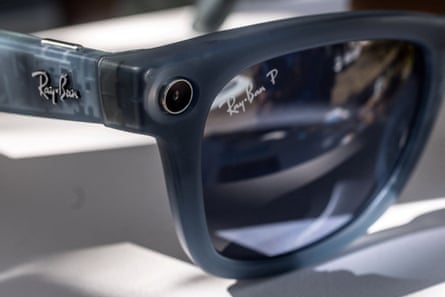
Technically, building facial recognition into smartglasses isn’t difficult. In late 2024, two Harvard dropouts were able to embed the facial recognition library PimEyes into a pair of Meta Ray-Bans; coupled with help from a large language model, the glasses were successfully able to connect strangers’ faces to their name, job, social media, address, contact information, information about family members and other personal data. (Meta told the Guardian that “these students simply used publicly available facial recognition software, PimEyes, on a computer that would work with photos taken on any camera, phone or recording device … Meta’s AI glasses do not have facial recognition technology.”)
But just last week, 404 Media reported that Meta filed a patent for a facial recognition feature for its AI glasses that would identify people in the frame and use that information to create highlight reels of that person or people. The example given in Meta’s patent was identifying and creating videos of guests at a dinner party.
According to Kade Crockford, the director for technology and justice programs at the ACLU of Massachusetts, the uncovered NameTag code signals a step toward a radical transformation of our existing privacy landscape – and they’ve “been dreading this moment for 20 years”.
Meta is keen to emphasise that their glasses are uniquely beneficial for blind and low-vision people, many of whom say the tech has been transformational for their daily independence and safety. While discussing NameTag in a recent podcast interview, Meta’s CTO, Andrew “Boz” Bosworth, emphasised that putting facial recognition into smartglasses could offer additional support to people living with vision or memory disabilities.
But the reasons to not introduce unchecked facial recognition into smartglasses are vast, privacy advocates have warned. Citizens attending protests could wind up with their names and faces being sucked into a database. To that end, ICE officers have already been caught using Meta Glasses to surveil demonstrators, and earlier this year, the Department of Homeland Security requested millions in order to build facial recognition into smartglasses. A woman could brush off an advance by a stranger in a bar, or on a bus, or at a workplace, only for that stranger to already know her name, which they may use to find her address and other information. Other vulnerable demographics – LGBTQ+ people, immigrants, people of color – may also be stalked, harassed and targeted by abusers receiving assistance from facial recognition.
Asked about Meta’s facial recognition plans, a spokesperson for Meta said that “we’re exploring these types of features as people regularly express interest in seeing them. Nothing has shipped to consumers and no final decision has been made on what to do here, if anything. If we do decide to roll something out, we will take a thoughtful approach and do so with full transparency. One decision we can be clear about – we are not building a central face database.”
A brewing backlash
As Meta promotes the glasses with paid influencer content and high-profile partnerships, resistance against the tech is intensifying. Activists recently plastered London bus stops with anti-glasses guerilla ads, one of which depicted the infamous pedophile Jeffrey Epstein in the Ray-Bans with the tagline “glasses for people who don’t do consent”. Some glasses owners say they’ve started leaving the spectacles at home because they don’t want to be associated with creeps. A professor in Germany built an app called Nearby Glasses, a free, open-source service that detects when smartglasses are close by and issues an alert. And during a July performance at a music festival in Madrid sponsored by Ray-Ban, the singer Lorde told the crowd that “you don’t know if someone’s wearing sunglasses, or if they’re wearing those fucked-up fucking … can I just say, for the record, fuck the glasses! Don’t get the glasses. Not sexy.”
In early July, Meta announced that it would push an update to detect when an LED light has been “physically tampered with or destroyed” and stop people filming using those glasses. Two months after we spoke, Ghost Metas decided to pause his business as a result of the update. “Too much risk,” said the now former LED disabler. One client, he added, had gotten in touch to say that his glasses were no longer working.
“People use our glasses because they’re genuinely helpful … for those wearing them and the people around them. Trust matters,” a spokesperson for Meta told the Guardian when asked about disabling the LED. “That’s why we built privacy into our AI glasses from the ground up. Every pair has a capture LED that blinks when you take a photo or video that you can save or share, it can’t be turned off, and if someone covers or damages the LED, the camera is disabled.”
But many other LED disablers told the Guardian they’re still working, even after Meta’s update.
“The new update hasn’t been impacting the glasses at all,” said one disabler in early August, after Facebook had announced the update. Since the update, he said he’s tampered with the lights on the Gen 2 and Kylie Jenner models, and that “they work fine.”
“I’ve done hundreds and [only] one person is having problems out of hundreds, so I chalk that up to him being a dumbass,” said another. “Mine are working perfect still.”
Others are still able to get by with lower-risk alternatives to physically drilling out the LED – including an Engadget journalist, who found they were able to successfully block out the recording light with a $2 sticker.
Things have gotten so bad that Instagram, which is also owned by Meta, is publicly warning that the glasses are being used to harass people and warns about posting content from Meta Glasses. “If you’re posting content that is taking advantage of people and harassing them, like a lot of these pickup line kind of videos that we’ve heard of and seen, then we’re going to take the content down,” the head of Instagram, Adam Mosseri, said in a video announcing a crackdown on harassing content. “We’re trying to fight that every way we can.”
As part of this purported crackdown, Instagram deactivated the accounts of several pickup artists with large followings. As of publishing this story, however, dozens of pickup artist videos filmed with Meta Glasses are still easily discoverable on Instagram, clearly marked by captions such as “POV MILF RIZZ”, “POV LATINA RUNDOWN” and “POV COLLEGE RIZZ”. After we notified Meta to multiple active accounts dedicated to pickup artist content, the accounts were deactivated.
Though taking pictures and videos in public spaces is generally legal in the US, existing laws regarding two-party consent and wiretapping, particularly on the state level, may have rendered some nonconsensual recordings captured by Meta Glasses illegal. (Of course, victims would generally have to know that recordings exist in order to take action against them.) Even so, the passage of meaningful federal privacy regulation in the US that would take policy out of the hands of corporations, replacing patchworked state laws and setting standards that would shift the regulatory burden to companies instead of individuals.
“The argument for federal privacy legislation is stronger every day, and Congress’s seeming commitment to do nothing is also stronger,” said Quintin. “I think privacy is a human right, and we should expect it. We used to expect it, and I don’t know why we as a society have largely just given up on that. I think we should demand it, and demand that Congress take action and regulate privacy.”
But Meta has proven a market, and other tech companies are chasing. Google has a partnership with Samsung and the designer eyewear company Gentle Monster, and is also working on a collaboration with the affordable glasses-maker Warby Parker. And Apple is not only working on its own glasses, but is also rumoured to be infusing cameras into its popular AirPods designed to feed an AI system information about the wearer’s surroundings, according to Bloomberg. Across Silicon Valley, AI hardware startups – including many designing AI wearables beyond glasses – abound.
Meta itself is mining deeper into higher echelons of luxury fashion. In 2025 it released a limited-edition pair of smart Ray-Bans with the French clothing brand Coperni, and it’s due to release a pair of smartglasses designed in collaboration with Prada. (In February, Zuckerberg even sat front row at a Prada fashion show.) The fashion industry seems excited to make this new era of surveillance as chic as possible.
“We’re frogs in a boiling pot, and the temperature is getting hotter and hotter,” said Clarkson, the lawyer. “So here we have a leap in the erosion of our privacy rights through this slick technology that big tech promises will enrich our lives, make us more connected, smarter, more efficient – when instead it’s going to move us, by an order of magnitude, toward a far more surveilled state of existence.”
In the modern world, anonymity is a precious resource. If smartphones have made constant filming more acceptable, smartglasses are among a class of technologies that make it quieter – omnipresent, but less and less visible.
A pair of glasses suddenly come with endless question marks, and a humming fear that our presence in public spaces involves a Foucauldian forfeiture of privacy. When you feel like anyone could be filming you, you act like you’re always being filmed.