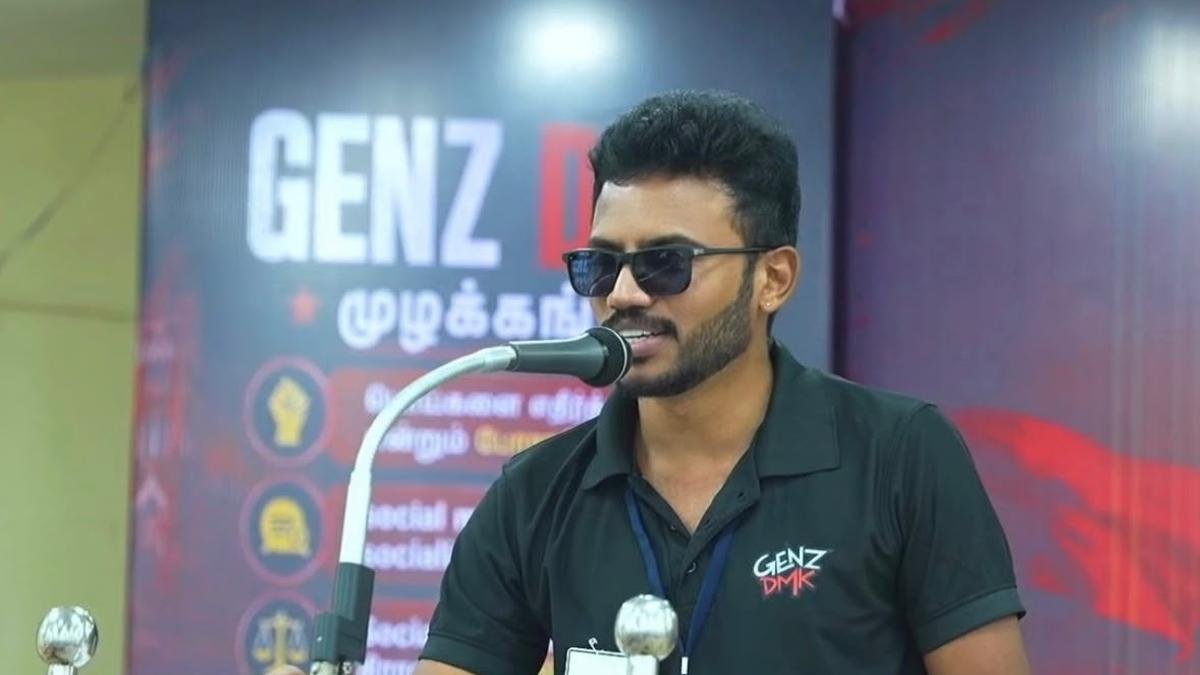
Dravida Munnetra Kazhagam (DMK) Gen Z wing leader A. Anbanantham (34) has approached the Madras High Court seeking anticipatory bail in a case booked against him under the Indecent Representation of Women (Prohibition) Act of 1986 for his derogatory Instagram post making references to Chief Minister C. Joseph Vijay, the latter’s wife, son and a film actor.
Justice C. Kumarappan, on Friday (July 3, 2026), adjourned the hearing on the advance bail plea to Monday (July 6). The Rayakottai police in Krishnagiri district had registerd the First Information Report (FIR) against the petitioner on June 23 on the basis of a complaint lodged by M. Moorthy, the ruling Tamilaga Vettri Kazhagam (TVK) party office-bearer in Krishnagiri.
According to the complainant, the petitioner had made highly disparaging remarks against the Chief Minister and had also dragged the latter’s family members and the actor in the “objectionable video” posted on his Instagram page. He submitted a pen drive containing those videos and urged the police to initiate appropriate action under the relevant criminal laws.
Thereafter, the police had booked the petitioner under Section 6 of the Indecent Representation of Women (Prohibition) Act and Sections 79 (uttering words intended at insulting the modesty of a woman), 351(2) (criminal intimidation), 352 (intentionally insulting a person with intent to provoke breach of peace) and 353(1)(b) (statements conducing to public mischief) of the Bharatiya Nyaya Sanhita.
The petitioner had initially approached the Krishnagiri Principal District and Sessions Court seeking anticipatory bail in the case. The Sessions Court had dismissed his petition on June 29 after the prosecution vehemently opposed the grant of the relief on the ground that the petitioner was in the habit of “gaining cheap publicity” by circulating such videos with vulgar content though his social media accounts.
“This court is conscious of the fact that the government cannot act in a manner that suppresses an individual’s freedom of speech. At the same time, while any individual has the authority to question the govemment for its actions, they have no authority to question a person for their private actions. Criticising someone personally about their private life does not amount to criticising the government. Therefore, this court considers that the petitioner’s argument is unacceptable,” Principal District Judge S. Rajasimmavarman had written.