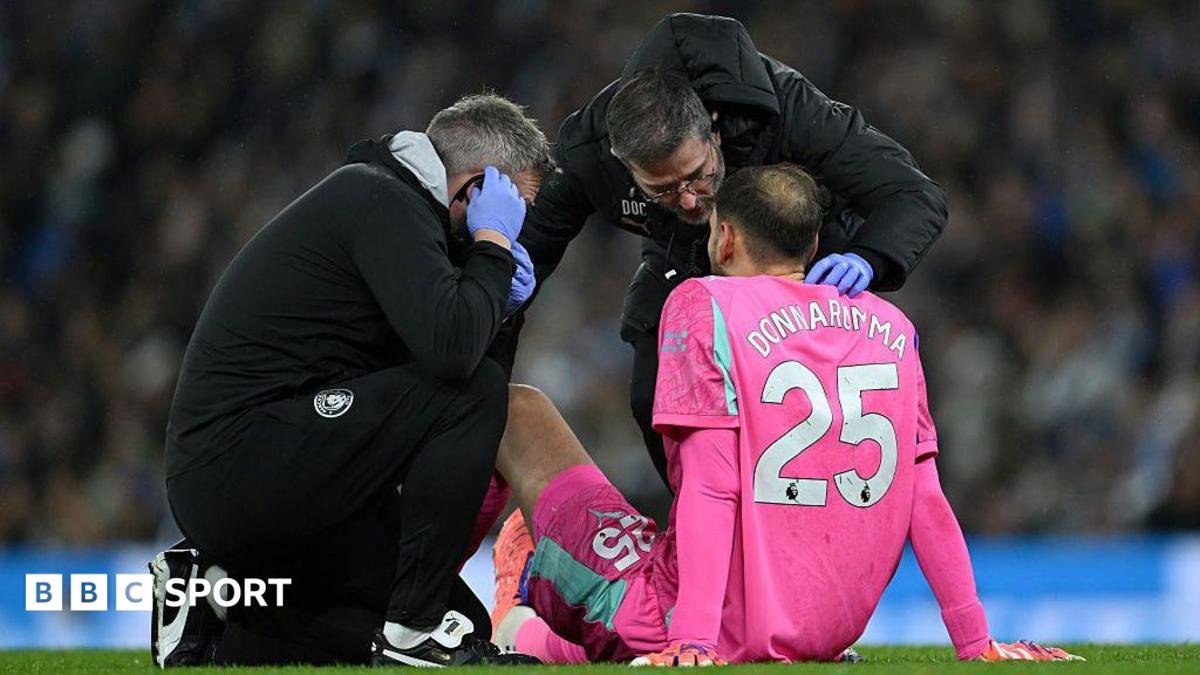
Image caption, Leeds United fans regularly booed a goalkeeper getting treatment last season after Manchester City's Gianluigi Donnarumma went down at the Etihad ByDale Johnson Football issues correspondent Published 12 minutes ago English football is set to implement a trial to try to eradicate the goalkeeper tactical timeout this season, BBC Sport can reveal.
The Football Association, Premier League, English Football League, National League and Women's Super League have agreed on the measure, pending permission from the International Football Association Board (Ifab).
Earlier this year, Ifab decided against changing the law and invited leagues to volunteer for trials.
Pro Ref, led by chief refereeing officer Howard Webb, has been in discussions with the leagues to determine how to tackle the issue.
It settled on a team having to remove an outfield player from the field.
If a referee signals that the physio can come on to treat a goalkeeper, the coach will have 10 seconds to nominate another player to leave the pitch for one minute, telling the fourth official of their choice.
If no player has been selected within 10 seconds, the captain must leave the field.
If clearance is received by the Ifab in time, the first game to feature the trial will be the Carabao Cup preliminary round tie between Tranmere and Rochdale on Saturday, 1 August.
BBC Sport understands that the Australian A-League will trial a variation with the captain always having to leave the field.
The tactic of gaining a timeout as the keeper is treated has become increasingly common and controversial in recent seasons.
It has not been uncommon for the goalkeeper to sit on the turf and signal for the physio, with all the other players rushing to the technical area for a team talk.
As soon as the coach has delivered their instructions, the keeper gets up to play on.
Goalkeeper treatment has also been used to disrupt the opposition's momentum when they are on top.
In November, Leeds United boss Daniel Farke accused Manchester City goalkeeper Gianluigi Donnarumma of feigning injury to "bend the rules" and break up play.
Measure intended to be proactive as a deterrent At the Ifab's AGM in February, head of referees Pierluigi Collina said that finding a solution to stop the goalkeeper tactical timeout was a priority.
At the 2026 World Cup, Collina told his officials to prevent players from going to the technical area on all stoppages.
The effectiveness of the measure is open to debate, as the three-minute hydration breaks in each half created a natural opportunity for a team talk.
In its own discussions, English football felt that merely stopping players going to the technical area would not deter coaches from using goalkeepers to break up play.
English football chose this trial as it follows the logic applied to outfield players, who must themselves leave the field for one minute if the physio comes on.
It is intended to be proactive as a deterrent rather than reactive to a team talk as it happens.
Match of the Day pundit Danny Murphy suggested last season that lawmakers could act to close the loophole in this exact way.
"I think they can change it really quickly," Murphy said.
"If a keeper goes down injured, instead of him having to go off, one of the outfield players should go off then it's fair all round.
"It's a little change that makes a world of difference." Officials will not prevent players from visiting the touchline as an injury is treated but it is hoped the prospect of playing with 10 players for a minute will act as an adequate disincentive.
This is especially the case in the final minutes of games, when teams trying to hold on to a result would use the goalkeeper to kill momentum.
Now they would have to play with 10 players.
There are a few exemptions when a team-mate will not have to go off.
Where a goalkeeper says they do not need the physio and they have not caused play to stop The goalkeeper and an outfield player have collided If a goalkeeper is fouled and needs immediate treatment If a goalkeeper is bleeding If there is a serious injury (has to be substituted) or concussion.
There have been some concerns that a requirement to leave the field for one minute could lead to players, both goalkeepers and outfield, attempting to play on with an injury.
The results of the trials will be assessed by Ifab at its meetings throughout the seasons, and this could lead to a permanent law change globally from 2027-28.