Until recently, for some of the women living around Vedanthangal, the birds they saw every day were simply part of the landscape. Today, they are part of their life, even the sounds of these avians being familiar to these women’s now-trained ears. That transformation was engineered by a nature-guide training programme from Chennai-based Care Earth Trust.
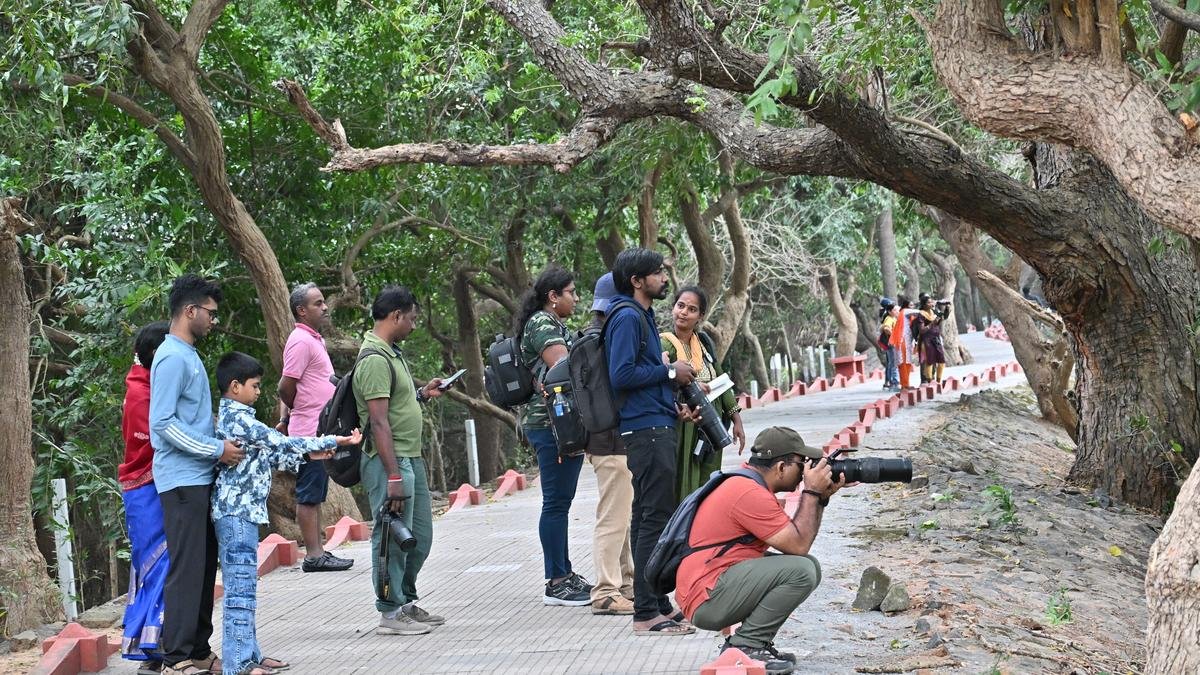
With the two-fold objective of increasing biodiversity awareness and providing livelihood opportunities, the programme began with women and young people from around Vedanthangal, training them in bird identification, wetland ecology, identification of trees butterflies, and communication skills. After months of classroom lessons and practical sessions, a group of eight trained participants have come together as ‘Golden Wings’ and are now conducting guided walks at Vedanthangal.
Vedanthangal resident S. Kalaiselvi Srinivasan, now a Golden Wings guide, says the work has given her an income opportunity as well as improved her communication skills.
For Subathirai D, however, the journey began with skepticism from those around her. When she first started attending the training, women in her neighbourhood questioned why she was spending her time on it. To them, learning about birds and nature seemed unnecessary, especially when she could be spending that time on household responsibilities or other work. But that perception began to change when Subathirai returned from the training and started earning through nature walks.
This is precisely the larger idea behind the project, says B. Ramamoorthy, Project Coordinator at Care Earth Trust. The organisation wanted to address two issues at once: the limited awareness among local communities about the biodiversity around them and the lack of livelihood opportunities for women in villages such as Vedanthangal.
The team worked through the panchayat, went around houses to explain the programme and spoke to families when women were hesitant to participate. Childcare was arranged during training and nature walks, food was provided, and the women themselves suggested Sundays as the most convenient day for classes.
The initial training involved classroom sessions using colour printouts and presentations to teach the participants about different birds, trees and butterflies. They then moved to practical walks, where they learnt to identify birds through their appearance and calls and understand local and native trees and their uses. They were also taken on a week-long exposure visit to Thattekad in Kerala to learn about forest biodiversity and migratory birds. The training did not stop with bird identification. The women were taught spoken English, people management and social-media skills.
For Anjana Venkatesan, Programme Manager – Policy Research at Care Earth Trust, the project is about creating a connection between local women and the ecotourism circuit while drawing attention to the biodiversity outside Chennai. “Connecting them to the local kind of ecotourism circuit is a win-win for both of us,” she said. She also wants to challenge the perception that people have to travel to the Western Ghats to experience rich bird diversity. “Right in the outskirts of Chennai, you have these pockets with our existing forests and existing wetlands,” she said, adding that some of these areas record around 70 bird species during the migratory season.
The next phase of the programme is now taking shape in Unamancheri, Vandalur, where women are undergoing training. Among them is 29-year-old Madhumitha S., a B.Sc graduate who works in medical coding. Originally from Medavakkam, she moved to Unamancheri after marriage and has been attending the Sunday classes for around two months.
For Madhumitha, the training has meant discovering a side of the place she now calls home. Before joining the programme, she was familiar mainly with common birds. The classes introduced her to a much wider range of birds, trees, butterflies and other species. She said the experience was a completely new subject for her and that she found learning about birds and other species interesting. Having grown up in the city, she also noticed the difference after moving towards the more interior parts of Vandalur, where she began seeing peacocks and deer.
Madhumitha is now learning how to handle tourists, engage them and conduct nature walks. She plans to continue her medical-coding job during the week and take up nature walks on weekends after completing her training.
For Anjana, the project is also changing the organisation itself. “We’re not going in with this knowledge. It’s something that we’re learning and adapting as we go along,” she said. For the women at Vedanthangal, the training has opened up opportunities they may not have considered before. They are now guiding visitors through the birds and trees they grew up around. In Unamancheri, women like Madhumita are only beginning to learn about this world. For them, the journey is just starting.