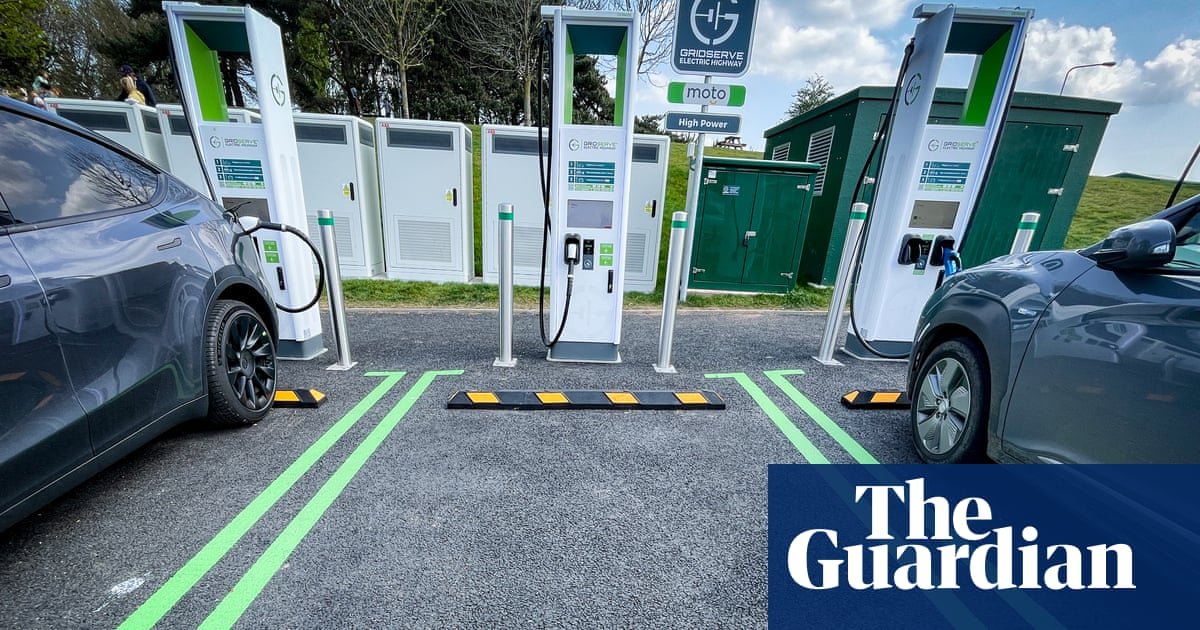
Lobbyists say the public charging network has doubled over the past three years, with rapid charging growing quickest of all.
The UK’s rollout of electric vehicle chargers has slowed amid challenging cost pressures and uncertainty over government sales targets.
Charger companies installed 5,100 public charge points in the first half of 2026, pushing the total to 121,171, according to Zapmap, a data company.
That was a 10% increase on the same point a year before – well below growth rates above 40% in 2024.
Although the pace of growth may be expected to slow as the network grows, it needs to remain high to meet the UK government’s target of 300,000 public chargers by 2030 and match the growth in electric car sales.
The number of EVs on Britain’s roads surpassed 2m in April.
However, charger installations have slowed markedly in the last two years, amid concerns over the pace of the transition away from petrol and diesel engines.
The car industry across UK and Europe has lobbied heavily for the government to weaken sales targets, known as the zero emission vehicle (ZEV) mandate, which enforce a rapid increase in the number of electric cars sold each year. .The Labour government has already added loopholes known as “flexibilities” to the mandate, which was brought in by the Conservatives in 2023.
The flexibilities allow car manufacturers to sell more petrol engine cars, and the government is considering also lowering the headline target for EV sales from 80% by 2030 to as low as 50%.
Jarrod Birch, the head of policy and public affairs at ChargeUK, a lobby group for the charging industry, said: “The public charging network has doubled over the past three years, and rapid charging is growing quickest of all, with nine in 10 built outside of London in the past 12 months.
It is a British success story, funded by private investment made on the certainty of future customers that the government’s ZEV mandate provides.
“But the mandate has now been argued over for three years, under two governments.
It is no surprise that investors are hesitating as doubt surrounds the policy once again.” Zapmap’s figures suggested firms were focusing particularly on ultra-rapid chargers, with a 37% increase in numbers year on year.
Ultra-rapid chargers, which can deliver more than 150 kilowatts (kW) of power, tend to be situated by motorways and main roads, for drivers to top up quickly on longer journeys.
That means they tend to be more profitable than standard or rapid chargers, as companies can levy higher prices and serve more drivers each day. skip past newsletter promotion after newsletter promotion Quick GuideElectric vehicle charging speeds ShowNot all chargers are created equal More and more people are buying electric cars, and are having to grapple with charging for the first time.
However, not all chargers are created equal, and the profusion of units can cause confusion.
Charging speeds are measured by power output in kilowatts (kW), while battery capacity is measured in kilowatt hours (kWh).
For example, a Nissan Leaf has 39kWh of battery capacity, while a Tesla Model Y has 60kWh.
Recharge times vary depending on battery size: divide the battery size by the power to get a very rough idea of how many hours it will take to charge. (E.g., a 60kWh battery at a 22kW charger would take about three hours.) The quicker the charge, the more it tends to cost.
Slow: up to 8kW Common at homes, on-street chargers and places cars hang around like car parks or hotels.
Suitable for charging overnight.
Plugging in with a UK three-pin plug to the mains at home will deliver about 2.3kW – although it is not recommended.
Fast: 8kW to 49kW Found at urban sites like supermarkets, shopping centres or car parks.
Capable of charging a smaller battery in a few hours.
Rapid: 50kW to 150kW Typically found close to big roads for journey charging, but also increasingly found in locations such as supermarkets or gyms with short dwell times.
50kW could give 80% charge in less than an hour.
Ultra-rapid: 150kW and above Most chargers being installed at motorway services or dedicated charging hubs are now at least 150kW.
Many newer cars can now handle 150kW, and several can charge at speeds of over 300kW, adding hundreds of miles of range in around 10 minutes.
She added that councils were finally rolling out chargers funded by the government’s local electric vehicle infrastructure (Levi) scheme.
The funding is aimed at providing more on-street chargers for people who do not have private parking.
“The Levi funding has seen an increased number of tenders awarded, and these – generally on-street chargers – have started to be rolled out locally,” Shufflebotham said.
“This, alongside the uplift in councils supporting through-pavement charging, and an increase in local charging at supermarkets, car parks and fuel forecourts, will encourage more and more drivers to go electric.” The tough environment for charging companies – who also face intense industry competition and rising costs – has prompted predictions of a wave of mergers and acquisitions as stronger players snap up struggling rivals.
One of the biggest companies, InstaVolt, last week bought the smaller GeniePoint network.
Explore more on these topicsAutomotive industry Electric, hybrid and low-emission cars Greenhouse gas emissions Ethical and green living Motoring (Technology) Motoring (Money) Transport news Share Reuse this content