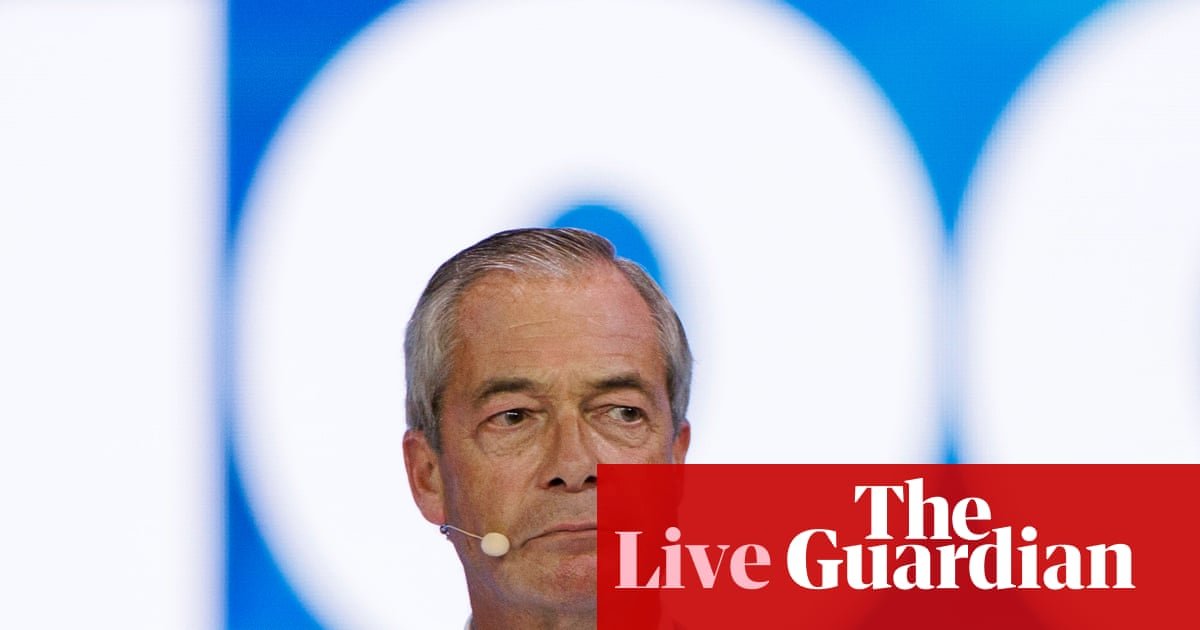
Ulrich Siegmund, the AfD’s state leader, arrived to vote on a moped with his wife, Julia.
Polling stations open in Saxony-Anhalt with anti-immigration party AfD predicted to gain 41% vote share German voterswent to the polls on Sunday for a crucial regional election where the far-right, anti-immigration and Moscow-friendly Alternative für Deutschland (AfD) is expected to win.
AfD, polling at more than 40% for months in Saxony-Anhalt, even has its sights on winning its first-ever state government, although this is far from assured.
Polls opened at 8am and 1.7 million voters have until 6pm to cast their ballots, with first projections expected shortly after.
The eastern German state is governed by the centre-right Christian Democratic Union (CDU) – the party of Friedrich Merz, the chancellor – in coalition with two smaller parties, and its state premier, Sven Schulze, hopes to rebuild a multiparty coalition to cling to power.
All other major parties have so far maintained a “firewall” of non-cooperation with the AfD, whose Saxony-Anhalt branch is categorised as “right-wing extremist” by Germany’s domestic intelligence agency.
The AfD’s top candidate Ulrich Siegmund – a 35-year-old who is feted like a rock star at campaign events and has a large social media following – has confidently predicted gaining an absolute majority.
“It was the others who erected the firewalls,” he told Bild.
“If no one wants to work with us, then we’ll just have to do it alone.” Such a scenario would shake Germany, which has so far kept extremist parties in check.
A strong AfD win would also heap pressure on Merz, who has vowed to reboot a stagnant economy and restrict irregular immigration, but has seen his party beaten by the AfD in national surveys too.
“If the AfD wins in Saxony-Anhalt, Merz’s critics will become even more vocal, and calls for better leadership will become impossible to ignore,” said the political scientist Wolfgang Schroeder of the University of Kassel.
Siegmund has promised to lead a political revolution from the state of 2.1 million people and propel the AfD to national victory in 2029.
The AfD’s key campaign promises include a “remigration and deportation offensive”, a ban on LGBTQ rainbow flags at public schools, and an end to new windfarms.
The party has also tapped into a sense of nostalgia for communist East Germany and lingering resentment about an enduring wealth gap with the west, decades after the 1989 fall of the Berlin Wall.
The prospect of an AfD state government has sparked alarm among mainstream parties and minority groups.
Thousands of the AfD’s opponents joined a “festival of democracy” rally in Magdeburg on the eve of the vote.
The German Economic Institute said the AfD’s immigration policy would be “ruinous” for the state, where the population is already ageing, shrinking and highly reliant on foreign-born workers.
Others have voiced fears an AfD-run state security apparatus could leak sensitive information to Russia.
The Kremlin “makes no secret of the fact that the AfD is the most important instrument for destabilising Germany for Putin”, the Thuringia state interior minister, Georg Maier, told the Handelsblatt.
The latest poll, released on Thursday by the public broadcaster ZDF, gave the AfD 41% of the vote.
The CDU was predicted a 23% share, the centre-left Social Democratic party (SPD) 8.5%, and the Greens 6%, while two smaller parties failed to cross the 5% hurdle to reenter parliament.
A similar result may allow a scenario where the CDU and others form a minority government with ad hoc support from the far-left Die Linke, which polled at 11.5%.
Explore more on these topicsGermany Alternative für Deutschland (AfD) Europe The far right news Share Reuse this content