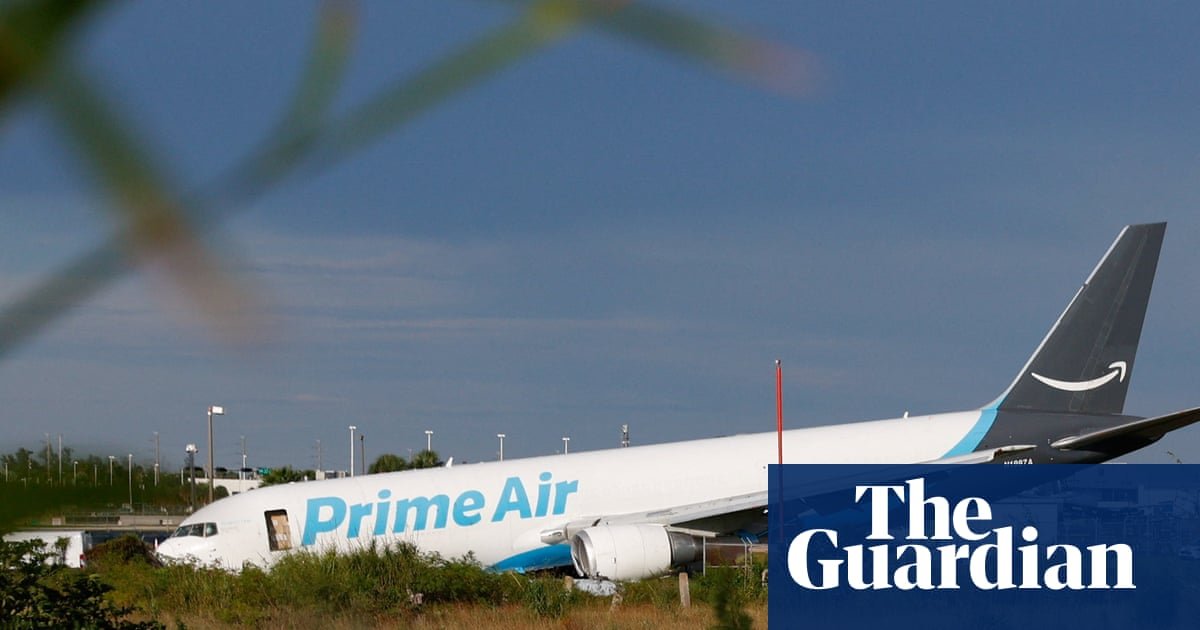
A view of an Amazon Prime Air cargo plane that overran a runway at Miami international airport, in Miami, Florida, on Sunday.
Focus likely on whether plane touched down too late in its glide path on to tarmac to enable it to stop safely Federal investigators have started collecting evidence, including a flight data recorder, following the Sunday crash of an Amazon cargo jet at Miami international airport that killed five people and injured five others.
Speaking at a press conference on Monday, Jennifer Homendy, chair of the National Transportation Safety Board (NTSB), announced a preliminary investigation into the Amazon Air flight 7598 accident involving a Boeing 767-33 Alpha operated by 21 Air, an all-cargo airline.
“What we know so far is the flight was arriving from San Juan, Puerto Rico, with two crew members on board.
This was the third flight for the aircraft.
That aircraft yesterday went from Cincinnati to Miami, Miami to San Juan, and San Juan back to Miami,” Homendy said.
She added: “[It] overran runway 30 on landing, struck navigational aids and equipment, then impacted a 2012 white Ford Econoline van that was owned by Professional Ocean Service Corporation, which is a contract cleaning company for the airline.
In the van were seven persons on board.
“The aircraft then traveled through a perimeter fence and impacted a Toyota Corolla Cross LE, which was traveling on Northwest 67th Avenue, and then continued into the grass and impacted another fence line, which separated an area where Tesla robotaxis were stationed.
In total, it was about 1,300ft past the paved surface.” Homendy described the Ford Econoline van as “torn apart”, and noted that for the Corolla Cross LE, “you can see airbags … you can see components from vehicles, both passenger vehicles and the aircraft itself”.
Federal investigators are expected to focus on several areas, including operations and human performance, flight crew experience, as well as 21 Air’s policies and contractual relationship with Amazon.
Other areas of focus include air traffic services, radar data, aircraft performance and structure, meteorology, as well as the “lack thereof of an engineered materials arresting system, or EMAS … a crushable, lightweight material that’s at the end of a runway that safely stops an aircraft”, Homendy said.
She added that although the NTSB would remain on scene for at least a week, its focus during that time will not be on determining probable cause, but rather on documenting the scene and collecting perishable evidence.
Video footage from Sunday showed the Boeing 767 jet wobbling slightly, coming in fast and flying relatively far along the runway before it touched down.
After the aircraft overshot the runway, coming to rest in a parking lot with its nose tipped forward, flames burst out of part of the jet and thick, dark smoke began billowing into the air.
The crash trapped the pilot and copilot in the cockpit and some occupants in cars, said Miami-Dade rescue fire chief Ray Jadallah said.
The agency said crews also had to extricate a person who was trapped under a vehicle.
Jadallah described the incident as a “very complex situation” where the plane crashed into multiple vehicles as it ran off the tarmac, trapping several people inside their vehicles.
Video of the Amazon Prime Air Boeing 767-33A, operated by contractor 21 Air, posted to social media show it touching down far along the runway.
Other posted footage shows the plane with a left hand wheel of the landing gear still a little above the ground as the jet speeds down the tarmac, apparently abnormally fast, and then it overruns the end of the runway, where the right undercarriage collapsed and the wing caught fire.
Typically, the landing zone is within the first 3,000 ft (914m) of a runway.
Aviation safety expert Steve Arroyo said if it was beyond that area, the plane should normally have aborted the landing and gone around for another attempt.
Mary Schiavo, who is a pilot and former inspector general of the transportation department, said video posted online shows the Amazon plane floating above the runway for an extended period without flaring the nose upward to force the main landing gear onto the ground.
Storm clouds can be seen in the area and strong winds reported.
Schiavo said that if the plane had a tail wind, that could have contributed to it floating further down the runway.
“A tail wind would certainly add to your troubles if you’ve already given up a good chunk of the runway by not touching down and landing right away,” Schiavo said.
Miami airport is not equipped with “arresting beds”, systems of lightweight, crushable material that the federal aviation authority (FAA) says have been installed at more than 120 airports nationwide at the end of runways to help safely stop planes that overshoot.
Some 200 emergency personnel responded to the incident, finding the plane with heavy flames and smoke from a complex engine compartment fire, the fire department said.
The flight operators, 21 Air, is a cargo carrier based in North Carolina.
The 32-year-old Boeing 767 was originally built to carry passengers and flew for several airlines for more than two decades before being converted to a cargo plane in 2015, according to flight-tracking site Flightradar24.
More than 160 flights were canceled and nearly 325 delayed by late Sunday, according to FlightAware, a website that tracks flight disruptions.
Flights later resumed, although two runways at the busy airport remained out of service on Monday morning.
The Associated Press contributed reporting Explore more on these topicsFlorida Miami Amazon news Share Reuse this content