Officials say blaze in Fontainebleau forest is of ‘exceptional scale’, with 900 homes evacuated and road and rail links hit
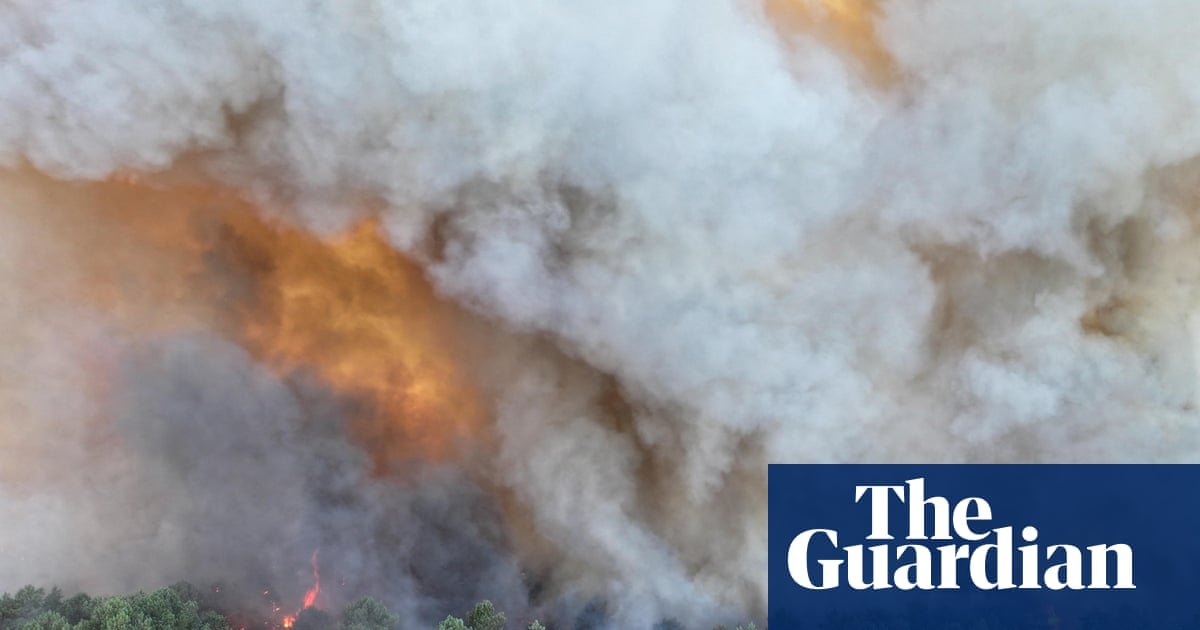
French firefighters are tackling a blaze of unprecedented scale sweeping through Fontainebleau forest south-east of Paris, while in southern Spain the prime minister visited the scene of a deadly wildfire and warned: “The climate emergency kills.”
The fire in Fontainebleau, a one-time royal hunting preserve about 40 miles (60km) from the French capital that today is dotted with villages, began late on Sunday afternoon. The blaze, which is unusual in its proximity to Paris, raced across about 800 hectares (2,000 acres) of forest.
By Monday afternoon it had not been contained and “continued to progress moderately”, said Pierre Ory, the prefect of Seine et Marne department. The Paris region remains under the highest heatwave alert.
The mayor of Fontainebleau, Julien Gondard, said he was shocked and angered. “This exceptional area is consumed by flames, we’ve never seen anything like this,” he told the local TV station ICI Paris Île-de-France. “The forest is fragile and it’s in a critical condition.”
Fire officials said it could take several days to several weeks to fully contain the fire. They described it as “very virulent” and of “exceptional scale”.
The interior minister, Laurent Nuñez, visiting an operations room in Fontainebleau on Monday, said: “The aim is to contain the fire.”
Nuñez said about 900 homes had been evacuated, no home had yet been burned and no one was injured. He said an investigation was under way to determine the cause of the fire.
“The fire began at several points at the end of yesterday afternoon – around 10 points, which would suggest it could have been voluntary in origin. I won’t say more because an investigation is ongoing,” he said.
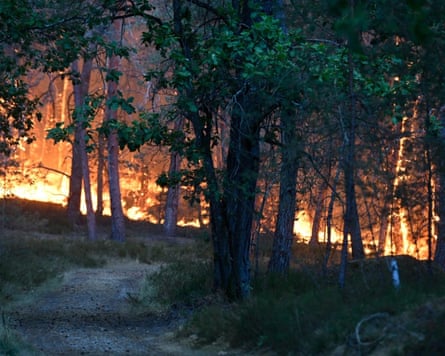
Nuñez said forest fires had burned 32,000 hectares of land in France so far this year, “already more than the 2025 season and it’s only 13 July”.
He added that since the start of the summer 44 people had been arrested across the country on suspicion of being responsible for the outbreak of fires.
High-speed rail was affected after the fire broke out on Sunday because key lines pass near the forest. The French rail company SNCF said there were delays of up to eight hours for trains arriving at or leaving from Gare de Lyon in Paris. On Monday morning, rail services were returning to normal.
Half of the 700 residents of the village of Le Vaudoué were evacuated and firefighters were operating in several other towns in the area, the local Seine-et-Marne fire service said.
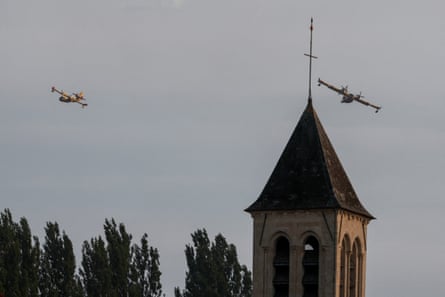
Without the use of firefighting planes, other villages would already have been evacuated, said Olivier Compta, who was overseeing the firefighting operation.
About 400 firefighters have been working to contain the fire, which ignited two days before the 14 July Bastille Day national holiday.
Eric Brocardi, a spokesperson for France’s national federation of firefighters, said it was the first time firefighting planes had been sent up from the normally drier and hotter south of the country to extinguish fires in the Paris region. Two firefighting helicopters and an observation aircraft were also helping to tackle the blaze, he said. “The aim is to save lives and property.”
Earlier, firefighters dealt with a fire that had blocked a highway running east from Paris and disrupted a high-speed train line to the south of France.
The Paris region, along with large parts of the rest of France, has had a succession of heatwaves since May. Temperature records have also been broken in several other countries across Europe and the heatwaves have caused thousands of excess deaths, according to estimates in Spain, France, Belgium and Britain.
In Spain, where 13 people are known to have been killed by last week’s deadly wildfire in the south-eastern region of Almería, and where 10 people are still unaccounted for, the prime minister, Pedro Sánchez, renewed his calls for joint national action to address effects of the climate emergency.
“A third of all the land that burned in Europe last year was here in Spain,” he said during a visit to the affected area on Monday morning. “That’s not just down to the fires that have traditionally happened; it’s also due to a worsening because of climate change that’s happening across the Iberian peninsula and especially in Spain.”
Sánchez repeated his calls for a “state pact” to tackle the changing climate. “It’s not just about reacting when these fires hit; it’s also about preventing them, building perimeters, and about teaching people how to react when a fire – or any of the civil emergencies that are unfortunately becoming more common – hits.”
He added: “I’ve said it many times before, but the climate emergency kills. We’re seeing that across Europe and we’re seeing that in Spain.”
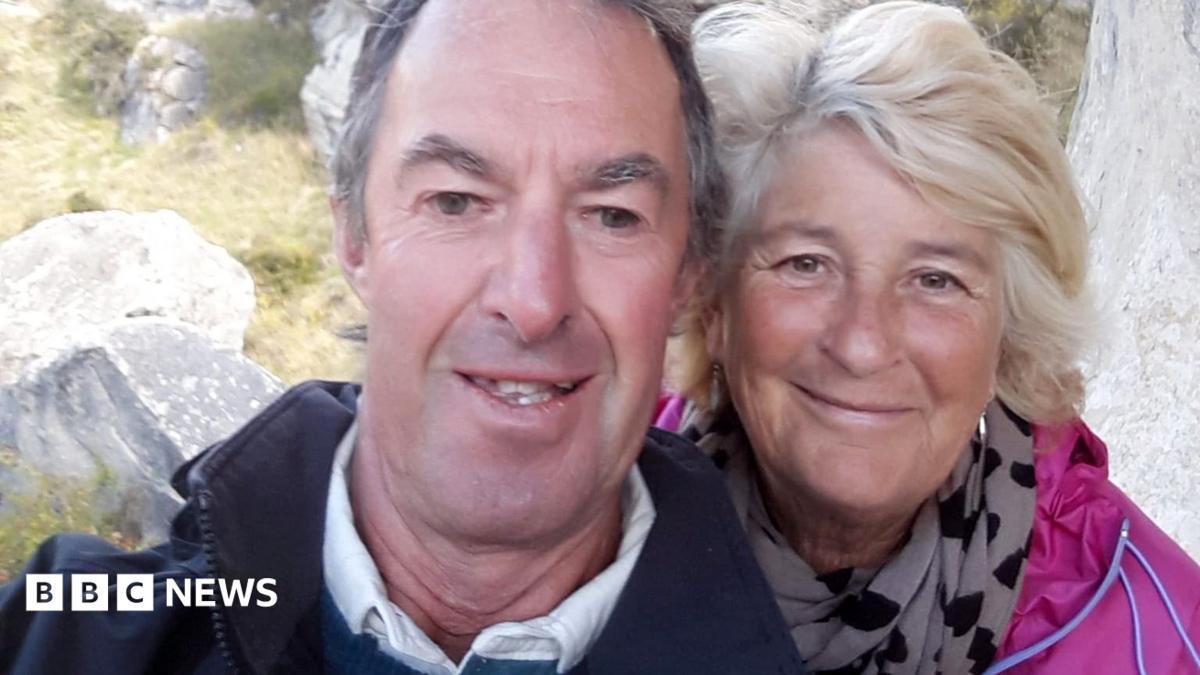
Forensic experts said on Monday that they had identified six of the 12 bodies recovered from the fire zone. The six include two British women and one British man. One of the British women was married to a Spaniard whose remains have also been identified. The others were a French woman and a Belgian man.
The June heatwaves that hit Europe would have been “virtually impossible” without climate change, the World Weather Attribution group of scientists has said.
Human-caused climate breakdown is supercharging extreme weather across the world, driving more frequent and more deadly disasters such as heatwaves and wildfires.