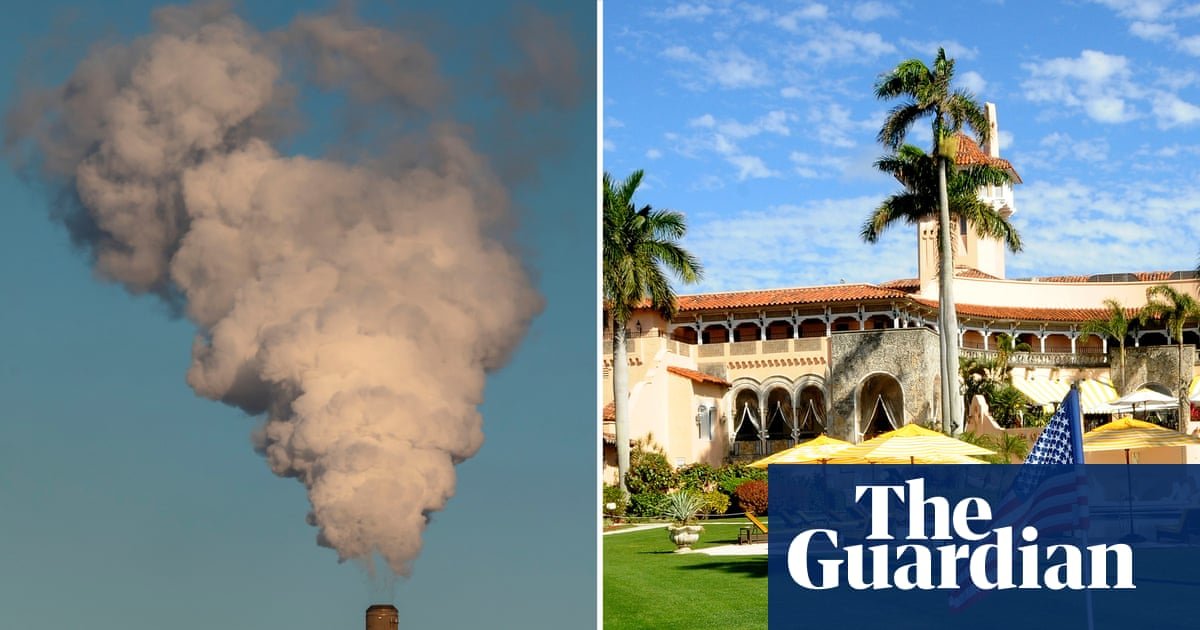
Smoke billows from a power plant, left; Trump’s Mar-a-Lago resort, right.
The senators condemned the administration for refusing to cooperate with congressional oversight.
Senators’ report says taxpayers face higher bills after ‘bargain’ between president and major polluters The fossil fuel industry secured an estimated $190bn in tax breaks and subsidies over the next decade after responding to Donald Trump’s pre-election call for major campaign donations, leaving American taxpayers to shoulder higher bills and public health costs associated with pollution, according to a new report.
Released on Thursday by Senator Sheldon Whitehouse, ranking member of the Senate environment and public works committee, and Senate Democratic leader Chuck Schumer, the report details what the senators describe as the fossil fuel industry’s expansive influence over the Trump administration.
Pointing to Trump’s April 2024 fundraiser at Mar-a-Lago, Florida where he reportedly asked industry executives for $1bn in campaign contributions, in exchange for tax breaks and deregulations, the report said: “Big oil delivered in the hundreds of millions.” The senators said: “The Trump administration has delivered right back, handing polluters benefits worth hundreds of billions of dollars.
That bargain came at a price, and American families are the ones paying it: higher energy bills and higher costs associated with increased damages from climate change and air and water pollution.” The senators also cited the Trump administration’s “near-total refusal to cooperate with legitimate congressional oversight”, saying it “complicated” their investigation.
The estimate of $190bn savings for industry is calculated from existing tax breaks and subsidies over the next 10 years plus new benefits delivered by the One Big Beautiful Bill Act, according to an analysis by Senator Bernie Sanders for legislation he proposed with Congresswoman Ilhan Omar to eliminate “handouts” for industry.
In addition to an estimated $201m investment in Trump’s re-election campaign, industry executives contributed $19m to his inaugural fund, which the report described as “the largest political investment the industry has ever made”.
In exchange, the report said Trump appointed 26 senior officials – all of whom had previously worked for fossil fuel, chemical, or other polluting industries – across various government agencies including the Environmental Protection Agency, as well as the energy and interior departments.
The report also noted that the fossil-fuel industry secured various policies that would curb competition from clean energy, increase gas and coal consumption and “force Americans to spend at least $580bn in added fuel costs alone over the next three decades”.
As part of Trump’s “big, beautiful” domestic spending bill, signed last July, the government created a $1bn direct subsidy fund for fossil fuels, using the Defense Production Act authority to “funnel taxpayer money into propping up fossil fuel projects” considered economically risky by private capital markets.
The act also provides a permanent 20% business income deduction for oil and gas companies, which the report said would cost the government an estimated $737bn overall.
Trump gives a pen to a coalminer after he signed an executive order supporting coal-fired power plants in February.
The senators noted that “the rules at issue were designed to limit emissions of known neurotoxin and carcinogens”.
It also highlighted that the Trump administration repealed federal vehicle greenhouse gas standards and moved to roll back emissions rules for power plants and oil and gas facilities.
While the Trump administration estimated the changes would save Americans $1.3tn, the report cites an EPA estimate of $1.5tn in additional fuel, repair and maintenance costs for consumers.
Separately, the EPA estimated that the repeal would result in at least $580bn in additional fuel costs over the next three decades.
The report describes the policy as potentially the “single largest payback” the Trump administration has provided the fossil fuel industry.
Moreover, the report found that the Trump administration’s attacks on fossil fuel competitors include paying companies $1.8bn in taxpayer funds to cancel wind projects across the country.
As of May, more than 160 projects – all proposed on private land – had been frozen.
According to the report, the stalled projects represent approximately 30 gigawatts of generating capacity, $54bn in capital investment, and enough electricity to power more than 8.5m homes.
The report also pointed to Trump’s own pledge earlier this year: “My goal is to not let any windmill be built.” The report said: “The buyouts follow the same structure: taxpayer money is used to buy off fossil fuel’s low-cost clean energy competition – a double hit, first to the public treasury, then to the electric rates.” In the second Trump administration, environmental enforcement has also weakened.
The report found that the justice department has brought 76% fewer civil environmental enforcement cases than during Joe Biden’s first year in office, and 81% fewer than during Trump’s first term.
Highlighting the impact of the fossil fuel industry’s influence on Trump and its consequences for the American public, the report stated that Trump’s “polluter-first agenda exposed Americans to price shocks on fossil fuels, heating, food production, and electricity; increased the cost of trucking food to grocery stores; and raised fertilizer prices for farmers”.
One modeling estimate cited in the report found that average household energy bills could be $78 to $192 higher per year by 2035.
Industrial energy costs, meanwhile, are projected to rise by between $7bn and $11bn over the same period.
In response to the report, White House spokesperson Taylor Rogers told the Guardian: “These Democrat senators should do some self-reflection on their ties to the so-called ‘green’ energy industry.
They wasted billions of American taxpayer dollars in the name of the Green New Scam.
“While they are focused on a useless partisan report, the Trump administration is actively working to pass historic permitting reform to help improve energy infrastructure and lower costs.” The administration has hailed its “energy dominance” agenda as delivering for industry, energy workers and saving the US public money in energy costs.
The report, however, said the sharpest increases could ironically fall on Republican-led states that lack state-level policies supporting renewable energy development.
In addition to rising energy costs, the report pointed to the public health costs associated with Trump’s policies, noting that fossil fuel-related air pollution and climate-related harms cost approximately $820bn annually, or roughly $2,500 per person in additional health costs each year.
“Even if Americans do not suffer from polluter-driven heart or respiratory disease, they pay more as health insurance companies spread around those costs,” the report said.
Homeowner insurance costs are also rising as climate-driven disasters become more frequent and severe.
The report noted that the average American homeowner now pays “about $2,948 per year in insurance premiums, nearly 12% higher than just one year ago”.
The report also found that in 2025, fossil fuel companies paid more to shareholders than the direct damages attributable to extreme weather in the US, despite surges in hurricanes, wildfires, floods, heatwaves and droughts.
Several environmental advocacy organizations have criticized the Trump administration in response to the report.
Climate Power spokesperson Alex Glass told the Guardian: “This report lays it out in black and white.
The Trump administration isn’t setting energy policy; the fossil fuel industry is writing it for them.
Fossil fuel money bought access, and fossil fuel executives got the keys to the agencies meant to regulate.” Similarly, Mahyar Sorour, the director of beyond fossil fuels policy at the Sierra Club, said: “This report elevates a troubling reality: while fossil fuel companies throw money at politicians to fulfill polluters’ wishlists, American families are left paying for an energy system that puts corporate profits ahead of public health.
“It’s time to make polluters pay.” Meanwhile, David Arkush, director of Public Citizen’s climate program, told the Guardian: “The campaign contributions to Donald Trump by big oil have paid dividends, and have allowed the fossil fuel industry to continue to pollute our communities … Every American family struggling with high costs is suffering because of the corrupt relationship between Donald Trump and the fossil fuel industry.” Explore more on these topicsUS politics Fossil fuels Donald Trump Energy news Share Reuse this content