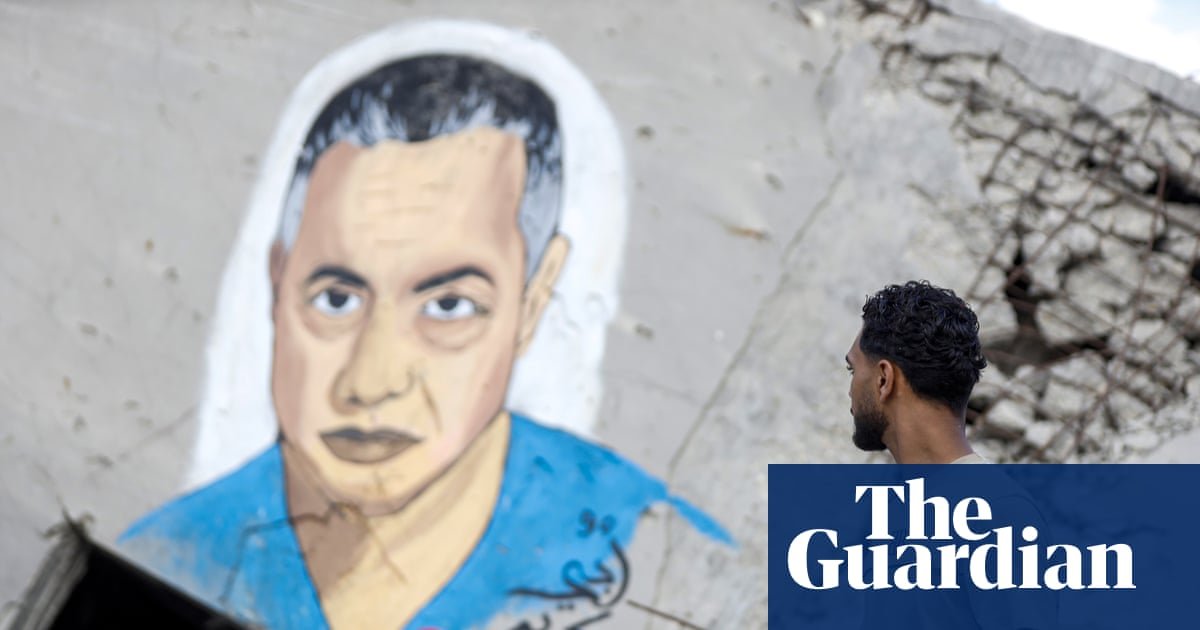
A mural of Hussam Abu Safiya painted on a bombed building in Gaza City.
The senior doctor was detained by Israeli forces in December 2024.
Independent Israeli professor says Hussam Abu Safiya’s life will be at risk until he receives proper medical treatment An independent professor who reviewed the medical records of a prominent Gaza doctor held in an Israeli prison without charge for nearly 23 months has raised serious concerns about his health.
Hussam Abu Safiya was detained at work on 27 December 2024 and later held in solitary confinement at Rakefet, a notorious underground prison.
During a visit by a lawyer from Physicians for Human Rights Israel (PHRI) in the summer, the doctor told of harsh conditions, untreated medical problems and severe food shortages.
Witnesses said he had become almost unrecognisable.
Nearly 700 days after his arrest, Israeli authorities have yet to bring any formal charges against Abu Safiya, who is the director of Kamal Adwan hospital in northern Gaza.
He was classified as an “unlawful combatant” along with more than 375 medical workers – a designation Israel has used to justify prolonged detention without trial.
Last month, Israel’s supreme court rejected a petition to release the doctor.
Over the weekend, a district court rejected a separate petition to allow Abu Safiya an independent medical examination, despite troubling findings in his medical records that were not adequately investigated, according to Prof Amit Tirosh, an independent Israeli specialist who reviewed a file obtained by PHRI.
Hussam Abu Safiya, right, shows a UN delegation around the Kamal Adwan hospital in northern Gaza in September 2024.
His family have not been able to communicate with him directly in detention.
“Continuous food deprivation and weight loss, repeated beatings and injuries, with inadequate medical care, can definitely cost Dr Abu Safiya his life,” Tirosh said.
“According to PHRI records, more than 100 prisoners died in Israeli facilities between 2023 and 2025 … a threat to his life unfortunately cannot be ruled out.” Tirosh identified insufficient investigation of chest pain, delays in treating scabies and a drop in haemoglobin levels that warranted further examination.
“A 14kg weight loss is very alarming, even more so if the cause is unknown,” he added.
“More troubling, the medical team was neither surprised nor concerned: one prison physician wrote that his weight loss over a year is ‘a common trend among security prisoners associated to their diet’.
“Haemoglobin dropped between February and July 2026, long after the weight loss, so detention or starvation alone cannot explain it; it coincided with the reported beatings in Rakefet.
“Such blood loss can be life-threatening and requires urgent ER evaluation.
Per the records, these urgent problems were not addressed and could endanger his life.” Medical records documented bruising around one of Abu Safiya’s eyes, dizziness and rib pain in July.
He told his lawyers he had been beaten by prison guards but Tirosh said the records did not explain his injuries.
The district court ruling also revealed allegations made by Israeli authorities that Abu Safiya had exaggerated his medical problems, set up organisations from prison, influenced other prisoners and maintained international contacts.
PHRI said the Israeli allegations did not justify denying him an independent medical examination, a right protected by law.
“The bottom line is that a third party should see him and the full medical records,” said Tirosh.
‘‘Refusing an independent examination is never justified.
“To the Israeli prison system authorities I would say that I feel deep shame to be counted with them as a doctor or health provider in Israel.
As a system, they betray every medical and ethical principle I stand for.” The Israeli prison service did not immediately respond to a request for comment.
Abu Safiya had become the face of health workers struggling to treat patients throughout the war in Gaza before his detention.
He is being held indefinitely, along with thousands of other Palestinian civilians, in prisons that Israeli rights groups say have become torture camps.
At the time of his arrest at work, Abu Safiya was wearing a white medical coat that he had refused to wash since his son, Ibrahim, was killed by a drone strike at the hospital entrance that October.
Abu Safiya had helped keep the hospital running through more than 80 days of siege and attacks by Israeli forces amid an intensive military operation in the surrounding refugee camp.
“Fourteen Palestinian doctors, including hospital directors and specialists in essential medical fields, remain imprisoned without charge or trial at a time when Gaza’s healthcare system desperately needs them,” said Naji Abbas of PHRI.
A spokesperson for the Israeli prison service (IPS) told the Guardian the allegations are “part of a broader campaign aimed at discrediting the state of Israel” and that the IPS “operates in accordance with the law and under constant judicial oversight”.
Abu Safiya’s family have not been able to communicate with him directly in detention.
Explore more on these topicsGaza Israel Middle East and north Africa Palestine Doctors Pre-charge detention Human rights news Share Reuse this content