Students are demanding a chief election officer and faster union polls.
Protesters were detained as students raised slogans of ‘Delhi Police, go back.’ Updated on: Oct 26, 2026, 16:49:32 IST By Gargi Shukla Prefer HTon Google Share via Copy link Hours after Delhi's Jamia Millia Islamia announced the resumption of student union elections after a nearly two-decade hiatus, fresh protests erupted on campus on Monday as students demanded a time-bound election process and the appointment of a chief election officer.
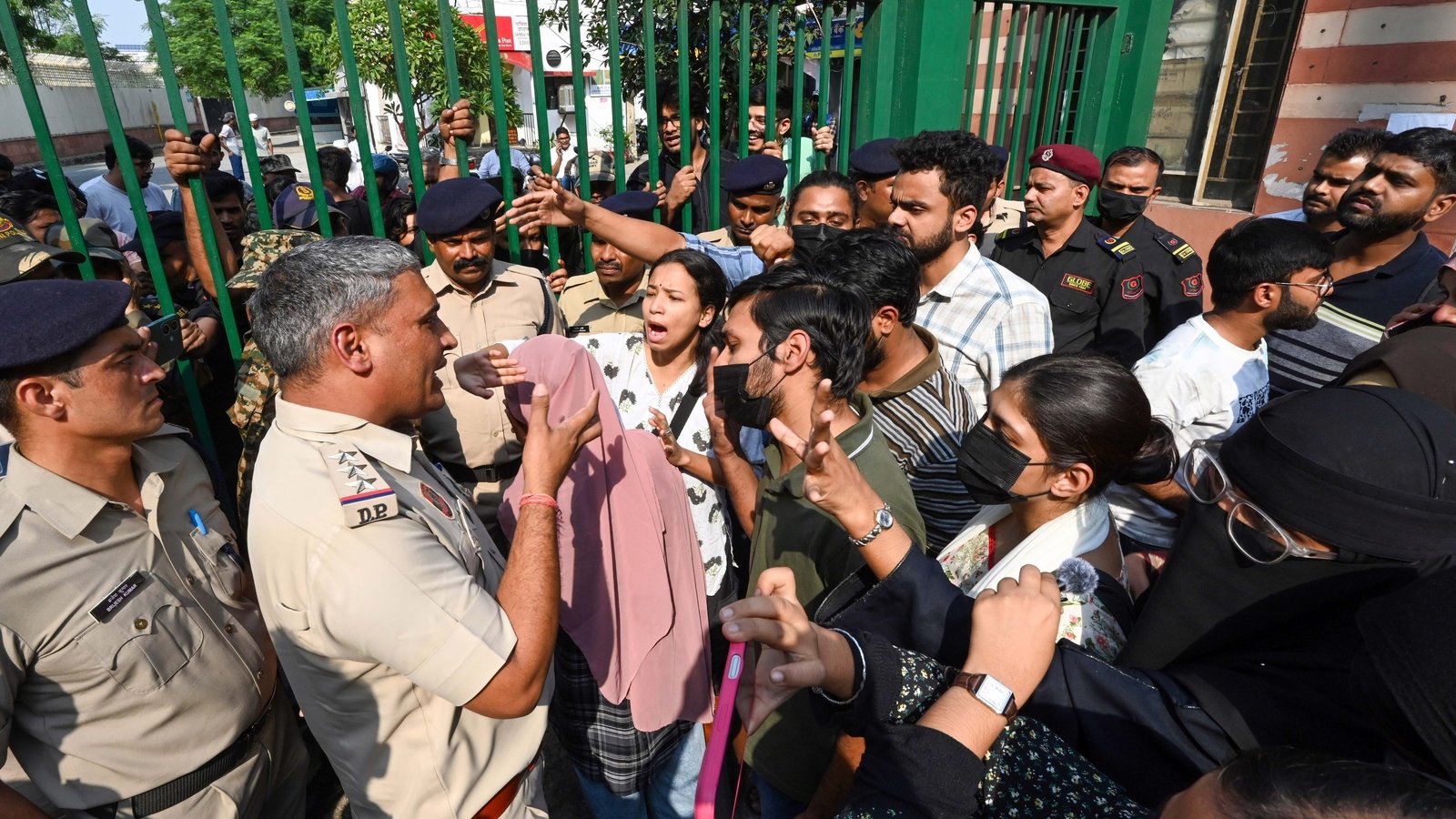
Students of Jamia Millia Islamia stage a protest demanding entry to their campus amid an ongoing strike, as security personnel allow only hostel residents to enter the campus in New Delhi. ( Arvind Yadav/ Hindustan Times) Earlier in the day, around 100 female students entered the campus through different gates, with some gathering outside Gate no.
7, while several protesters were also detained by the Delhi Police.
The students raised slogans of “Delhi Police, go back” as tensions continued over the restoration of the Jamia Millia Islamia Students’ Union (JMISU), whose elections have not been held since 2006.
“We want the administration to appoint a chief election officer and fast-track the election process.
Until then, the protest will continue,” Asif Khan, a student at JMI’s Faculty of Law, told HT.
The absence of an elected student body has left students without an effective channel to communicate their grievances to the university administration, a 20-year-old student told HT.
“From admissions to hostel seats to food in the mess, there is a problem with everything at Jamia.
We don’t have anyone between us, the students, and the Jamia administration.
We want a union to bridge that gap,” the student said.
Students protest at JMI. (HT)
The announcement came after nearly two weeks of protests and hunger strikes on campus over the restoration of the JMISU.
The decision followed nearly five hours of negotiations between student representatives and university officials.
The administration also revoked suspension orders and show-cause notices issued to some students and assured an inquiry into the conduct of security personnel during the protests.
“The Jamia Millia Islamia Students Union Election will be held after 15 days, from the date of approval of the constitution of the students’ union.
Suspension and show-cause notices issued to students are hereby revoked.
A committee shall be constituted to enquire into the actions of security staff during the period of protest,” JMI registrar Professor Mahtab Alam Rizvi said in a statement.
The university also asked the protesting students to issue an apology through a press conference for any defamatory statements, actions or social media posts directed against the administration during the agitation.
On October 21, the university constituted a committee to draft the union’s constitution.
Students, though, continued to demand a formal notification and a clear timeline for the elections.
Four students subsequently launched an indefinite hunger strike.
Following negotiations with university officials that continued until around 4 am on Monday, two students ended their hunger strike, while Ebin Basil and Rehan Khan remained on strike, according to the students.
Despite the administration’s assurance on elections and the withdrawal of disciplinary notices, the protesters said several demands remained unresolved and refused to call off the agitation.
Their demands include the suspension of online classes, the reopening of canteens and the library, a defined timeline for approval of the students’ union constitution, and the resignation of the chief proctor.
Earlier, the university shifted classes across all courses to online mode with immediate effect, citing students' safety due to escalating tensions at the protest site.
It had also advised students to avoid visiting the campus, with gates and libraries set to remain closed until further notice.
Deep Dive Powered ByAsk HT ABOUT THE AUTHOR Gargi Shukla Gargi Shukla is a correspondent with Hindustan Times.
She reports on schools, colleges and issues that affect students, teachers, parents, and educational institutions in India's capital.
She closely tracks the political economy of education, student politics, and policy developments shaping the sector in Delhi.