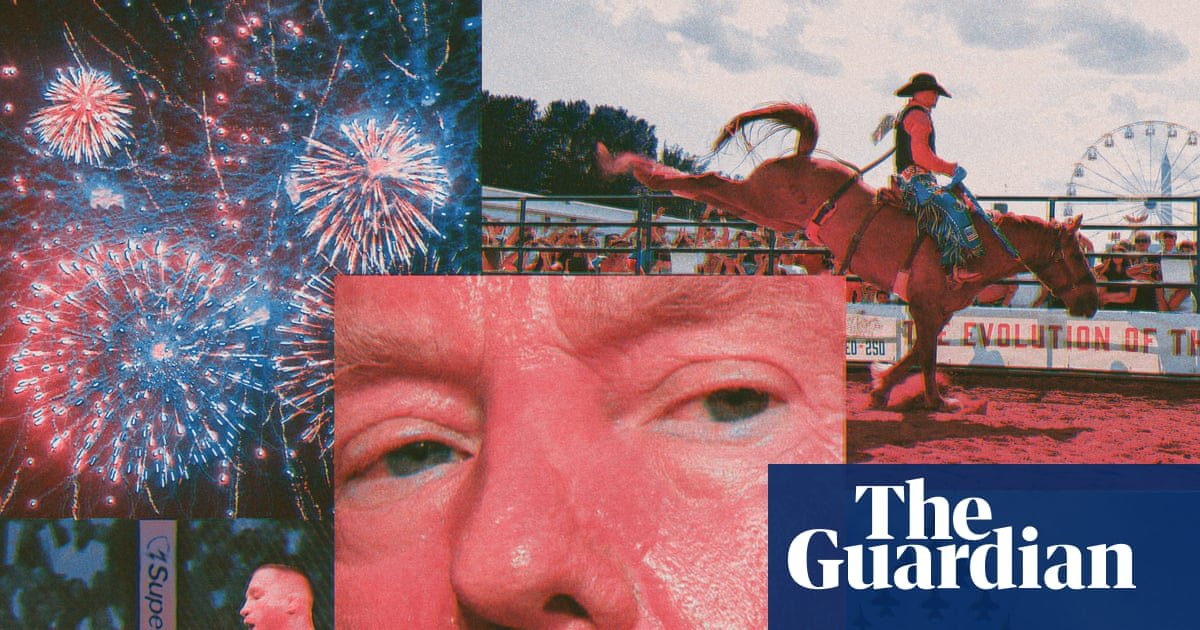
Donald Trump is making the 250th birthday of the US all about him.
Illustration: Guardian Design Donald Trump is making the 250th birthday of the US all about him.
Illustration: Guardian Design Friday briefing: The US at 250: who gets to tell the story?
In today’s newsletter: As official celebrations spotlight a narrow cast of white heroes, communities across the US are reclaiming the histories that Freedom 250 leaves out Good morning, and a very happy 250th birthday to the United States of America.
If you prefer to celebrate with cage fighting on the White House lawn, an IndyCar rally through the streets of Washington DC, or simply by watching the president do his lonely bop to YMCA at a sparsely attended state fair, so much the better.
It takes a special kind of someone to make the semiquincentennial birthday of a nation of 349 million people, from a whole variety of backgrounds, all about himself.
But he wouldn’t be the only one centred on a very particular (white, male, Christian-centric) view of how the nation came to be.
Remembrance is a political act, and I wanted to know what the 250th means to all Americans.
So I booked a transatlantic call with Melissa Hellmann, senior reporter on the race and equity team for Guardian US.
We spoke about how the communities she reports on feel about this birthday season, and the brutal history and present rollback of rights that runs directly counter to America’s founding principle that all are created equal.
But first the headlines.
Five big stories UK news | Women from Black and Asian backgrounds are less likely than their white counterparts to receive an epidural while giving birth, research has revealed.
Ukraine | Ukraine and Russia have promised fresh assaults after Moscow launched a huge barrage on Kyiv, killing at least 27 people, tearing open apartment buildings and sending tens of thousands of people to shelters.
UK news | Criminal investigators in the UK say they have uncovered a “truly international network” of organised drug-facilitated sexual assault in which victims are sedated before being raped and sexually assaulted.
UK politics | Keir Starmer has formally apologised for the British state’s role in past forced adoptions after decades of campaigning by mothers and children affected.
World news | A rescue team pulled a 43-year-old security guard alive from a collapsed basement, ending an operation that became a symbol of hope after the devastation of twin earthquakes that struck Venezuela.
In depth: ‘The executive branch is ignoring history that tells the full story of America’ There is a large section of America’s past that Trump is trying to erase.
Photograph: Castle Light Images/Alamy Melissa lives in Philadelphia, where the Declaration of Independence, drafted by Thomas Jefferson, was adopted by representatives of the 13 colonies seeking freedom from the British empire on 4 July 1776.
One of many landmarks across the city is the President’s House, where the first US President, George Washington, resided when Philadelphia was the capital in 1790s – along with nine enslaved people who worked as staff there, under specific conditions which would ensure they remained slaves even after Pennsylvania’s Gradual Abolition Act was passed, setting terms for their freedom.
Their lives were, until recently, acknowledged on information plaques.
But, as Melissa reported earlier this year, following Trump’s executive order titled Restoring Truth and Sanity to American History, in January the National Park Service used hand tools to pry off these plaques and, while the city of Philadelphia challenged the edict through the court, for now those information panels remain in storage.
As tourists flock to this national memorial ahead of 4 July, Melissa tells me what they see: “There are printed out pieces of paper taped up, I believe by local activists, that say: ‘This is where these plaques used to be, and this is why they’re important’.” “A lot of people just feel that’s a slap in the face because for years activists fought to have those plaques displayed in the first place, and they say that the executive branch is basically ignoring this entire part of history that tells the full story of America”.
Reclaiming the whitewash, only not that Those guerilla explainers at the President’s House are a neat example of how many Americans have endeavoured to wrest back the telling of their nation’s story this year as the Trump administration presents a sanitised version of patriotic – mainly white and male – heroes via the official White House series of events called Freedom 250.
The centrepiece of Freedom 250 is a fleet of 18-wheeler mobile museums, or “Freedom Trucks”, travelling across the country in the run up to 4 July, offering a homage to American achievement.
They are particularly notable for their absence of any critical examination of race, slavery or civil rights.
It’s what Princeton professor Eddie Glaude Jr describes in a recent Guardian interview as “active forgetting”.
“What has to happen here in order to protect the innocence of the country?
Black folks have to be disappeared.
We have to be made to play minor parts in the story.” “I hear a lot of people talking about this paradox of America being found at a time when there was enslavement, and then the censorship around that with these celebrations,” Melissa tells me.
“I’ve been talking with different communities that are trying to highlight that paradox”.
She’s currently working on a story about the contribution of the Gullah Geechee people to the American Revolution.
These are descendants of formerly enslaved people in the US south-east, with whom the Guardian is working as part of the Scott Trust’s restorative justice programme.