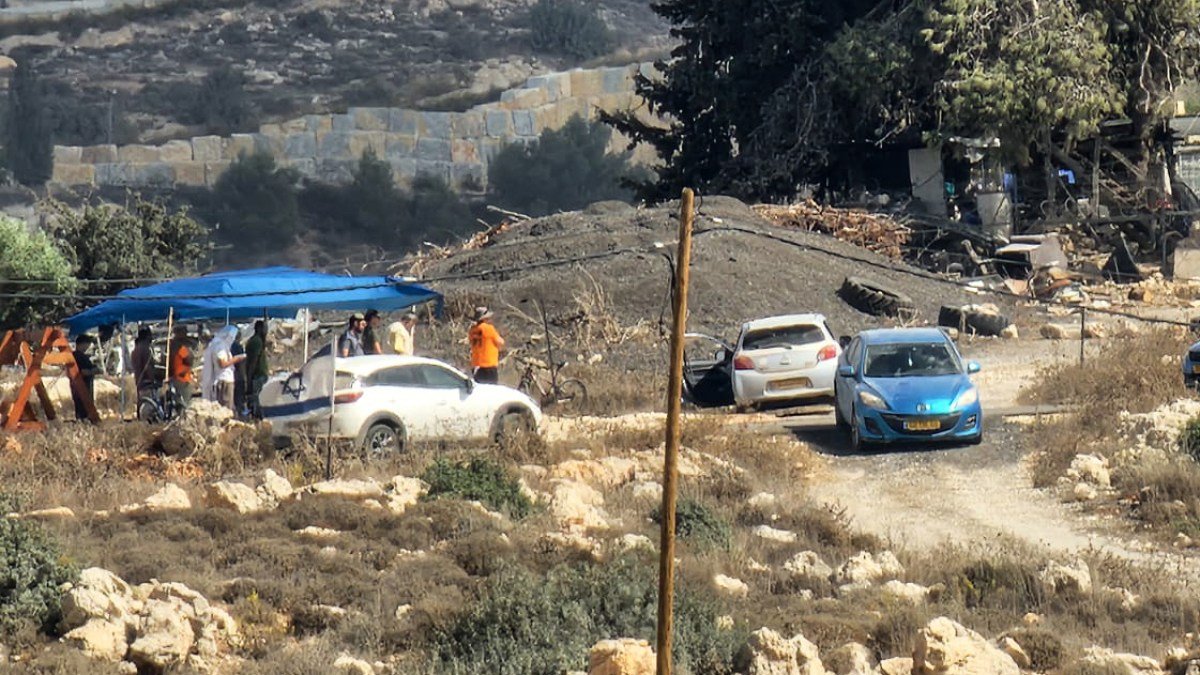
Israeli settlers posted outside the Abayat home in Umm Safa, northwest of Ramallah, occupied West Bank [Al Jazeera] By Al Jazeera Staff Published On 21 Oct 202621 Oct 2026 Yousef Shanaran, 52, built a well beside his house, which he can no longer reach.
Since October 5, Israeli settlers have besieged his family home in Wadi Rakhim around the clock, a once-quiet corner of the South Hebron Hills among limestone rocks and thorny brush.
They are unable to go outside on their own, even to fetch a little water from the well.
It took five days for the army to coordinate the family’s access to the well.
After running out of water three days earlier, the Israeli army on Tuesday allowed them to retrieve some from the well.
“Food, there’s none,” Shanaran, who built the sturdy two-storey house in 2016 on land between the Palestinian town of as-Samu and the village of Susiya, planting about 70 grapevines and 30 to 40 olive trees, told Al Jazeera by phone.
“My well, full of water; I built it and lost money on it,” he said.
“They keep me from it because they want to get me out of my house.” More than half a year ago, settlers pitched a tent 300 metres (about 1,000 feet) from the Shanaran residence, restricting the family’s movement and exposing them to attacks and intimidation.
On October 5, the tent was moved just 30 metres from their home.
That day, about 50 settlers attacked the family with sticks and pepper spray.
This marked the beginning of the full siege on Shanaran’s home.
Yousef Shanaran, whose home has been besieged by Israeli settlers [Al Jazeera] A siege the army ‘doesn’t recognise’ Nasser Nawajeh, a longtime B’Tselem field researcher who now heads the Susiya village council in Masafer Yatta, has tried to deliver supplies to the Shanaran family during the siege, but most attempts have failed.
“Once I tried to bring aid to the people, and right away there was an attack from the settlers,” he told Al Jazeera.
“I mean they’re there 24 hours to attack.” Advertisement Nothing can move in or out of Shanaran’s home without the army’s permission.
“This is a displacement policy,” he said.
“If they want to take the kids out to school, we have to wait for the army to take them.
If you want to bring in food or water, we have to do coordination.” Since October 15, he has kept asking the army for coordination to deliver supplies to the family — and given excuses each day: “‘The army’s busy, can’t come, there aren’t any forces’ — they tell us ‘tomorrow and tomorrow’,” he said.
There are now two armies to contend with, Nawajeh said: the settlers’ regional units, the Kitat Konenut, meaning rapid response squads in Hebrew; and the regular army, which “comes, demolishes [the settlers’ tent] and leaves”.
When the soldiers leave, the settlers simply pitch up their tent again.
Shanaran said the soldiers stationed outside his house do nothing.
“They stand and sit, eating and drinking, relaxed, at the door of the house,” he said.
Nawajeh said the soldiers’ presence essentially amounts to a green light for the siege to continue.
“Sometimes the soldiers don’t even stop the settlers coming close; they hit people and sit with the soldiers at the door,” he said.
As the house is in Area B, an area technically under joint Israeli-Palestinian control, the army could arrest all the settlers as there is a closure order against them.
“But there’s no enforcement of these laws,” he added.
The soldiers posted outside the family home see their ostensible job as shielding the family from a beating, not ending the blockade.
“In practice, the Palestinians are living in a prison inside.
The siege is basically a prison,” he added.
Shanaran said his family, trapped in their home, is living a life worse than prison.
“Prison ends.
Here, you’re sitting in your own house, and they’ve locked you up in it — and you’re afraid,” he said.
Nasser Nawajeh tries to bring supplies to Yousef Shanaran, but is often unable to get past the siege on the latter’s house [Al Jazeera] ‘If they drive out the first house, they drive out the second’ The Shanaran home is the closest Palestinian one to the outposts encroaching on it, Nawajeh said.
Settlers see no difference between Area A, intended to be administered by Palestinians, Area B under mixed Israeli-Palestinian authority, and Area C, which is fully under Israeli military and civil control.
“They start with the house on the edge, in the corner.
If they drive out the first house, they drive out the second,” he added.
This tactic is now being applied in Masafer Yatta, an area south of the occupied West Bank which has come under repeated Israeli settler and military attacks.
Advertisement Following similar sieges further north in Jalud, where the Tubasi family was forced from their home in July and attacked in September when they tried to return under a court order, and in Qusra, where settlers besieged three homes, one owned by an American citizen, before the army set up barracks beside the besieged homes.
B’Tselem’s Yair Dvir believes that the fact that the Qusra siege drew wide coverage was because one of the Palestinians involved held US citizenship.
“In reality, attacks like these occur continually across the West Bank,” Dvir said.
Settlers have now built more than 400 outposts across the West Bank, isolating Palestinian homes and communities through their control of nearby hilltops and pathways.
Dror Etkes, cofounder of the settlement-monitoring group Kerem Navot, said, with Palestinians surrounded, these doorstep sieges reflect “an advanced stage of the complete collapse of any rule of law, any attempt to enforce law in the West Bank”.
Violence that once kept Palestinians off open grazing and farmland is gradually moving into built-up areas, Etkes said.
Driving whole farming communities off their land in one fell swoop is still beyond settlers’ reach, he said, but “what they’re trying to do right now is to expel certain families … who are residing outside of the big cluster of a built-up area”.
At the eastern end of the farming village of Umm Safa, northwest of Ramallah, stands the home of Muhammad al-Abayat.
The family has lived there since 1973, before the nearby illegal settlement of Ateret was established, according to the village mayor, Marwan Sabah.
It now sits between Ateret and one of the six outposts surrounding the village.
Late in September, Israeli settlers pitched a tent at the family’s door, then fixed a gate blocking the path to their home, where 15 people live.
The children cannot get to school, and al-Abayat’s wife is ill and needs an operation.
“Even his kids are banned; the family can barely get the basic supplies to him,” Sabah said.
Anyone who tries to reach the family is attacked or pepper-sprayed.
The village won a court ruling and a police decision to open the gate, but “the settlers lock the gate themselves most of the time”, he said.
The mayor says the village as a whole faces a “suffocating siege”, with illegal outposts surrounding it and military support buttressing them.
“Right now all of Umm Safa’s land is under the settlers’ control, including the village cemetery,” he said.
Now that the harvest is under way, “all the olives are in their hands”.
Even basic services are becoming impossible, “all the rubbish — we can’t get it out”, he added.
Amid the settler siege on October 20, the Israeli Civil Administration issued a demolition notice for the Abayat family home.
When the army carries out the siege In Madama, south of Nablus, settler outposts in Area B to the north and west, along with an illegal settlement and bypass road to the south, have surrounded the village.
On October 12, the army sealed all three main entrances to the village with earth mounds.
On the same day, a weeklong siege of neighbouring Burin was lifted.
Advertisement This forced villagers, including teachers, women and children, to quickly cross the mounds on foot while two cars waited on either side, said Wail Qut, a Madama resident and lawyer with the Jerusalem Legal Aid and Human Rights Center (JLAC), which is challenging a new Area B outpost near the village before Israel’s High Court.
A teacher was beaten by settlers while trying to cross, he said, and two dialysis patients now face a far longer route to the hospital where they need regular treatment.
On October 18, a bulldozer that villagers say came from the Yitzhar illegal settlement shut the last road in use – a backroad towards Asira al-Qibliya, uprooting nearby olive trees.
According to Qut, the army’s District Coordination Office told the mayor the barriers would stay until “the farmers don’t go to their land [during the olive harvest], especially in the north”, where the settler outpost in question lies.
“I’ve lived here all my life, and this is unprecedented for Madama village,” Qut said after the backroad was sealed.
“The settlers are seizing a golden opportunity.
No deterrence from the Israeli government … they are just trying to do their best before the Israeli election.” Marwan Sabah, mayor of Umm Safavillage, at a previous olive harvest [Al Jazeera] On Tuesday, the northern entrance was finally reopened.
But villagers reported that settlers from the Area B outpost attacked olive harvesters near the approach to the village that evening.
The next day, the military sealed the entrance again, with many olive trees filmed being destroyed in the process.
The siege continues, residents say.
Different stages of the same squeeze Last week, settlers east of Jerusalem strung barbed wire around the Bedouin communities of al-Tabna and al-Muhtawish, near Khan al-Ahmar.
Suleiman Ali Salem al-Arab, known as Abu Ra’id, said their livestock are penned in and have nowhere to graze, and the five-minute trip to a nearby road now takes an hour.
Settlers are driving posts for a fence to enclose the communities completely.
“They put it between the houses and shut people in so they can drive people out,” said Abu Raid.
In Ras al-Ahmar, in the northern Jordan Valley, the siege is closer to dispossessing its inhabitants altogether.
Israeli forces have sealed other access points and confiscated tractors and water tanks as the “Crimson Thread” barrier is built through the area.
According to the Israeli group Jordan Valley Activists, another 11 families have left in the past two weeks, leaving about 20 of the 59 families that originally lived there.
“More than half the families have been displaced because of thirst,” says Thaer Bisharat, a local herder.
“We fast like it’s Ramadan, and the sheep become like camels.” As settler sieges intensify — enabled and eventually replaced by the military itself — Nawajeh fears another wave of Palestinian displacement is under way.
“It’s becoming something normal,” he said.
“Every day dozens of settlers could take a Palestinian house and besiege it.” “Imagine someone set an unjust enemy upon you, pitched a tent under your window, holding a grudge against you,” said Shanaran, from his besieged home.
“Every time you go out, he comes, beats you, or stops you.
How would your life be?”