Good for business – or profit at any cost?
The controversial side of private equity – a visual explainer While it can transform firms for better or worse, the use of private equity in essential services is attracting scrutiny.
Here we examine some of its more contentious elements in the UK veterinary sector Private equity could be the two most controversial words in business.
For its supporters, it can bring investment, expertise and efficiency to a company.
For critics, it is a one way ticket to profiteering, cutting costs and losing staff.
The arguments over private equity are particularly fierce when it is used in the public sector, particularly the NHS.
What is undeniable is that it is everywhere, with one in eight British workers employed by firms funded by private equity.
So what exactly is it?
And why do some aspects of it provoke such strong feelings?
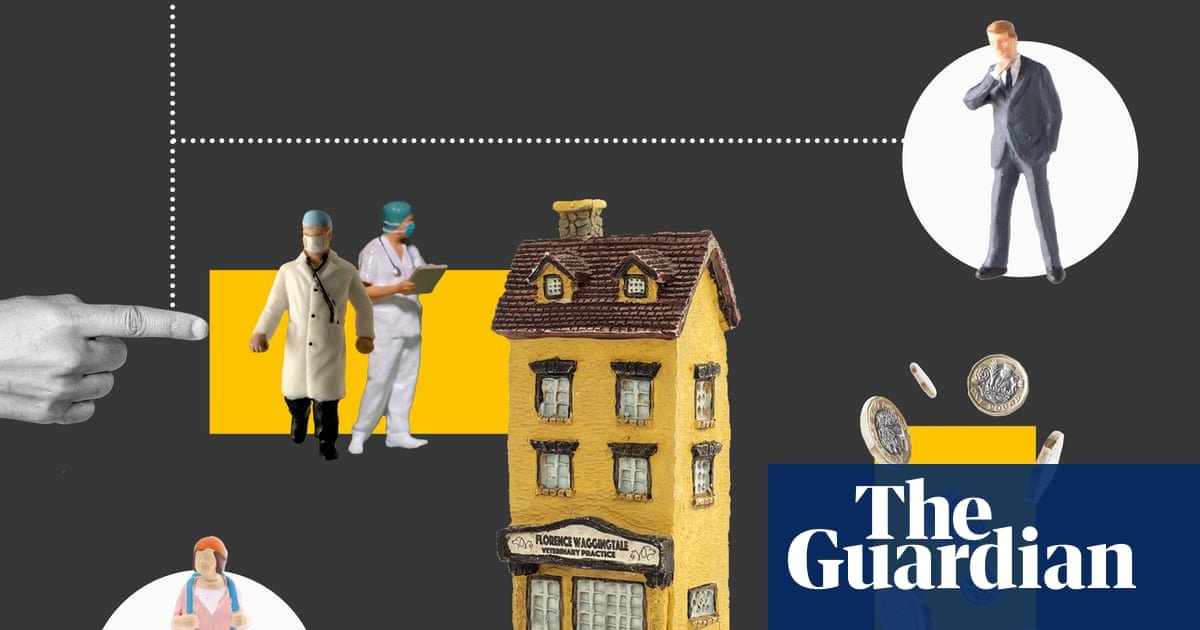
To help explain, the Guardian has created a fictional vet practice to explore some of the controversial practices that can happen within private equity.
The example below is illustrative not definitive, and focuses only on some of the elements that have attracted criticism.
It is a vast, complex industry that is hard to capture, with a range of financing structures and practices.
But this example may help to explain why these three more divisive aspects have drawn attention.
1.
The use of debt Imagine this is the local vet practice where you usually take your dog. (1/10) You’ve been coming here for years, but this time the owner has changed.
You might not even notice. (2/10) But let's look behind the scenes at how this could affect you.
Here's what might happen if a private equity firm were to buy the company using a 'leveraged buyout'. (3/10) In this example a private equity firm has offered £10m to buy out your local practice.
Private equity can sometimes pay significant sums; one vet told the FT he almost “fell off his chair” after seeing the offer. (4/10) The original owner takes the money and exits.
But in this kind of takeover the source of that money is very important. (5/10) In a typical leveraged buyout, only a small proportion of the money comes from private equity.
Usually this is 2-5% of the total investment, according to private equity groups such as ILPA .
In this case, the private equity firm contributes 2.5% of the £10m – £0.25m. (6/10) Then investors usually provide 45–50% of the cash – £4.75m here.
Investors can be high-net-worth individuals or funds such as pension funds.
They invest in private equity because they want a financial return. (7/10) To raise the rest, the private equity company will usually borrow money, often from a bank.
In this case, the remaining 50% (£5m).
Debt is often the key source of funding in leveraged buyouts, but it can be risky. (8/10) The risk tends to sit with the company being bought because the loan (£5m) isn't paid back by the private equity firm, but from the cashflow of the vet business.
In effect the vet business is partially paying for its own purchase.
This ownership structure is one form of private-equity ownership and it can result in companies carrying big debt. (9/10) Straight away, the vet practice will need to start repaying that loan alongside its usual costs.
This can put a strain on the company’s finances, even before the new managers have made any other changes. (10/10) Responding to criticism that private equity’s use of debt places a burden on the companies they buy, James Gribben, a spokesperson for UK Private Capital, an industry body and trade association, says private equity uses “leverage” responsibly.
In finance, leverage is the use of debt to increase returns gained from an investment.
“Responsible use of leverage is about optimising a company’s capital structure to support growth, not placing it under undue strain,” Gribben says: “Lenders undertake rigorous due diligence and will not support transactions they consider over-leveraged.” He adds: “Crucially, private equity firms succeed by building stronger, more valuable businesses over time, so it is firmly in their interests to ensure debt levels are sustainable.” Gribben also says leveraged buyouts are just one of a range of financing structures used by private equity.
2.
Cutting costs As a customer, you may not notice the new ownership.
Private equity-backed companies often don't change the branding of the independent vet practices they take over – something the Competition and Markets Authority (CMA) has asked them to address.
But under the surface things may be shifting. (1/10) While most business owners aim to make a profit, some argue that private equity's incentives set it apart.
"The underlying, very clear incentive of private equity, is profit maximisation in a short space of time," says Dr David Reader, a senior lecturer in law at the University of Glasgow, who is researching private equity in the vet sector. (2/10) Profits can be maximised by cutting costs, and wages are often a company's largest expense.
“Over the last couple of years we’ve seen a lot of people being made redundant,” says Suzanna Hudson-Cooke, of the British Veterinary Union (BVU). (3/10) “Private equity and large corporations generally have tended to reduce non-clinical staff from receptionists to vet care assistants,” Hudson-Cooke says.
“Clinical staff end up doing these roles with veterinary nurses, for example, doing reception.
It has a huge impact on the whole clinic.” (4/10) The business could also save money by delivering services for less.
They can use cheaper supplies, or cut less profitable parts of the business such as 24-hour care. (5/10) Another way to increase profits is to raise prices.
Vet bills in Britain have gone up 60% between 2015 and 2023.
In one example, the Guardian found a cat-owner was quoted £900 to remove plaque from her cat’s teeth.
Not all of the rise can be attributed to private equity, but all three private equity-owned vet groups were part of a category of five that charged on average 18% more than independents, the CMA investigation found. (6/10) Of course, customers could leave and find a different vet. (7/10) But that becomes harder if your vet is bought as part of a “roll-up”, whereby private equity firms acquire multiple practices in a certain area.
According to 2024 figures from the CMA, 44% of small animal practices are owned by private equity. (8/10) There are advantages to being part of a large group: efficiences of scale for example.
But for customers, consolidation can make it hard to shop around for a better deal. (9/10) The financial author Nicholas Shaxson described roll-ups as a "common (and super-profitable) technique in PE-land”.
Roll-ups also exacerbate the pricing problem, says Dr Scott Summers, an associate professor in Law at the University of East Anglia who is co-authoring the private equity study with Reader: "If this happens across the market, pet ownership is going to become something only someone who's incredibly wealthy can afford." (10/10) When asked about the negative side-effects of private equity’s profit maximisation, Gribben says: “Private equity firms professionalise businesses, helping them adapt to the challenges of the energy transition and tech disruption, with both the capital and expertise that makes them competitive.” He adds: “The UK is an open market and roll-ups bring real strategic benefits by helping businesses that couldn’t deliver those capabilities on their own.
“They don’t take competition out of the market, but change its shape with firms still competing alongside new entrants and under the watch of regulators to make sure standards and choice are protected.” In addition to the CMA’s recommendations for the veterinary sector – calling for transparency of ownership and more clearly published prices – there is also a legislative push to set up a new independent regulator for veterinary clinics.
At the moment, individual medical staff are regulated but not the businesses they work for.
3.
Short-term ownership After several years, the private equity firm decides to sell.
The typical private equity holding period ranges from four to seven years, according to UK Private Capital. (1/8) Summers is concerned about the state the veterinary sector will be left in when private equity firms pull out: "They'll actually kill the market because people will stop going.
That's typically when private equity will identify that tipping point, and strategise their exit." (2/8) Let's bring back the investors and the bank that gave money to buy our vet.
Part of the reason private equity sell – or "exit" – after a relatively short period is that investors expect a return on their money. (3/8) Let's say the private equity firm exits by selling the vet to a new owner. (4/8) If the sale is successful, the firm pays back its investors and gives them a return on investment. (5/8) In cases in which private equity bought the company using a debt-funded deal such as a leveraged buyout, the debt remains with the vet practice. (6/8) In an ideal scenario, the vet practice has grown and is a more efficient, profitable business.
In a bad scenario, however, what is left behind is a company saddled with debt and charging customers high prices for lower-quality services. (7/8) And the impact can go beyond an individual business.
Summers fears that rising vet prices could take us to “a point where having a pet is just for the elite". (8/8) In response to criticism that private equity’s ownership model prioritises short-term financial goals over the long-term health of the businesses it buys, Gribben says: “Private equity investment is inherently long term.
Private equity firms hold investments for over six years on average.” He argues that the financial health of the company is critical to private equity.
“Private equity fundamentally needs to create growing companies or businesses with strong growth potential as the more attractive the business, the higher returns it can deliver to investors,” he says.
Previously, the veterinary sector, which comprised of thousands of small businesses run by owners who were also practising vets, had drawbacks for customers and staff, says Dr David Reader, a senior lecturer in law at the University of Glasgow.
“There are benefits to be had from investment from private equity, in fragmented markets [it helps] realise efficiencies,” he says, citing the ability to invest in new medical technology, flexibility and work-life balance for staff, as well as higher pay for some in the sector.
But, in the view of both Dr Reader and Dr Scott Summers, those benefits need to be weighed against the risks.
Especially in sectors centred around care.
“The problem with private equity is it sits at odds with animal welfare, which is the core of this market,” says Summers.
“So there is a question here, I think, a societal question.
Should private equity be involved in those markets?
Does it add enough value given it comes with all those risks?” Words and build: Anna Leach Design: Prina Shah Additional programming: Ed Gargan