Everton’s great lost talent of the 90s explains the drinking culture that enveloped him as a teenager, his time in jail, struggles with depression and how he got clean
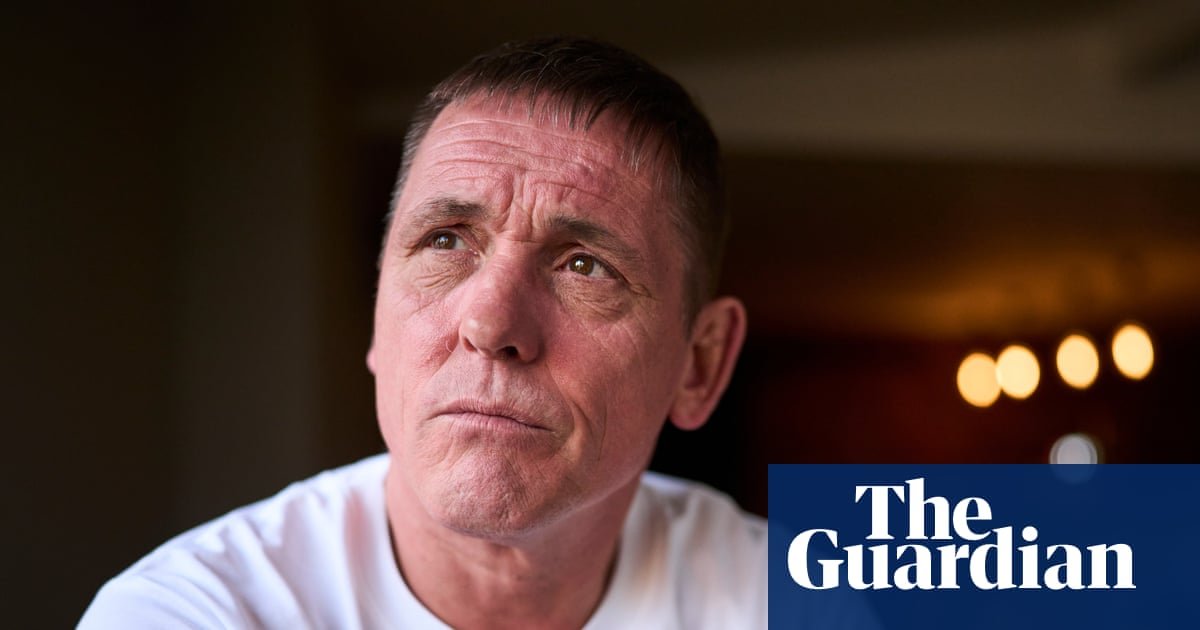
“I was just a kid and no one was there for me,” Billy Kenny says as he wipes away the tears of hurt and regret on a September afternoon in Liverpool. “I’m angry with Everton for not looking after me.
“Listen, I’m no angel. I’ve played my part, but there are other people who played their part in the demise of Billy Kenny. So I’m still bitter and frustrated today, at the age of 53. It was an absolute waste of talent.”
Kenny used to be one of the most promising young footballers in England, pursued by Alex Ferguson at Manchester United, Kenny Dalglish at Liverpool and Howard Kendall at Everton. He chose his beloved Everton and for a few fleeting months his extraordinary talent shimmered – most memorably during a man‑of‑the-match performance against Liverpool at Goodison Park in December 1992.
His teammate Peter Beardsley called him “the Goodison Gazza” in an eerily prophetic comparison. Kenny played once for England’s under-21s in March 1993, but his ravaging fall echoes the addictions and troubles of Paul Gascoigne.
Kenny discovered cocaine in the early hours of the morning after his greatest game, when he had just turned 19. A cocaine habit spiralled out of control very quickly and he retired from professional football two years later. He had played 23 games for Everton, four for Oldham and two for Barrow. Kenny struggled as an addict for years and ended up in prison.
“I’m clean now,” he says. “I’ve been off the drink and drugs, since my ma died 15 years ago.” Kenny looks up. “It’s my ma’s birthday today. I came off the drugs the day of her funeral and she’s given me the strength to stay sober. I just couldn’t do it while she was alive and that’s what kills me.”
Kenny breaks down twice during our interview, but he tells his story with raw force. He was besotted with Everton, but now the club haunts him. “I ended up being a product of Howard Kendall’s environment,” he says. “For years and years I carried all the blame, but there was no help at all.”
He thinks of Michael Branch, another former Everton player who also wound up in jail. “I spoke to Michael last year and he said at Finch Farm [Everton’s training ground] there are 17 people you can speak to about mental health – whether it’s problems with drink, drugs, your family, your girlfriend. There was no one for me.”
How would life have turned out for Kenny if he had been a gifted player today? “I wouldn’t be talking about misery. I would be talking about glory days and winning for Everton. I feel as though it’s been stolen from me and the fans have been robbed of me as well.”
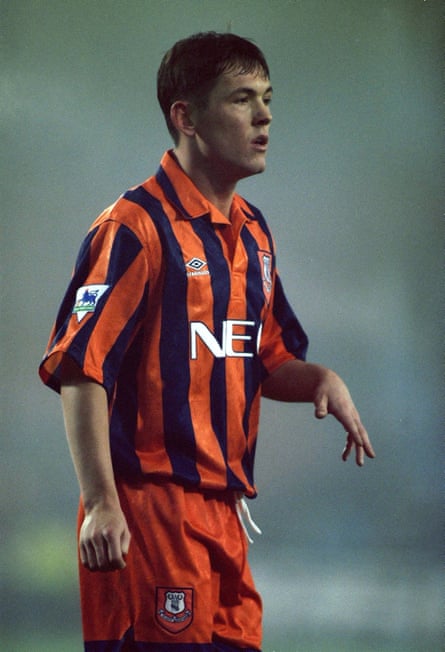
Kenny’s moving new book, written by the Guardian’s Jamie Fahey, who grew up on the same streets in Liverpool, is a penetrating and, yes, sobering depiction of a period in English football when drink addled so many young men. The complex figure of Kendall lies at the broken heart of this story.
“It’s bittersweet when I’m talking about Howard, because I grew up loving the fella,” he says of Kendall, who formed an unforgettable midfield with Colin Harvey and Alan Ball before becoming one of the most successful managers in Everton’s history. “Even today, I’ve got no hatred. He had his own troubles, didn’t he? Where does his alcoholism come from?”
Kenny, at first, hated drinking: “I couldn’t stand it. My dad never touched drugs his whole life, but he would have a couple of pints on a Saturday night. I’d be in bed and my dad would come tell me how good I played for Everton reserves. I had to chase him out because I didn’t like the smell of the ale.
“I then played with my idols in the Everton first team. Kendall always wanted us to go to the Sefton [a pub near the training ground] for a bevvy. As a first-team player I had to go. It was the same for Neville Southall, who never drank. Pat Nevin and Andy Hinchcliffe, too. They’d drop off all the pissed lads at the end. Kendall should have said: ‘Billy, you’re 18, go home.’
“The second time, with the senior pros, I stood with Nevin and the other non-drinkers. But I’ve gone over to the lads with my pint of blackcurrant and lemonade and they’re all laughing at me. A very senior player said: ‘You’d better have a shandy, son, because [Kendall] will sell you if you don’t drink.’
“The next time I dropped my guard, on the ale, and when I got home my head was spinning, spewing up all over my ma’s house. My ma laughed the first time. They really thought I was in a safe place. But I was with a load of alcoholics.
“I don’t care who reads it because I’ve carried this for years. I was just a kid, made up, playing with my idols. If my idols tell me to have a drink I’ll have a drink. I was always drunk from then on.”
In his book, Kenny says “it seemed as though most of the first‑team set-up lived for the booze”.
He describes to me how, for away games, “the first thing on the coach would be the crates of lager and chablis [for Kendall]. On one of my early away games, down to London, I wasn’t really drinking. [On the journey back to Liverpool after the game] I sat in the front with [the assistant manager] Colin Harvey, who I loved. Colin had my best interests at heart and we talked football while they were drinking in the back.
“We came off the M57 and I’m thinking: ‘Where are we going?’ It’s half 11 [at night] and the coach pulls into the Paradox nightclub. That was Kendall, taking us to the biggest nightclub in Liverpool.”
In January 1993, Kenny did well against Vinnie Jones and the hard men of Wimbledon as Everton won away. He injured his ankle, but he writes: “Kendall told me I’d played a blinder. He said the lads were made up with me and how it would be a real shame if I missed out on the Chinese and a few drinks. I could always put ice on my ankle in the restaurant. Then the killer line: ‘You’ll feel much better after a couple of drinks, lad.’”
Five months later, struggling with injury, Kenny lost himself in cocaine and ecstasy: “I started to adore the drugs, the birds and the music more than I needed Everton.”
His compulsive personality led to “three-day benders”, skipping training and disappearing from football. What would Kenny say to Kendall if his manager were alive today? “I’d say: ‘Howard, you should have looked after me. I shouldn’t have been made to feel I had to drink to play for your team.’”
When Everton terminated his contract in 1994 Kenny felt abandoned. “I needed help. I needed support. Empathy. Guidance. I received none of it.”
He explains: “Everton sent me to the Priory in Cheshire. But I’m 19 and in group therapy with 60‑year‑old alcoholics who’ve been hiding bottles of scotch in the garden. I couldn’t relate to none of it. They put me in there for two months. Colin Harvey and Paul Power came to see me every day, to get me fit, but Everton were only doing that to sell me.”
Manchester City tried to sign Kenny, but Everton wanted a prohibitive £1m transfer fee. “They’d already done a deal with Oldham behind my back so I got no signing-on fee,” Kenny says. “That’s Everton for you. It’s a badly run club and that still carries on today.”
At Oldham, who were managed by Joe Royle, another former Everton favourite, Kenny felt motivated to try again. But everything fell apart when Royle left – to manage Everton.
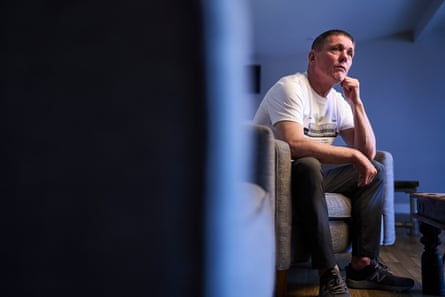
At 21, Kenny’s football life was over. The years passed in a drugged-up maze and he was sentenced to nine months in prison – six for drink-driving and three for missing the original trial. “I did five months and got myself in the gym, played five-a-side. No drugs, no drink. In a crazy way the only time I’ve had peace in my life was when I was locked up.”
Kenny was fortunate to escape a 14-month sentence a few years later “because someone was growing cannabis in my house when I was away”. He says: “I had to take the rap for that, but I was lucky. The judge was an Evertonian and I got a suspended sentence. I didn’t want to go to jail then because my ma was dying.”
At his mother’s wake, Kenny left his pint on the counter and walked out of the pub. He swore, in her memory, he would never resort to drugs again. He tells me he has kept his promise but “I still get depression”, adding: “I can have a great morning, take the dog out, do an hour on the bags, come home, eat lovely food, and it’s back. But I don’t go round the pub. I don’t phone anyone for drugs. I let it take its toll.”
Kenny’s weathered face brightens. “I’m getting three or four good days a week now where for 25 years I didn’t have one fucking good day. I was either sitting in my house crying or I’d be out, off my head. Now the depression can knock all it wants. I’ve learned to live with it.”
Should he have chosen Manchester United or Liverpool instead of Everton? Both clubs were keen to sign Kenny as a teenager – with Liverpool arranging for him to travel to and from Wembley with the first-team squad for the 1988 FA Cup final when he was 14. “I think about this all the time. As much as I loved the Liverpool staff and the way they treated me, it was out of the question. I’m a born Evertonian. But Man United? I went to United for six weeks in the summer holidays and I saw how Fergie got rid of Kevin Moran, Paul McGrath, Norman Whiteside, Bryan Robson and, later, Lee Sharpe. He wouldn’t stand for any drinking or lack of discipline.
“I’d have been perfect for Fergie. He loved me and I loved it at United. But I’ve given my life to Everton and if I had to do it again I’d probably still go to Everton because I loved the fans. I’m one of them.”
We can see Everton’s new stadium from where we sit and Kenny confirms he has been back to watch the club he once loved so much. “All these ex-players who’re connected to Everton are manufactured Evertonians. I went to the Chelsea game [last season] and it was the same faces, doing the same thing. That’s why our club isn’t moving forwards. Get rid of the dead wood.
“The only legends are the fans. I absolutely love Evertonians and I’m made up when the team does well for them. But that’s it. I just see Everton as the club who never looked after me.”
The Goodison Gazza is published by Reach on 8 October. To support the Guardian, order your copy at guardianbookshop.com. Delivery charges may apply.
In the UK, the charity Mind is available on 0300 123 3393 and Childline on 0800 1111. In the US, call or text Mental Health America at 988 or chat 988lifeline.org. In Australia, support is available at Beyond Blue on 1300 22 4636, Lifeline on 13 11 14, and at MensLine on 1300 789 978