Sometimes, keeping things simple is enough, and that is exactly what the Google Pixel 11 — the base model in the series — aims to do.
Last year’s Google Pixel 10 brought some notable upgrades, including a larger battery, a 5x telephoto camera and a range of AI-powered features.
The Pixel 11 builds on that foundation with a more refined approach rather than making flashy changes.
Priced at ₹89,999, it is ₹10,000 more expensive than its predecessor, reflecting the rising prices seen across the premium smartphone segment.
However, with an impressive battery, capable cameras and a lighter design, the Pixel 11 still makes a compelling case for itself.
Let’s take a closer look at what makes it stand out.
Design The Pixel 11 carries forward the design language of the Pixel 10, but Google has made a few thoughtful changes that make the phone feel more refined.
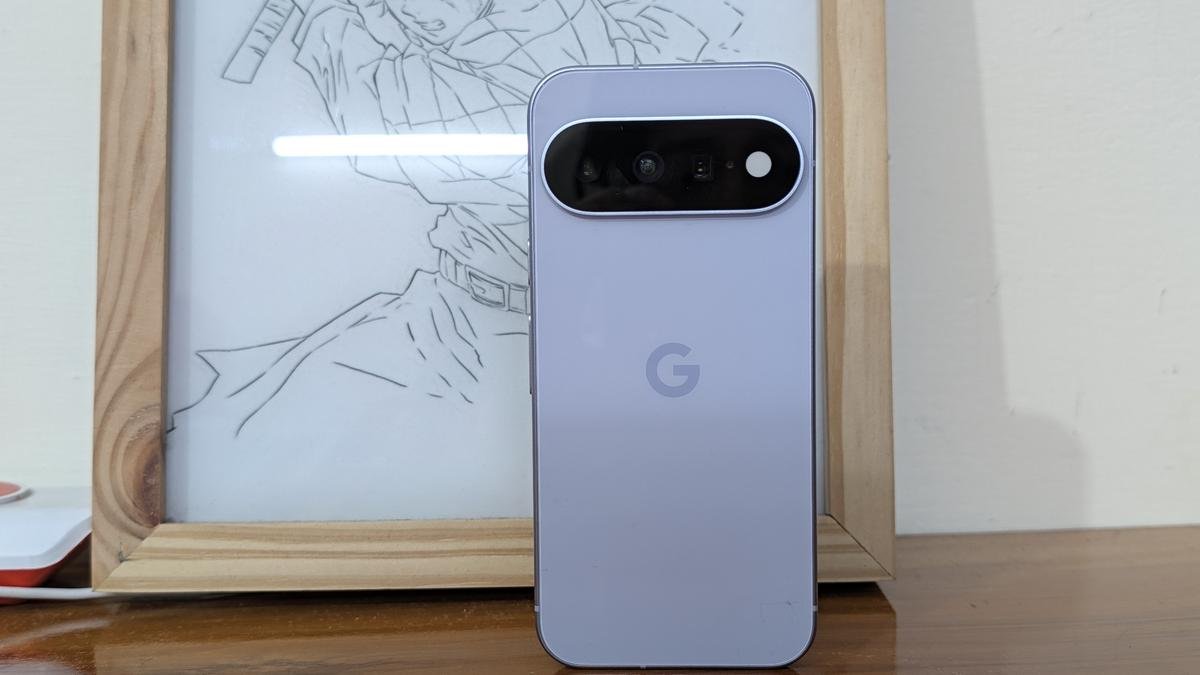
I have been using the Frost colour variant, and it is easily one of the prettiest finishes in the lineup.
The pale blue shade gives the phone a clean and understated look, while the curved edges make it comfortable to hold.
The other options include Pistachio, Hibiscus and Obsidian, giving users a good mix of subtle and more playful finishes.
The biggest visual change is the camera bar, which is now slimmer and sits more evenly against the rear panel.
It still remains the defining element of the Pixel’s design, but the reduced profile makes the phone look cleaner and allows it to sit more comfortably on a flat surface.
At 197 grams, the Pixel 11 also feels relatively light for a premium smartphone, particularly when held for longer periods.
The phone uses Gorilla Glass Victus 2 on the front and back, paired with an aluminium frame, and carries an IP68 rating for dust and water resistance.
The polished back with a satin-finish aluminium frame adds to the premium feel, although the glossy rear can still attract fingerprints.
Overall, the Pixel 11 does not re-invent Google’s design, but the refinements make an already familiar design feel more polished.
Display The Google Pixel 11 gets the same 6.3-inch Actua OLED display size as its predecessor.
With a resolution of 1080x2424 pixels, 422ppi pixel density and a 60Hz to 120Hz refresh rate, the display remains sharp, colourful and smooth.
The screen can reach up to 3,000 nits of peak brightness, with HDR brightness going up to 2,000 nits, making outdoor visibility quite good.
Watching videos is enjoyable, with colours appearing vibrant without making the screen feel excessively punchy.
The 120Hz Smooth Display also makes scrolling through webpages, menus and social media feel fluid.
With a 20:9 aspect ratio, slim bezels and support for HDR, the Pixel 11 continues to offer a display that feels flagship-grade.
This is not an area where Google needed to make a dramatic change, and retaining what worked feels like another example of the phone’s smart approach.
OS and AI The Pixel 11 runs Android 17 and, as expected, software remains one of its biggest strengths.
Google continues to integrate Gemini deeply into the Pixel experience, with Gemini Live, Gemini Apps and other AI-powered features designed to make the phone more useful rather than simply adding AI for the sake of it.
Features such as Circle to Search, Live Translate and Call Assist further extend Google’s AI capabilities into everyday use.
The Pixel 11 also gets camera-focused AI tools such as Magic Capture, Camera Looks and Camera Coach.
There has been plenty of discussion around AI-generated photography and whether it compromises the originality of an image.
In my experience with Pixel phones, however, Google’s approach has always felt more focused on improving what the camera has captured rather than filling an image with unnecessary elements.
The Pixel 11 continues that philosophy.
The AI works largely in the background to improve composition, clarity and overall output, without making photographs look artificially enhanced.
That is perhaps what makes Google’s AI implementation more convincing.
It is not constantly trying to announce itself.
Instead, it simply makes everyday tasks easier.
Performance The Pixel 11 is powered by Google’s new Tensor G6 processor, paired with 12GB RAM and either 256GB or 512GB storage.
My unit came with 256GB.
In everyday use, the Pixel 11 feels fast and responsive.
Apps open quickly, multi-tasking is smooth and switching between several applications does not result in noticeable slowdowns.
Games also run comfortably, although Google continues to position the Tensor series more around a balanced combination of performance, AI and efficiency than outright gaming performance.
The benchmark numbers present an interesting picture.
The Pixel 11 scored 2,302 in Geekbench single-core and 6,926 in multi-core testing.
The Pixel 10, in comparison, recorded 1,841 and 5,124 respectively, meaning the new phone delivers a sizable improvement in both CPU tests.
Its AnTuTu score of 1,227,772, however, is lower than the Pixel 10’s roughly 1.34-million score from our testing.
Benchmark results can vary depending on software and testing conditions, so I would not treat that difference as representative of the overall experience.
More importantly, the Pixel 11 feels fast during real-world use.
Interestingly, its benchmark performance also comes out ahead of both the Pixel 11 Pro XL and the Pixel 11 Pro Fold in my tests, showing that the standard Pixel 11 is not necessarily the weakest performer in Google’s latest lineup.
Overall, the Pixel 11 offers the kind of performance most users will need, while Tensor G6 continues Google’s focus on AI and software optimisation.
Camera I have always liked Pixel cameras, largely because of how consistently they reproduce the scene in front of you.
The Pixel 11 continues that tradition; while the hardware looks familiar, the results show that Google has made meaningful improvements.
Pixel 11 camera sample | Photo Credit: Haider Ali Khan The rear camera setup includes a 48 MP wide camera, a 13 MP ultrawide and a 10.8 MP 5x telephoto camera.
On paper, this is almost identical to the Pixel 10, but the larger main sensor and improvements from the Tensor G6 help the Pixel 11 produce better results, particularly in challenging lighting.
Pixel 11 camera sample | Photo Credit: Haider Ali Khan Daylight photographs are detailed, well exposed and generally natural-looking.
Colours have enough vibrancy without becoming overly saturated, while dynamic range remains one of the phone’s strongest points.
Portraits also maintain good subject separation and natural skin tones.
Pixel 11 camera sample | Photo Credit: Haider Ali Khan Where the Pixel 11 really impresses is low-light photography.
Night shots retain a surprising amount of detail while keeping exposure under control.
Whether it is a dimly lit indoor scene or a nighttime street, the camera does a very good job of bringing out details without making the image look unnaturally bright.
The AI processing deserves credit here too.
Google’s computational photography has sometimes been questioned for how much it changes an image, but the Pixel 11’s approach feels more purposeful.
Rather than adding unnecessary objects or turning an ordinary photograph into something artificial, the processing generally works towards making the original shot cleaner, sharper and better exposed.
Pixel 11 camera sample | Photo Credit: Haider Ali Khan The 5x telephoto camera remains another major advantage, but the Pixel 11 takes the zoom experience further with Super Zoom now going up to 30x, compared with 20x on the Pixel 10.
At longer distances, the improvement is noticeable.
Images at 10x remain useful, while 30x can produce surprisingly detailed results for subjects that would otherwise be difficult to capture.
The AI processing does play a role at the highest zoom levels, so some fine details can occasionally look processed, but overall the feature is impressive for a compact flagship.
The 10.5 MP autofocus selfie camera also produces good results, with a wide field of view that works well for group selfies.
Overall, the Pixel 11 continues to be one of the strongest camera phones in its segment.
Battery Battery life is another area where the Pixel 11 makes a meaningful improvement.
It packs a typical 4,985 mAh battery, compared with the 4,970 mAh capacity on the Pixel 10, but the bigger story is Google’s claim of more than 30 hours of battery life and the improved efficiency of the new Tensor G6 chip.
The Pixel 11 comfortably handles a full day of heavy usage, including photography, video streaming, browsing and multi-tasking.
It also supports up to 30W wired charging, with Google claiming around 55% charge in 30 minutes when paired with a compatible charger.
Wireless charging gets a more substantial upgrade through Pixelsnap, which now supports Qi2.2-certified wireless charging at up to 25W.
The magnetic system remains one of the more useful additions to the Pixel ecosystem, particularly for anyone who uses compatible magnetic accessories.
The Pixel 11 does not necessarily compete with every rival on charging speed, but its combination of endurance and wireless charging convenience makes it a practical upgrade.
Verdict The Google Pixel 11 is not a phone that tries to reinvent the Pixel formula.
Instead, Google has focused on making the existing experience better, and that approach works surprisingly well.
The design remains familiar but feels more refined, the Tensor G6 brings improved CPU performance, battery life is stronger, base storage has doubled to 256GB, and the camera system continues to be one of the phone’s biggest strengths.
At ₹89,999, the Pixel 11 is certainly not inexpensive, especially when the Pixel 10 started at ₹79,999.
But the price increase does come with meaningful additions, including more storage, improved performance, better battery endurance, faster Pixelsnap charging and a more capable zoom experience.
For someone upgrading from an older Pixel or entering the Pixel ecosystem for the first time, the Pixel 11 makes a strong case for itself.