The Ministry of Home Affairs notified that the Central Armed Police Forces (General Administration) Act, 2026, will come into force from Thursday (October 8, 2026), nearly five months after the legislation was passed by Parliament, even as its constitutional validity is under challenge before the Supreme Court.
Serving CAPF officers have challenged the law, which will impact cadre management and the deputation of Indian Police Service (IPS) officers to senior positions in the Central Armed Police Forces (CAPFs).
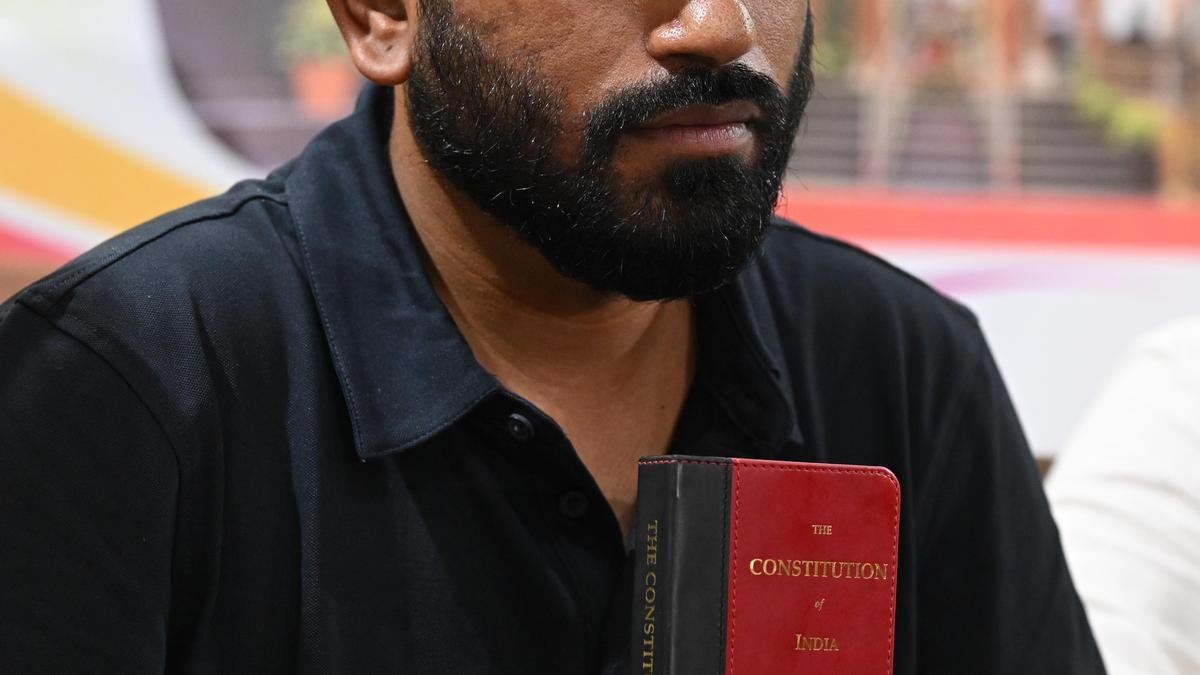
Among them is Central Reserve Police Force (CRPF) Assistant Commandant Bibhor Kumar Singh, a Shaurya Chakra awardee who lost both his legs in an anti-Maoist operation in Bihar in 2022 and is the lead petitioner in one of the cases.
CJI sets up special bench to hear CAPF officers’ plea after case was struck off Tuesday’s cause list despite judicial order “In exercise of the powers conferred by sub-section (2) of section 1 of the Central Armed Police Forces (General Administration) Act, 2026 (9 of 2026), the Central Government hereby appoints the 08th day of October, 2026, as the date on which the provisions of the said Act shall come into force,” said the notification.
The notification assumes significance as the new law has emerged as a key issue in separate contempt proceedings concerning the implementation of the Supreme Court’s May 23, 2025, judgment on cadre issues in the CAPFs.
On September 30, a Bench of Justices Manoj Misra and Ujjal Bhuyan decided to hear the contempt petitions along with three writ petitions challenging the validity of the CAPF Act on October 15.
Supreme Court issues notice to government on pleas against CAPF Act The contempt proceedings arise from allegations that the Union government has not fully implemented the May 2025 judgment, in which the Supreme Court directed that deputation of IPS officers to senior posts in the CAPFs be progressively reduced.
The contempt petitioners told the court that the new Act did not cover several directions of the 2025 judgment and, therefore, there was no reason to defer the contempt proceedings until November 18, which had earlier been fixed as the returnable date in the writ petitions challenging the legislation.
Appearing for the government, the Solicitor General sought two weeks to study the issue and assist the court on whether the contempt proceedings could be taken up independently of the challenge to the Act.
The Bench subsequently directed that the contempt petitions and the writ petitions be listed together at 2 p.m. on October 15.
The September 30 order also detailed the unusual circumstances in which the contempt proceedings and the constitutional challenges came to be placed before a common Bench.
According to a report submitted by the Supreme Court Registry, counsel representing the respondents in both sets of cases had mentioned the matter before the Chief Justice of India, seeking that they be heard by a single Bench.
The request was made as one of the defences raised in the contempt proceedings concerned the notification of the CAPF Act whose constitutional validity was being challenged separately.
The Chief Justice then constituted a Bench comprising the presiding judges of the two separate Benches that had until then been dealing with the contempt petitions and the writ petitions, respectively.
The Registry report followed another unusual development a day earlier, when a Supreme Court Bench of Justices Ujjal Bhuyan and Atul S.
Chandurkar sought an explanation from the Registry on why the contempt matter had been struck off the cause list despite a specific judicial direction that it be heard at 2 p.m. on September 29.
“Since it is a judicial order to get the case listed today at 02:00 PM, we direct listing of this case, along with the other connected matters, again tomorrow, i.e. on 30.09.2026, at 02:00 PM, with a note by the Registry, as to why the matter was struck off from the cause list despite there being a judicial order,” the Court had said.
The September 30 Bench accepted the Registry’s explanation and directed that the report be taken on record and kept in a sealed cover.
The matter has its origins in the Supreme Court’s May 23, 2025, judgment by a Bench of Justices A.S.
Oka and Ujjal Bhuyan, which held that Group A officers of the CAPFs constitute “Organised Services” for all purposes.
The Court had also directed the government to progressively reduce posts reserved for IPS officers on deputation in the Senior Administrative Grade (SAG), or up to the rank of Inspector General, within an outer limit of two years.
It additionally directed a time-bound review of the cadre structure and service rules within six months.
An Organised Group A Service has a defined cadre structure, hierarchy, promotional avenues and cadre-controlling mechanism, as opposed to isolated Group A posts.
Contempt petitions were subsequently filed by retired CAPF officers alleging that the directions had not been implemented in their entirety.
During the proceedings, Union Home Secretary Govind Mohan filed an affidavit explaining the government’s position.
According to the affidavit, 46 IPS officers had been brought on deputation to the CAPFs up to the SAG level since the May 2025 judgment.
While hearing the contempt matter on September 2, Justice Bhuyan had orally remarked that there was a “strong lobby” and that CAPF cadre officers were being “completely stifled”.
According to the Alliance of All Ex-Para-Military Forces Welfare Association, which represents the interests of serving and retired personnel, the cadre dispute affects around 13,000 CAPF officers.