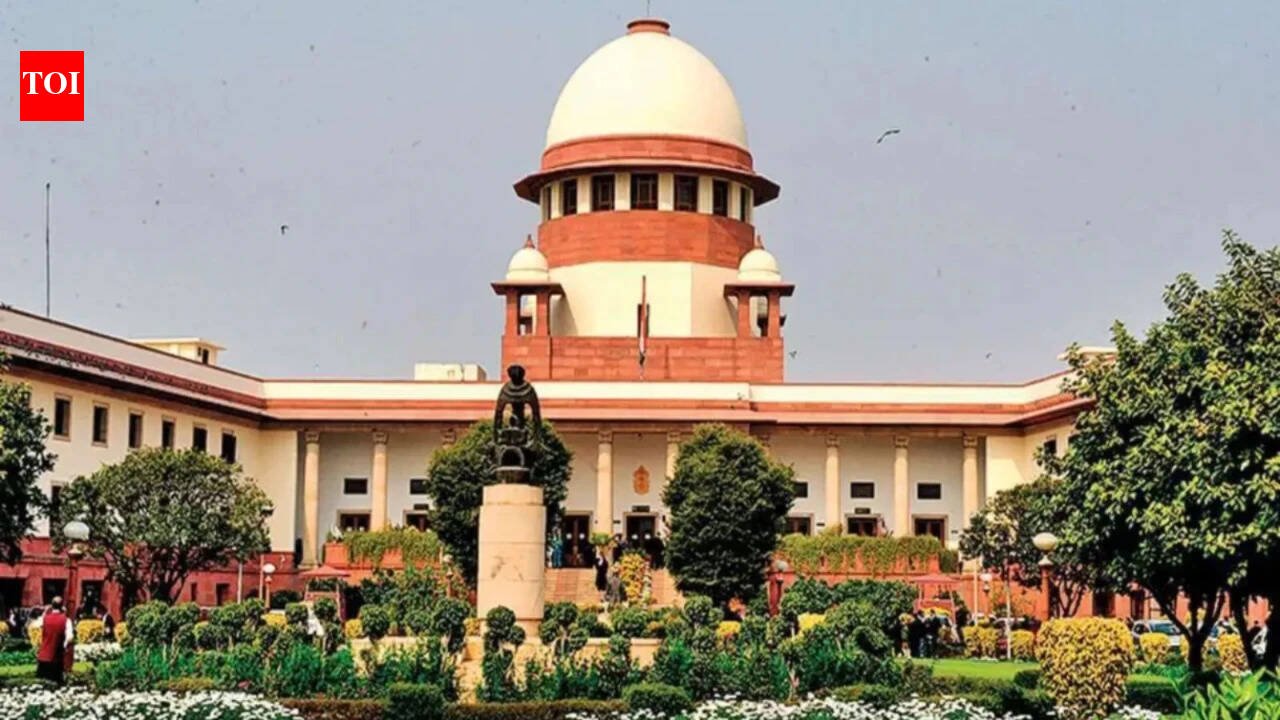
File photo: Supreme Court NEW DELHI: The Supreme Court on Tuesday said the urban system in Gurugram collapses during rains because adequate investment was not made in infrastructure such as drainage and sewage systems.
The court contrasted this with Greater Noida, saying the latter was planned with the next 30-40 years in mind.The observations came while the top court was hearing a plea challenging the Karnataka High Court's decision upholding the state's Premium Floor Area Ratio (FAR) scheme.A bench headed by Chief Justice Surya Kant, along with Justices Joymalya Bagchi and V Mohana, issued notice on the plea filed by the Citizens Action Forum.The bench, however, clarified that the additional FAR available under the scheme should not be used to regularise illegal construction.Supreme Court raises infrastructure concerns Chief Justice Surya Kant said there was no visible improvement or addition to the basic infrastructure of the township, such as roads, sewer lines and bus flyovers, despite the additional construction capacity."We have seen in Gurugram how this system collapses if any natural calamity comes.
Because, without adding to this infrastructure, you are burdening the size of the plot with multiple storeys," the CJI said.He said the situation was different in Greater Noida because the city had been planned keeping the next 30-40 years in mind.The observations came amid arguments over whether Bengaluru's existing infrastructure can support additional construction allowed under the Premium FAR scheme.What is the Premium FAR scheme?
The Premium FAR scheme allows property owners to purchase additional construction rights beyond the ordinarily permissible FAR by paying prescribed premium charges.
The stated objective is to facilitate vertical development and generate revenue for urban local bodies.FAR refers to the ratio of a building's total floor area to the size of the plot on which it stands.Senior advocate Aditya Sondhi, appearing for the Citizens Action Forum, argued that road width had effectively become the main criterion for granting Premium FAR, despite existing pressure on Bengaluru's parking, water, electricity and other infrastructure.Justice Bagchi also referred to Bengaluru's traffic problems, saying the city has a "traffic nightmare" and that this was a serious concern raised by the petitioner.Solicitor general Tushar Mehta, appearing for the state authorities, said the overall additional FAR remained capped at 0.6.
He also said existing setback and parking requirements continued to apply and that developers could not simply purchase additional FAR without meeting parking and other regulatory requirements.Mehta said the money collected under the scheme would go into a dedicated fund for civic infrastructure.Government says Premium FAR cannot regularise illegal buildings A key issue before the bench was whether the Premium FAR scheme could be used to regularise unauthorised construction.Sondhi questioned how the new scheme differed from the earlier Akrama-Sakrama scheme, under which unauthorised constructions were legalised.
He told the court that a provision in the Greater Bengaluru Authority Act allowed Premium FAR to be used for regularising existing illegal constructions.Mehta rejected the contention and gave an assurance that unauthorised construction covered by the Akrama-Sakrama scheme would not be regularised under the Premium FAR scheme."It has nothing to do with that.
Kindly record my statement.
It is completely different.
You can also pass directions to this effect," Mehta said.He argued that urban space was limited and vertical growth was the way forward, adding that cities were increasingly moving towards vertical development.Karnataka authorities get four weeks to respond The Supreme Court asked the Bengaluru authorities to file their response to the plea within four weeks.The case challenges the Karnataka High Court's June 15 judgment upholding the constitutional validity of the Premium FAR scheme.
The high court had dismissed petitions arguing that the scheme violated property rights and reduced the value of Transferable Development Rights (TDRs).Join conversation Share your thoughts in the comments Be respectful · TOI community guidelines The Premium FAR scheme was introduced under Section 18-B of the Karnataka Town and Country Planning Act, 1961.
The high court had held that it did not violate Articles 14, 21 or 300A of the Constitution.The NGO had argued that Premium FAR allowed developers to purchase additional building rights at rates significantly below the market cost of TDRs, thereby undermining TDRs secured by landowners as compensation for land.The high court rejected the argument, holding that a state policy resulting in fluctuations in property values would not by itself make the policy violative of Article 300A.