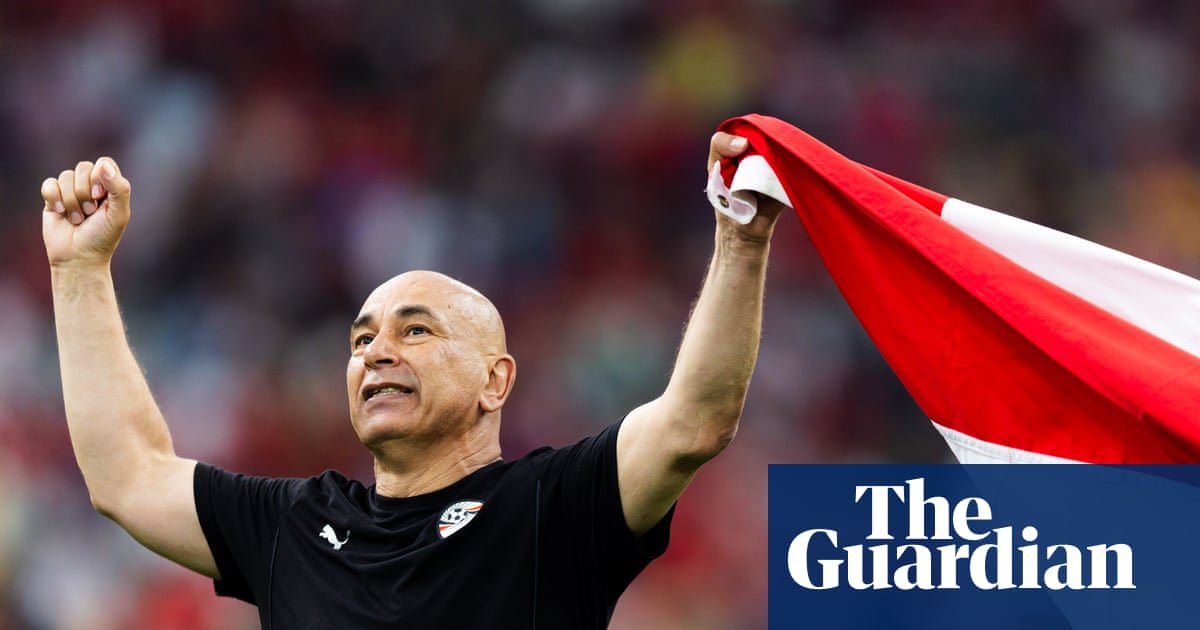
Egypt face Australia in a historic World Cup game on Friday and the manager has been keen to highlight president Al-Sisi’s role in the achievement
After Egypt’s 3-1 victory over New Zealand at the World Cup, the national team coach, Hossam Hassan, issued a statement of gratitude to the country’s president, Abdel Fatah al-Sisi.
Al-Sisi had sent a congratulatory message to the team and, for Hassan, that almost seemed like a bigger event than the result. The president’s message, he said, was “a medal on his chest,” adding that it has the “effect of magic” before praising the “unprecedented development” of Egyptian sport under al-Sisi’s leadership.
Al-Sisi, it is worth pointing out, is a military general who has overseen a sweeping crackdown on all forms of dissent since seizing power in 2013, and under whom the security apparatus has infiltrated every aspect of civilian life.
Hassan, meanwhile, is an Egyptian football legend, arguably the nation’s greatest ever striker; a three-time Africa Cup of Nations winner as a player. As a manager, his record is historic as well, taking the Pharaohs to the World Cup unbeaten with 26 points from a possible 30, then delivering what 92 years of Egyptian football had failed to: a victory at a World Cup. Progress to the knockout stage followed. His achievements are beyond doubt.
Yet to listen to Hassan speak is to realise that football can seem secondary to the 59-year-old. Maybe he has no choice, but he often uses his position as a platform to express loyalty and deference to the state. Since his appointment as the Pharaohs manager, the line between football management and politics has become blurred.
In a sense that platform was set up for him years ago. After a disappointing Afcon campaign in 2019, al-Sisi told his sports minister, Ashraf Sobhy, that Egypt should stop hiring foreign coaches, asking: “Why don’t we have confidence in Egyptian coaches?” before laughing and remarking that “the result [ie not winning] is the same” anyway.
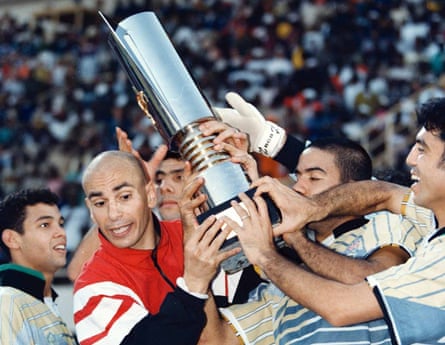
When the national team coach Rui Vitória was dismissed after a poor Afcon performance in early 2024, the EFA chose a domestic coach, hiring Hassan, who reportedly declined to negotiate a penalty clause in the event of his sacking. During this World Cup, he said his contract expired in February, but that he has been leading the team as “national duty” rather than in a professional capacity.
A year after Hassan’s appointment, the state’s protection of the national team project was laid out explicitly. During a CAF/Unilever Afcon Trophy reception in late 2025 that hosted ministry, Egyptian Football Association (EFA) and Confederation of African Football (CAF) officials, as well as former players, pundits, content creators, and journalists, Sobhy made the government’s expectations clear. In his address, he urged journalists and pundits not to criticise the national team’s staff, and to “have their backs the same way we all have our military and political leadership’s backs”.
After Egypt secured World Cup qualification, Hassan said “success begins from the top of the pyramid and the officials of the state” and that the reward he wanted most was “the chance to meet the president”. He added that the man in charge of the country “shouldered a great burden that no one else could bear”.
In June 2025, seemingly unprompted, Hassan and his twin brother Ibrahim, the team director, issued a statement marking the anniversary of the 30 June protests that preceded the military’s 2013 rise to power. They called it “a symbol of dignity”.
Hassan has at times also moved to police pundits who criticise his performance as coach. Breaking entirely with convention, he appointed a cassation court lawyer as his official legal spokesperson, granting him full authority “to take all necessary legal measures to pursue those who spread rumours, as well as anyone who seeks to sow discord in the football community”.
In February the coach’s lawyer filed a formal complaint with the Supreme Council for Media Regulation (SCMR), often described as the state’s chief censor, against a TV presenter who, on his personal Facebook page, had criticised the Hassan twins’ management of the national team. The complaint claimed that the posts “affected the national team’s management,” and urged the regulator to escalate the matter to its complaints committee for investigation and to “take legal action in accordance with the law”.
The SCMR complaints committee summoned the TV presenter’s representative for questioning over the posts, but there has been no information on the outcome of the complaint.
After the match against Belgium, the twins’ lawyer filed another complaint to the regulator, demanding a ban on the former Egypt player and current pundit, Reda Abdel Aal, accusing him of trying to “disturb the security and peace of the country” and of interfering with Hassan’s “official national mission”. No decision on the complaint has been announced.
Hassan’s actions align with the reality of who now owns Egyptian football. Over the past decade, its infrastructure has been systematically absorbed by entities linked to the military and intelligence services. The shirt sponsor is the Administrative Capital for Urban Development (ACUD), a military-owned enterprise established in 2016. The only way to buy a match ticket is via an app called Tazkarti, that holds a biometric Fan ID for every stadium-goer in the country, and is a subsidiary of United Media Services (UMS), a sprawling media conglomerate owned by Egypt’s General Intelligence Service.
Another UMS subsidiary, Sports United, runs the TV channels that show the domestic league, cups, national team friendlies, as well as the only exclusive website permitted to livestream matches, the commercial rights for clubs, and in-stadium advertising. The venues are managed by another UMS entity – Estadat – which frames itself as providing “advanced management systems … and professional design and operation of stadiums,” and which “owns the rights to manage the largest number of stadiums and sports bodies” in the country.
As for the World Cup viewing experience, the Egyptian public is encouraged to attend the World Cup “Fan Zone”, entirely owned and managed by ACUD, organised by Sports United and with access granted only by registering through Tazkarti.
These days every point of contact between a supporter and the national team, and more broadly, the sport, runs through the state security apparatus.
Middle East and north Africa