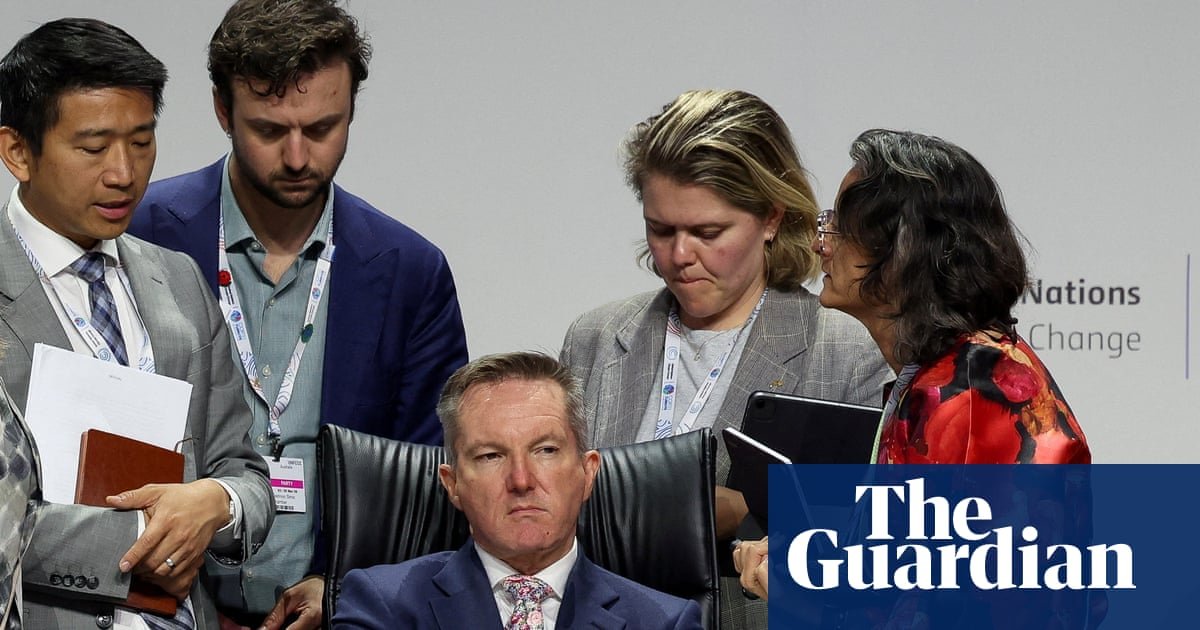
The longest-running UN climate talks featured plenty of high-stakes drama before they came crashing to a halt without a deal
Just after 6pm last Saturday, as the sun was setting over Turkey, the UK energy minister, Miatta Fahnbulleh, accompanied by a handful of key advisers, strode out from her delegation office at the UN Cop31 summit in Antalya. As she made her way rapidly through the warren of beflagged windowless rooms housing countries’ offices, other heads of delegation emerged, exchanged brief greetings and joined the procession.
From the EU’s offices, Ireland’s climate minister, Darragh O’Brien, and the EU climate commissioner, Wopke Hoekstra, took the measure of the group before marching purposefully off, tailed by a throng of baffled journalists running to the plush offices of the joint presidencies of the Cop in the next building along.
In a summit that had seemed limp and deadlocked to that point, about 24 hours after it was scheduled to end, it was a galvanising moment at last. While some of the advisers peeled off to stand outside the cordon of blue-uniformed UN guards, the core group – made up of about 30 ministers and officials, including the chair of the least developed countries, with the backing of at least 130 countries, including Latin American nations, Pacific islands and some African states – presented themselves to the Australian and Turkish hosts of the summit. “Almost the whole world was there,” one Pacific island delegate put it a short time later.
The meeting did not last long, at least not for the EU, of which the Irish hold the revolving presidency, thus leading on Cop negotiations. O’Brien was brushing back past the bemused UN guards just 10 minutes later.
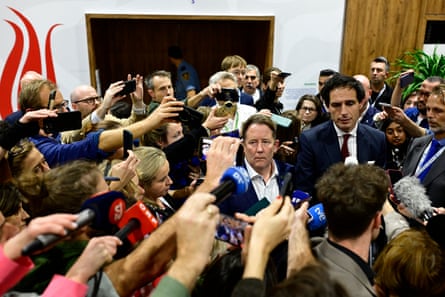
Those 10 minutes were the crunch point of two weeks of negotiations, and arguably of more than 30 years of Cops. Within hours of that meeting, the talks had broken down beyond repair, and the prematurely named “Antalya pact”, which was supposed to be the main outcome of the talks, was scuppered. Despite increasingly desperate attempts by the joint Cop31 presidencies of Australia and Turkey to recover ground, with a new draft text and urgent meetings with key parties, the deal they had hoped to broker was off.
Fossil fuel omission
So what exactly went so wrong? And where does Cop go from here? The immediate reason for the failure was simple: fossil fuels. Owing to the intransigence of a small number of countries, led by Saudi Arabia and Russia, the words “fossil fuels”, and all reference to the need to “transition away” from them, had been excised from draft texts of the “pact”. This was more than the “progressive coalition”, as they called themselves, of 130 countries could stand.
“We will not endorse a decision that does not even mention fossil fuels, which is the main driver of climate change,” said O’Brien. “We will not accept a Cop that greenwashes fossil fuel.” As the final plenary ticked on, country after country – close to 40 in the end – said they also would not accept it.
“This is not the time to make half-hearted decisions,” said Ana Aguilar, the chief negotiator of Panama. “This is not a failure of multilateralism,” she added. “What we cannot accept is that we are asked to drop our stance, because the atmosphere does not negotiate – the planet does not negotiate.”
Even at this late stage, Turkey still held hopes of a deal. Murat Kurum, the Turkish president of Cop31, had control of the gavel, and at one point when the UN climate chief, Simon Stiell, moved to intervene, Kurum curtly told him to sit down. At another point, one of Stiell’s assistants half-rose and moved towards the gavel, as if fearing Kurum would bring it down anyway.
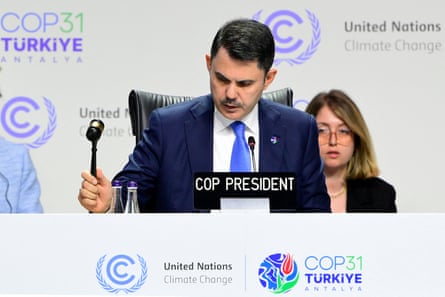
Eventually Kurum had to concede defeat. “Some countries fixated on a word or phrase and, frankly, brought other issues unrelated to climate change into these discussions, unfortunately preventing the process from moving forward,” he said, bitterly. “We did everything we could. The decision rests with 196 countries. Therefore, we will respect their decision.”
It was a historic moment – the first time that Cop talks had foundered on the refusal to recognise fossil fuels, despite teetering on the brink at many meetings in preceding years. Bill Hare, the chief executive of the Climate Analytics thinktank and a Cop veteran, spoke for many in describing Cop31’s dramatic end not as a failure but as a much-needed turning point after so many anaemic outcomes. He called it “a successful defence of [Cop] integrity against a coordinated attack by a few countries implacably opposed to action on climate change”.
Rich country hypocrisy?
But the reception for the result was complex, and mixed. Though many welcomed the position taken by the EU, the bloc also came under fire with charges of hypocrisy for taking a stand on fossil fuels while continuing to approve oil and gas developments at home, and for its stance on finance. Developing countries accused the EU of obstructing efforts to flesh out a commitment made last year to triple the finance they receive to help them adapt to the impacts of extreme weather, and of bringing forward too little climate finance to meet the poor world’s needs.
“Let’s be honest about the EU’s role,” said Harjeet Singh, the global convener of the Fill the Fund campaign. “It came to Antalya with empty pockets: no new money for adaptation, the adaptation fund or the loss and damage fund. Behind closed doors, it blocked a meaningful just transition mechanism. It talks about phasing out fossil fuels while still expanding fossil fuel infrastructure at home. Rejecting a text over missing fossil fuel language and carbon capture greenwashing is right. Doing it while refusing to pay for the transition is hypocrisy. You can’t demand ambition from developing countries and refuse to fund it.”
For the developing world, labouring under a debt burden that has become crippling with the impacts of the Covid pandemic, inflation, interest rate rises, and the fossil fuel supply crunch after the Iran war, the failure of the rich to fulfil their obligations under the Paris agreement to provide adequate climate finance to the poor is a persistent sore spot at these talks.
Avantika Goswami, the programme manager at India’s Centre for Science and Environment thinktank, said: “Cop 31 wasted an opportunity to secure ambitious outcomes on just transition and adaptation finance. The process revealed deep divergences in how the global north and global south envision tackling climate change, and eroded trust in multilateralism further through bad-faith narrative games and blocking tactics deployed by the global north, especially the EU.”
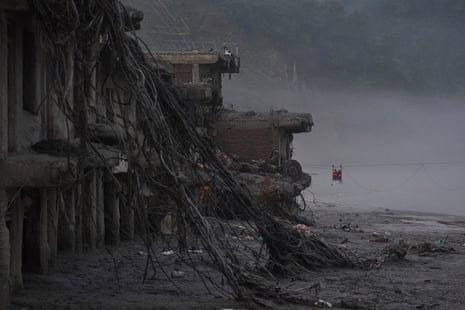
The need for climate finance has never been more acute. When a climate-weakened glacier collapsed in Nepal in September, killing more than 1,500 people and destroying more than 7,500 homes, the country received a paltry $22m from the “loss and damage” fund meant for the rescue and rehabilitation of stricken countries. Bareesh Chowdhury, of Friends of the Earth Bangladesh, said: “The developed world is shameless – the fund responding to loss and damage received over $2bn in requests and had not even peanuts to disburse, and this year there has been even less in new commitments. All this while countries like Nepal bleed. There are only empty words and empty pockets for us in the global south.”
Already pressing global needs for finance are set to grow: the climate-supercharged El Niño threatens 50 million people with acute hunger, and the rest of the world with food price rises and trillions of dollars in likely economic damages that will threaten livelihoods, development and civil stability around the world.
Clearly, it is in developed countries’ interests to prevent such instability – but few seem to realise it, given their cuts to climate finance and failure to make good on funding promises. Even the UK, which appointed a former spy chief as climate security adviser at the start of the talks, slashed its own climate finance earlier this year, weeks after partially publishing a secret dossier that warned of nuclear war arising from climate-driven overseas ecosystem collapse.
Australia, the EU and other developed countries protested repeatedly that Cop31 was not meant to be a “finance Cop”, where new cash pledges are made. That is irrelevant. The lesson of Cop31 is that if they want progress on their goals, they need to front up the cash the poor world needs – otherwise,it is only half a bargain.
‘Unbridgeable’ divides
The problems mounted in the lead-up to that chaotic final day. Oil producers pulled out all the stops behind the scenes at this year’s Cop31, insiders said. “Turkey was telling people it would ‘manage’ Saudi Arabia here – actually, it’s Turkey that’s been managed by Saudi,” said one. Saudi had frequent and unfettered access to the Turkish presidency, according to people who witnessed this. Saudi’s energy minister, Prince Abdulaziz bin Salman, the head of its delegation, was behind closed doors saying he was “unsure” that “hydrocarbons” were linked to the climate crisis. And Turkey’s president, Recep Tayyip Erdoğan, also happily made fossil fuel deals on the eve of the Cop, celebrating the opening of two new oilfields.
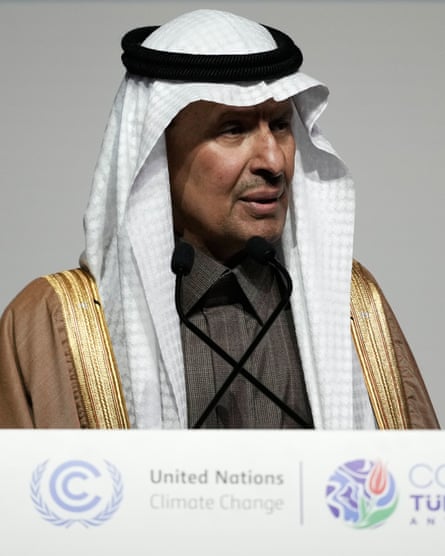
When the second version of the draft text arrived on Thursday, three days before the final plenary, with its removal of every reference to fossil fuels, and its largesse for controversial “carbon capture and storage” technology – beloved of Saudi, which extolled its virtues even in the final plenary, but regarded by campaigners as just an excuse to keep the oil industry going – many discerned in it the allyship between Turkey and its regional friends. “It could have been written by Saudi Arabia,” said one delegate. To which their neighbour replied: “It probably was.”
Cop31, to make matters worse, was a dual presidency, because Turkey and Australia both submitted bids to hold it, and neither would give up. The Australian co-president of Cop, Chris Bowen, insisted throughout that the presidencies had worked well together but the strain was telling, with Bowen skipping key meetings in the run-up to the summit and fewer attempts to publicise Australia’s efforts.
They made their own job harder with the decision to add a target of deriving 35% of energy from electricity by 2035 into the cover decision. It was an idea that had lots of support but many countries, most vocally India, objected both to the late timing of this proposed pledge, with little time for economics ministries to test and model, and also to the principle of taking a voluntary pledge from the “action agenda” and making it binding. “If they were going to try this, they should have done it much sooner,” said one insider. Some were also concerned that it did not specify “clean electricity”, and campaigners resented the pledge as a “distraction” from the more serious business of passing the “just transition mechanism”, which aims to enshrine the principles of social justice and racial equality into the move to a low-carbon society, mainly through helping workers affected by the shift.
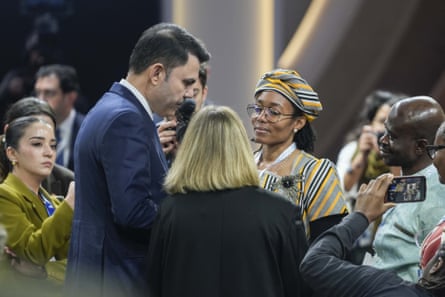
With so much going on, both presidencies appeared at many points overwhelmed and the Australians were increasingly sidelined; one of the reasons for the long delays between draft texts was that everything had to be passed through the Turkish foreign ministry. Several developing countries reported to the Guardian that by early in the second week, they were barely seeing either of the presidencies. Those strained relations reached breaking point in the final plenary, when Ghana’s minister Zanetor Agyeman-Rawlings complained of being “rudely interrupted [by Kurum] and cut off while delivering my statement”. Kurum later apologised to her, but the spat was symptomatic of an “arrogant” attitude and “lack of transparency” throughout, one witness told the Guardian later.
Some of the big countries that were still in the loop found that they could be told one thing in meetings with Australia, and something different when they met Turkey. “A mess” was how several insiders described the situation. “Where were the points people for the key issues?” asked one. “It was lacking in organisation, you couldn’t find out who was supposed to be doing what,” said another.
Amid the dual presidency, the UN was largely sidelined. This added to the delays in bringing out new drafts of texts, because they needed legal, protocol and language checks that the presidencies appeared not to have taken into account.
But while the dual presidency undoubtedly created friction, it is difficult to see whether another presidency could have done any better, when it came to the main sticking point: fossil fuels. Any presidency would have faced blockers. As Bowen told journalists afterwards, there were “unbridgeable” divides.
The cost of Cop31’s failure
So what now? When Ethiopia takes the presidency of Cop32 next year, reform will be an unavoidable issue. A rising chorus of voices, including the EU, Al Gore, and the leading scientist Johan Rockström, have called for overhaul of the 34-year-old process, with the consensus system the key target. But letting go of consensus in favour of majority voting could be a step too far for many. Indu K Murthy, the principal research scientist at the Centre for Study of Science, Technology and Policy thinktank in India, said: “Consensus and multilateralism still matter, perhaps more than ever … What the Cops need is faster delivery and accountability, not a fight over voting rules that would itself need consensus to change.”
For the most disadvantaged countries, the summits hold out a lifeline. “My biggest concern is what the alternative would look like, and who would get to shape it,” said Lina Yassin, the adaptation lead for the least developed countries group. “Without a multilateral process grounded in consensus, climate decisions would increasingly be made in smaller forums, where political and economic power determine whose interests count. For the most vulnerable countries, the UNFCCC (United Nations framework convention on climate change) is one of the few places where they can negotiate on an equal legal footing with the world’s largest economies and emitters. That doesn’t guarantee fair outcomes, but losing that space would hardly make outcomes fairer.”
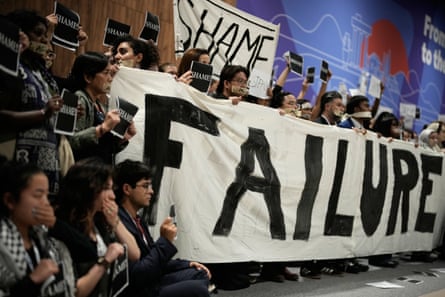
Besides, a focus on changing the consensus rules may be missing the point. The host will also face more immediate dilemmas, such as whether to abandon the idea of an overarching “cover decision” as a way of avoiding the showdown that broke Cop31. That would be controversial, however, as cover decisions have delivered most of the progress in the last half-decade, and preventing parties discussing fossil fuels by procedural means would infuriate the 130 countries of the “progressive coalition”.
Or what if Cops actually need to stop negotiating? Altogether, the world has done more than 30 years of climate diplomacy and discussion. Can more really be needed? That is what struck the Brazilian presidency of Cop30. André Corrêa do Lago, its president, said the Cop process needed to move from one of negotiation to one of “implementation” – that is, accepting current targets and focusing on putting them into practice, rather than coming up with new ones.
Whatever Ethiopia decides, the core issue of fossil fuels will not go away. Hare, of Climate Analytics, said countries “drew a line in the sand” at Cop31 and that would remain. “We will not stop,” one member of the progressive coalition said.
Ali Mohamed, Kenya’s climate envoy, said more diplomacy was needed in the year ahead. “Climate action requires global cooperation and collaboration. It requires bridge-building,” he said.
Ethiopia, which has still-unexploited coal and gas reserves, but generates about 95% of its electricity from low-carbon sources, recognises the challenge. Gedion Timothewos, Ethiopia’s foreign minister and president-designate of Cop32, said this week he would defend Cop, while listening to all countries. “The UN climate process remains the premier forum where every country has a voice, and where the international community comes together to confront a challenge that no nation can solve alone,” he said. “At a time when confidence in multilateralism is being tested, Ethiopia stands ready to work with all parties and stakeholders to rebuild trust, renew confidence, and transform climate commitments into meaningful action for people and planet.”
He believes Ethiopia’s position, as a country that has suffered catastrophe from drought and famine in the recent past, but has tried to rebuild its economy on sustainable terms, will set an example for the world: “Climate action and development and progress are not mutually exclusive. Good economic policy can also be good climate action.”
Before Cop32 next November, many of the “progressive coalition” will also meet in other forums. In July, after a pre-meeting in Ireland two months earlier, Tuvalu will host the next meeting of the “Santa Marta coalition”, a group of about 60 countries that met in April in Colombia, pledging to produce national roadmaps for their phaseout of fossil fuels, which about a dozen have so far published. Other similar initiatives outside the UNFCCC include the Fossil Fuel Non-Proliferation Treaty Initiative, supported by about 30 countries, and the Beyond Oil and Gas Alliance.
Throughout these dramas of high-stakes diplomacy, ministers running down corridors, gavels almost pushed aside, embarrassed world leaders and failed agreements, it could be easy to lose sight of what really counts. People must remember, said Jiwoh Abdulai, the environment minister for Sierra Leone, that the brunt of Cop31’s failure would be borne by the poorest and most disadvantaged. “It is deeply disappointing that we failed to make meaningful progress on climate issues that have devastating impacts on the most vulnerable people,” he said. “There are farmers losing their harvests, children unable to learn in the extreme heat, and communities losing lives and livelihoods to devastating floods and droughts.”
For poor countries, many of them already drowning in debt, arguments over the precise wording of Cop agreements matter much less than finding the money they desperately need to protect their citizens. That is why scores of the “progressive coalition” of 130 countries that were represented in the march to the presidency on Saturday night ended up telling the final plenary on Sunday that, despite the EU, they would not object to the “Antalya pact” passing, though without liking it much.
For them, the multilateral process of Cop is all there is, the only place where they can have a voice equal to those of the fossil fuel companies robbing them of their future, and the only place where their right to climate finance from the rich is enshrined in binding form. They cannot afford to see it fail again.