From manufactured election insecurity to an outbreak of ‘explosive’ diarrhea, Americans are bearing the brunt of harmful policies
Between widespread cuts to vital government agencies, various disease and illness outbreaks, and new environmental disaster vulnerabilities, the United States is facing a convergence of crises with widespread repercussions.
Yet the Trump administration has hamstrung the federal government from addressing these crises – and in some cases is actively fanning them. Over the past year, the administration has moved to shrink the federal workforce, roll back environmental protections and policies intended to fight the climate crisis, reduced funding for scientific research and is seeking to advance legislation that would impose new voting restrictions.
Just this week, Trump delivered an address casting doubt on the integrity of US elections, and last week, appointed a critic of mainstream climate science to oversee the government’s flagship report about the impact of climate change on the United States. Meanwhile, the country is facing a nationwide outbreak of cyclosporiasis, a parasitic illness that can cause “explosive” diarrhea.
Here’s a closer look at each crisis unfolding.
Election security
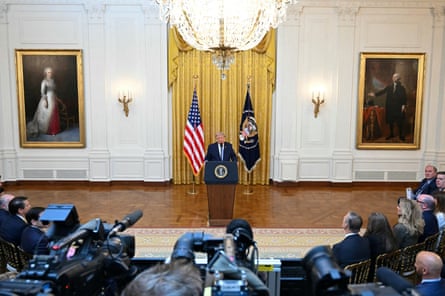
Trump’s zeal to downsize the federal government has spared few corners. Despite his professed concerns with election security – articulated on Thursday night in a conspiracy-laden attack on US democracy – his administration has dramatically weakened the offices intended to safeguard US elections.
His administration began its time in power by downplaying the significance of Russia’s threat of election meddling. His staffing cuts cost the cybersecurity and infrastructure security agency, which is tasked with countering cyber threats, a third of its workforce, according to Mark Warner, a Democratic senator. The administration has also proposed slashing the agency’s budget by $707m in order to address “weaponization and waste”.
Earlier this month, Trump ousted the only three commissioners left serving on an independent federal commission that assists states with election administration.
Other agencies that play a role in tracking and countering foreign election meddling have faced cuts too. The FBI has lost as many as 2,800 agents since January 2025, and when the federal housing official Bill Pulte took over as acting director of national intelligence, he fired dozens of staff members, according to CNN.
On his first day back in office, Trump pardoned about 1,500 people convicted or facing charges for the January 6 insurrection, and has also spread conspiracy theories sympathetic to Tina Peters, a Colorado election clerk convicted of charges related to breaking security after the 2020 election. The state’s Democratic governor, Jared Polis, shortened her sentence earlier this year.
Public health
Trump administration funding cuts have led to a spectrum of worsening outbreaks.
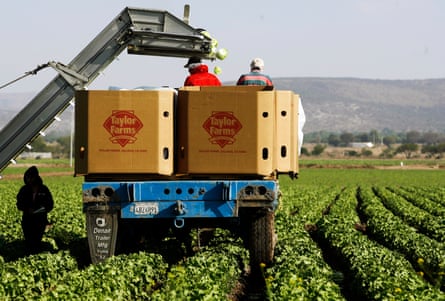
Public health officials in five states, including hard-hit Michigan, were faced with one of the nation’s largest outbreaks of the parasite cyclospora this summer, which causes “explosive” and watery diarrhea for weeks. Public health officials said their tracking of the disease was slowed because of a lack of resources. The administration cut $11.4bn in funding from state and local health departments just a year prior, and reduced the remit of a program dedicated to coordinating information on foodborne illnesses, including cyclospora.
Although the source of a five-state outbreak was linked to iceberg lettuce served at Taco Bell on Friday, public health officials warned the outbreak could continue through August.
The US is also on course for another record year of measles cases in 2026, surpassing last year, which was itself the worst year for cases in three decades. Some public health officials worry the US is on course to lose its measles elimination status, gained in 2000.
And the outbreak of new world screwworm has caused concern across the ranching and conservation worlds, as the parasitic fly can be a major burden to ranchers and wildlife alike. While some entomologists argue the northern march of the flesh-eating fly was in the making for decades, several former officials told Politico last month that Trump’s federal spending reviews slowed efforts to contain the issue. USDA reviews held up funding for the construction of one facility that was crucial in slowing screwworm’s impact on the US cattle supply, the officials said, adding that a $100m research initiative meant to create new tools to slow the insect’s advance was also delayed.
“We’ve already seen what happens when Donald Trump’s political appointees are put in charge of health and science funding – disaster ensues,” said Shaughnessy Naughton, president of 314 Action, which works to elect scientists to public office. “Screwworm monitoring, food safety surveillance and vaccine programs have been arbitrarily cut and less than a year later, we’re facing multiple infectious disease outbreaks. All of this was preventable – but it’s no surprise that Americans are getting sicker as Republicans continue to halt research and cut billions in funding for critical programs.”
Environmental upheaval
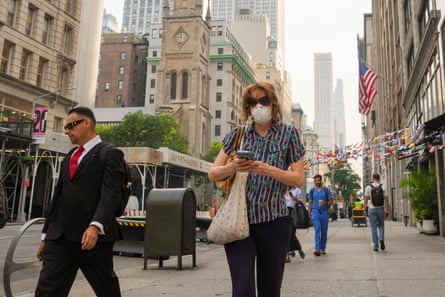
Since re-entering the White House last year, the Trump administration has embarked on a far-reaching assault on environmental protections, rolling back clean air and water standards and promoting fossil fuels. Even as much of the country struggles to breathe as Canadian wildfire smoke spreads over swaths of the US, experts warn of an even grimmer future in which the US grows ever more vulnerable to environmental disasters and toxic exposure. The administration’s efforts to exempt polluting companies from emissions controls – in some cases by simply sending an email – could expose Americans to more unhealthy air. So may its attempts to undercut renewable energy expansion and support the buildout of coal, the dirtiest fossil fuel. Research shows Trump’s pro-fossil fuel agenda has already helped push up the nation’s greenhouse gas emissions, which are warming the planet and increasing the severity and frequency of wildfires, hurricanes and other environmental disasters. In one particularly audacious move this year, the agency repealed the 2009 endangerment finding, which serves as the legal foundation for all federal climate regulations. The president has also pulled the US from the United Nations’ main climate treaty and top climate science body, while slashing funding for climate science. As they have unmade environmental protections, officials have also shuttered climate and weather research offices, terminated climate science projects and scaled back environmental monitoring. Taken together, the administration’s actions could leave Americans facing greater risks while weakening the nation’s ability to anticipate and understand them.