Almost 1,000 arrested as police charge crowd in Paris and teargas used to stop protesters reaching other city centres
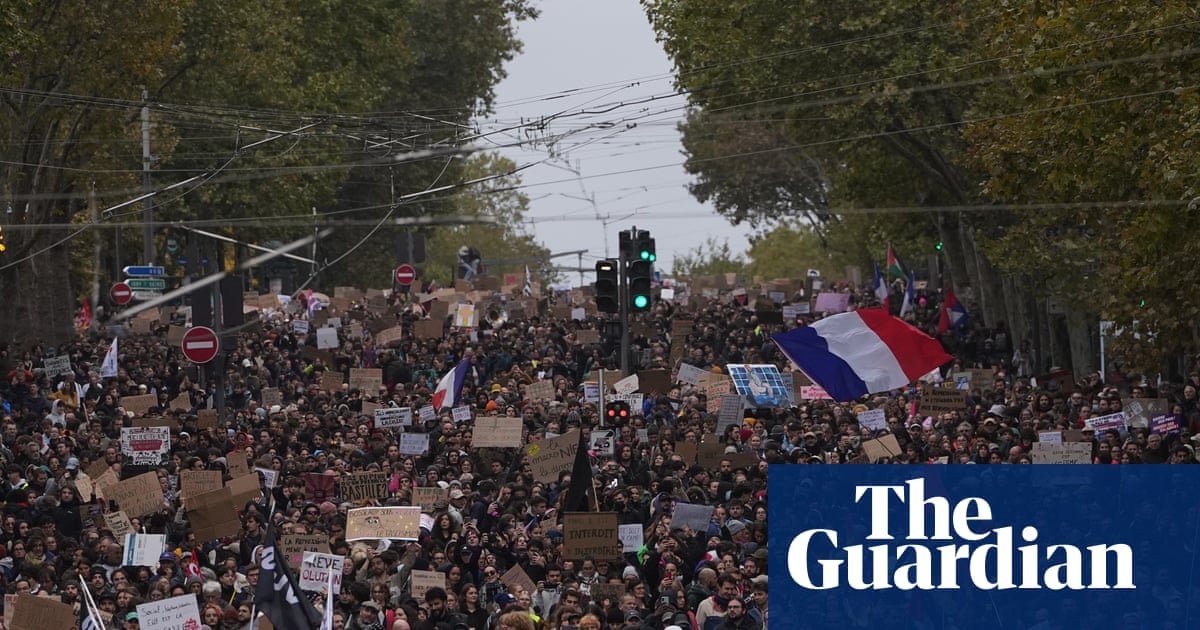
Hundreds of thousands marched in cities across France on Saturday in largely peaceful protests to support schoolchildren’s demands for more teachers and repairs to dilapidated buildings, as Emmanuel Macron faces a social and political crisis in his final months as president.
In Paris, at least 110,000 people marched along the eastern edge of the city, according to government estimates. They supported high schoolers but also complained of the high cost of living and the government’s heavy policing, saying riot police had been sent to target school protesters over the past month, instead of the government offering political solutions.
The mood in Paris on Saturday afternoon was peaceful and lighthearted, with brass bands playing and children and grandchildren present. Some people carried banners critical of the government’s policing, saying: “Oppression breeds rebellion” and “The right to protest”.
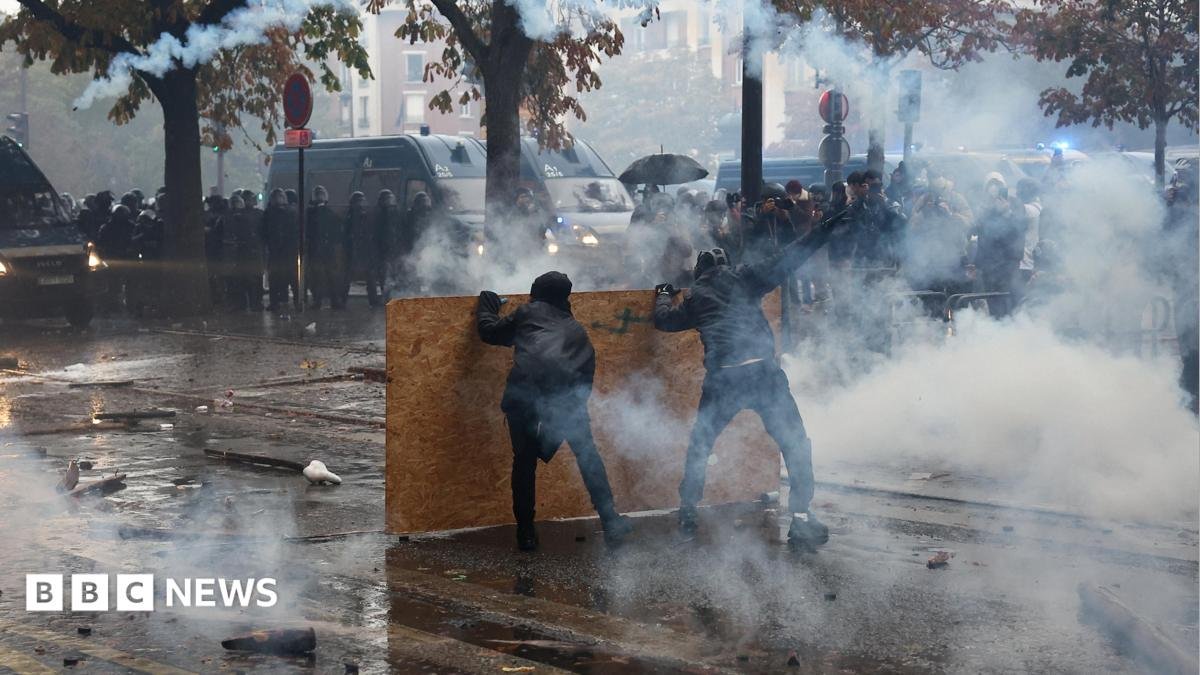
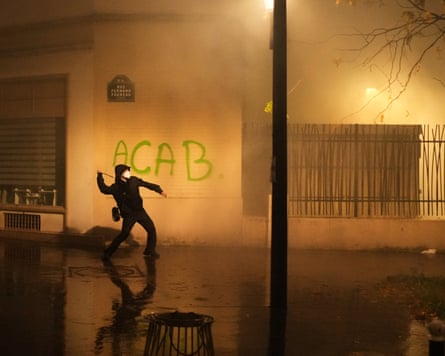
But at the end of the Paris demonstration, at Porte de Vincennes on the city’s eastern edge, different groups of masked men dressed in black emerged who had not appeared to have taken part in the peaceful march. Some groups of masked men threw glass bottles and stones at police, who responded with teargas, water cannon and stun grenades. A bin was set alight and fireworks were set off towards police.
Riot police also charged a larger crowd of protesters at the end of the Paris march, using batons against them.
Police fired teargas to prevent protesters in Lyon, Lille, Montpellier, Nantes and Toulouse from reaching city centres. In Marseille, some bin fires were lit amid clashes with police. At least two people were seriously injured, one in Clermont-Ferrand and another in Toulouse, who reportedly had fingers blown off.
The government estimated that at least 400,000 people had marched across France. Trade unions estimated the number at double that. The interior ministry said there had been almost 1,000 arrests.
Laurent Nuñez, the interior minister, said that at various street marches across France there were what he called “high-risk groups” who “broke away from the main body and sought to commit acts of violence”.
More than 70,000 police were on the streets of French cities, with shops boarded up and many museums closed. The government had feared a repeat of last Saturday, when, despite peaceful protests taking place, France saw one of the most violent days of unrest in years, with public buildings burned, hundreds of shops destroyed and looted and at least 2,700 people arrested in cities across the country.
At Saturday’s protests, there was widespread anger at Macron for banning non-union demonstrations that his government deemed “illegitimate” and for keeping all protesters away from city centres.
At the Paris march, Nadège, a 43-year-old communications worker, said she had been teargassed last weekend at a peaceful demonstration. “I’m out again peacefully today to support everyone who is brave enough to demonstrate. It does take courage. People are afraid now. We have to keep our rights alive … In France, it’s our legal right to protest in the street and I’m here to defend that.”
A 21-year-old student from a Paris science faculty that is now blockaded by demonstrators said: “We feel in France that we are increasingly living in an authoritarian regime that is trying to stop our democratic right to protest in the street.”
The radical left presidential candidate, Jean-Luc Mélenchon, who took part in the Paris rally, said Macron must “give in” and address France’s social malaise or face repeated protests. “Given the current situation, I think he will come to understand that this will happen again every week,” Mélenchon said.
The government has been facing a crisis since the start of high school demonstrations in mid-September, when children aged between 15 and 18 began protesting against staff shortages at their schools, leaking and crumbling buildings, and a lack of chairs in overcrowded classrooms. It grew into the biggest youth movement in years, with trade unions, teachers and parents joining. Police investigations are under way after some children and protesters were maimed and injured by explosive police weaponry.
At Saturday’s march there were some people dressed in yellow vests who had taken part in the gilets jaunes anti-government protests of 2018 and 2019. Standing amid demonstrators, Jérôme Rodrigues, a key figure from the gilets jaunes protest, said: “Today the government is afraid; that is why they are pushing demonstrators to the edge of the city, away from places of power. It’s not police shields that will provide an answer to French people struggling and unable to make ends meet.” He said it was likely that demonstrations would continue.
Pierre, 60, a retired banking consultant, said he was demonstrating in support of school students. “I have an eight-year-old granddaughter. I want her to have a brighter future than the sombre times we are facing today. There is a complete refusal by the government to listen to people’s demands.”
Jesse, 40, a charity worker from the north of Paris, carrying a sign saying “Free Hugs”, said: “I’m so angry. I’m here to support schoolchildren’s demands for better conditions. I’m so proud of them, and we have to stand together.”
She said: “I know I’m not going to war by coming out to demonstrate peacefully. But at times it really does feel like a war … This is the first time I’ve prepared so carefully for a peaceful march, wearing old clothes in case they are gassed or torn.”
In Orléans, thousands shouting anti-fascist slogans marched against a congress held by Marine Le Pen’s far-right anti-immigration National Rally party. Protesters criticised Le Pen, a frontrunner in next year’s presidential election, as well as Macron, who steps down from power next year. “Macron, resign. Le Pen in prison,” the crowd shouted.