Criticism comes as prime minister frames unity as point of difference to political opponents, saying ALP chooses ‘progress over protest’
Get our breaking news email, free app or daily news podcast
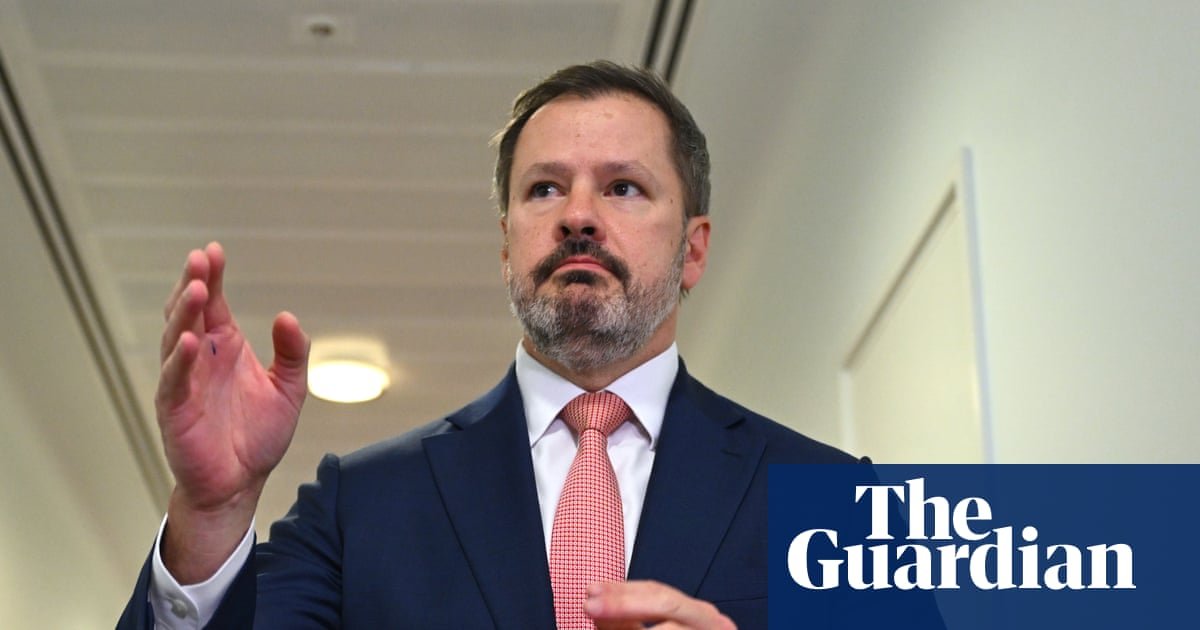
Outspoken Labor MP Ed Husic claims the party has become “allergic” to dissent and dispute, warning the unity on show at its tightly controlled national conference could backfire.
The former industry minister broke ranks with the government on the first day of Labor’s 50th party conference to support a gas export tax, endorse Indigenous truth-telling and press for more criticism of Israel’s conduct in Gaza.
As factional powerbrokers negotiated behind the scenes to avert contested debates on the conference floor, Husic hit out at the party’s culture under Anthony Albanese.
“This whole thing of being allergic to dissent [and] dispute, I don’t think that actually works in our long-term interests as a party,” he told ABC’s Afternoon Briefing.
In a speech to open the conference, Albanese framed the party’s unity as a point of difference to its political opponents.
“We choose progress over protest. We choose purpose over chaos. We choose unity over division,” he said.
Earlier, the government was given the green light from party members and MPs to wind back fuel subsidies for big miners, setting up a potential fight with resources giants.
The national conference also agreed to extract a “fairer return” from Australia’s natural resources, although Albanese shut down any prospect that would translate into a new gas export tax in the foreseeable future.
The Labor Environment Action Network (Lean) secured support at the opening day of the national conference to amend the policy platform to remove tax “disincentives” to an “orderly” energy transition.
The influential group of rank-and-file Labor members pushed the proposal as part of a campaign to cap the diesel fuel tax credit for mining companies, which they view as an expensive handbrake to decarbonisation.
More than 350 Labor branches, unions, climate campaigners and the mining billionaire Andrew Forrest have backed reforms to the scheme, which refunds miners, farmers and other industries the 52.6c a litre excise applied to petrol and diesel.
Treasury has forecast the scheme would cost the budget $47bn over the next four years, rising from $10.7bn in 2026-27 to $12.8bn in 2029-2030. More than $1bn a year goes to coalmine operators.
A trio of federal Labor MPs – Jerome Laxale, Sally Sitou and Ged Kearney – backed Lean’s amendment on the conference floor, demonstrating a level of support in Albanese’s caucus.
“Our job is not done. There are new policies that we need to reach our goals and targets,” Laxale told the conference.
“There are also tough decisions to be made to reform existing disincentives to decarbonisation.”
Senior Labor ministers were open to reforming the tax credits scheme before the US and Israel’s war on Iran and subsequent global oil shock pushed it off the agenda.
Albanese’s cabinet is not bound to immediately act on the platform and the government remains reluctant to pursue changes given the lingering uncertainty in the Middle East.
But the platform amendment will pressure it to act eventually.
Any move to wind back the tax credits would face fierce resistance from mining companies and their peak bodies, in particular the Minerals Council of Australia, which last month launched an industry campaign to protect access to the rebates.
Foreshadowing the industry campaign, Laxale told the conference that “reforming existing subsidies will be firmly resisted by the few whose profits are unfairly being boosted by taxpayers”.
It could also split Albanese’s cabinet, with the resources minister, Madeleine King, a public defender of the scheme.
Conference delegates rubber-stamped an amendment to the platform to secure a “fairer return” from natural resources, a set of words widely interpreted as setting an expectation for cabinet to eventually move to raise taxes on gas exports.
Albanese rejected that interpretation in an ABC radio interview ahead of the start of conference, ruling out any changes in the short term as the government focuses on shoring up fuel supplies amid the Middle East conflict.
The government also believes its plan to force gas producers to reserve 20% of exports for domestic users will effectively act as a tax.
Albanese’s stance failed to deter Labor’s most pro-tax MP, Husic, who challenged the government to show it has “steel in its spine” by adopting a policy that he said had widespread support in the community.
“Labor has a chance to be able to show, particularly to the broader public, that it’s got what it takes, that it’s got the steel in the spine to be able to make a call that’s really in the nation’s long-term interest,” Husic said at a press conference on the sidelines of the Adelaide conference.
“A lot of Australians reckon we’ve been ripped off. Labor can stand up, seize this moment, seize the money [and] also seize the agenda long-term.”