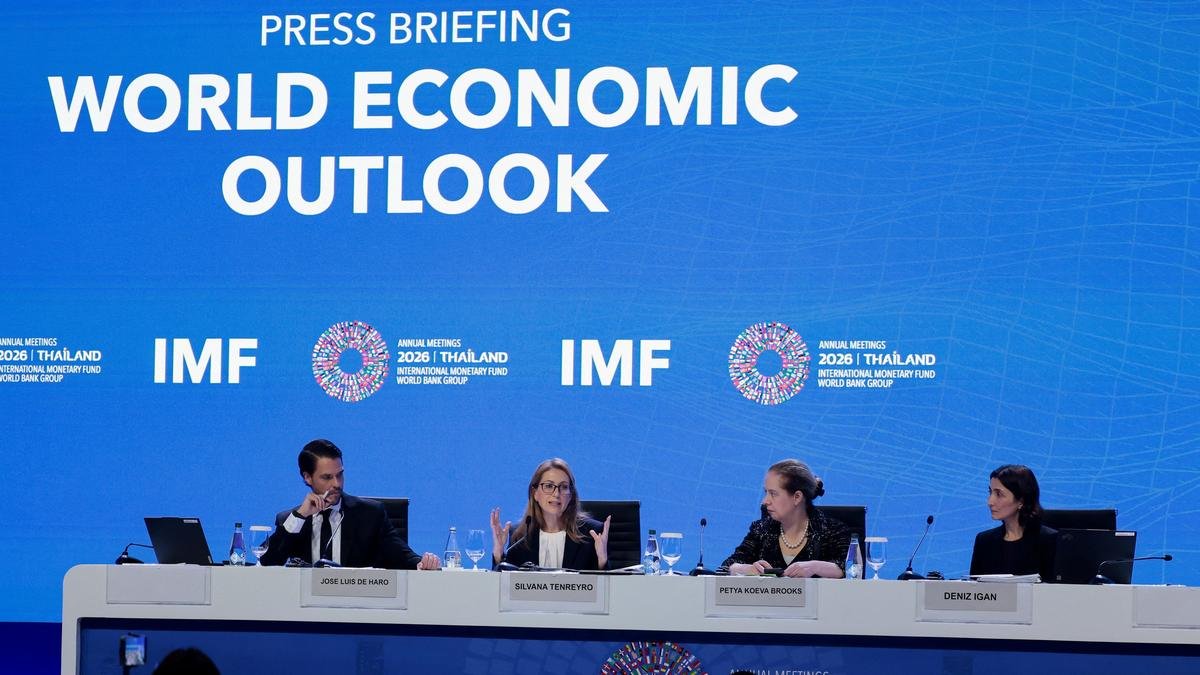
Updated on: Oct 13, 2026, 10:11:58 IST By Nidhi Giri Prefer HTon Google Share via Copy link India’s economy is expected to expand by 7 per cent in both FY27 and FY28, projected the International Monetary Fund (IMF) on Tuesday.
However, IMF cautioned that the global economic outlook faces increasing risks with rising food and energy costs along with geopolitical tensions.
It added that this could affect the resilience of economies across the world.
FILE PHOTO: A view of the International Monetary Fund (IMF) logo at its headquarters in Washington, D.C., U.S., November 24, 2024. (REUTERS) In the IMF's latest assessment, it raised the global growth forecast for this year to 3.1 per cent, up from the 3 per cent in July.
Despite the upgrade, the pace remains modest compared to the 3.5 per cent recorded by the world economy in 2025.
“The global economy remains resilient, but that resilience is becoming more fragile and more uneven,” the IMF said in its October 2026 World Economic Outlook.
It added that many had "no choice" but to spend less or face debt restructuring.
India among the fastest growing economies As per IMF, India’s growth is stronger than expected with robust domestic demand while remaining among the world’s fastest growing economies.
According to the Fund, the global economy managed to absorb multiple shocks because of diversified energy supplies, higher output from other countries and the release of stored reserves.
It also highlighted investments in artificial intelligence (AI) as key factors in sustaining economic activity.
Falling energy stalks, escalated geopolitical tensions and prolonged uncertainty could increase the pressure.
“Risks are skewed to the downside,” the report said.
Slow world trade volume in 2026, says IMF The IMF's report forecast a slow world trade volume growth in 2026 but a balance in 2027 with enhanced production chains and continued strength in technology-related trade.
“Global imbalances are expected to decline only modestly over the medium term, as large fiscal deficits, limited domestic rebalancing, technology-driven capital flows, and differing demand compositions across major economies under current policies continue to sustain external gaps,” IMF added in its report.
ABOUT THE AUTHOR Nidhi Giri Nidhi Giri is a Senior Content Producer at the Hindustan Times.
A Delhi-based journalist with over four years of experience in the news media industry, she specialises in national affairs, geopolitics, and policy shifts.
Her expertise spans breaking news coverage, live blogging, and long-form explainers.
Prior to joining HT, Nidhi was part of the newsrooms at Asian News International (ANI) and The Daily Jagran where she led newsroom shifts, contributed to planned content, and edited stories.
She has led real-time coverage of major national and international events.
Highlights of her career include an exclusive interview with Supreme Court Judge Justice N Kotiswar Singh, coverage of Lok Sabha Polls 2024, Union Budget, Operation Sindoor, Parliament Sessions, multiple state assembly elections, G20 New Delhi Summit 2023, India AI Summit, US Presidential Elections, and US-Iran conflict.
Nidhi is an alumna of Birla Vidya Niketan, Delhi, and holds a BA in English Honours from Bharati College, University of Delhi.
She also holds a PG Diploma in English Journalism from Indian Institute Of Mass Communication (IIMC), Dhenkanal, and an MA in Mass Communication.