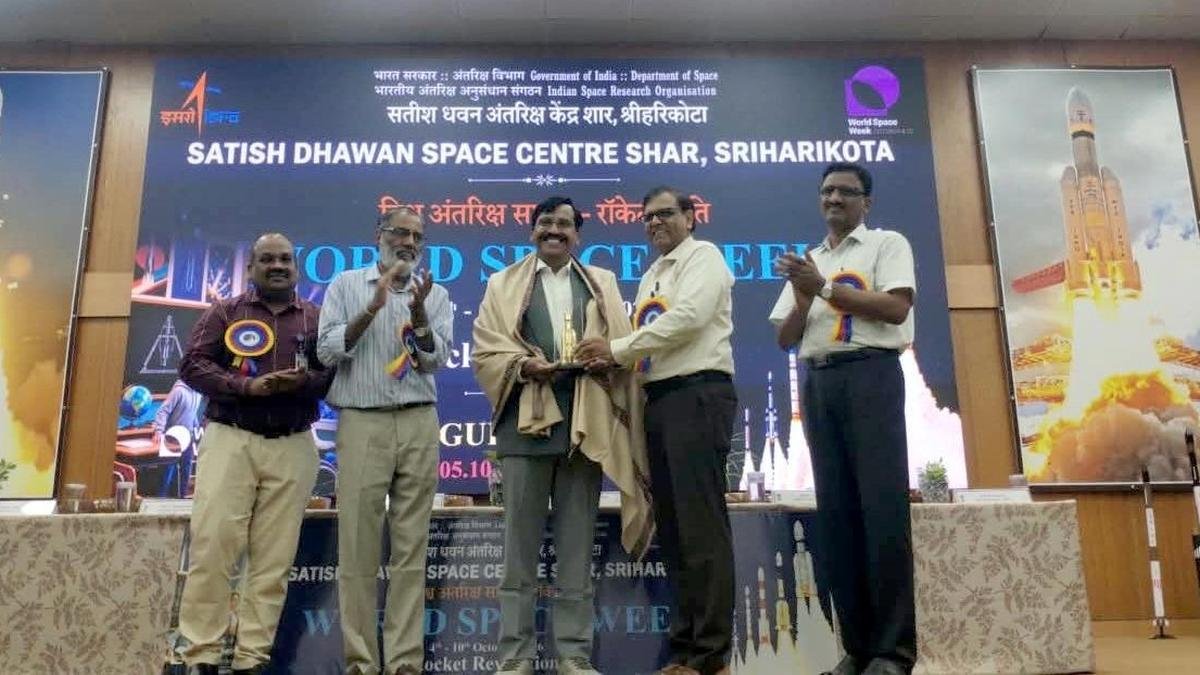
Vice-Chancellor of Jawaharlal Nehru Technological University, Anantapur (JNTU-A), Prof. H. Sudarsana Rao, on Monday said that India’s space sector has evolved beyond merely enhancing national prestige but has transformed into a powerful tool for improving the quality of life for the people across sectors such as agriculture, healthcare, disaster management, communication, navigation, and urban planning.
The V-C delivered the inaugural address at the launch of the Indian Space Week celebrations held at the Satish Dhawan Space Centre (SDSC-SHAR) in Sriharikota. Mr. Rao noted that the SHAR launch facility stands as a historic hub in India’s space journey, where the intellect, perseverance, and scientific spirit of Indian scientists, engineers, and technicians have translated the nation’s aspirations into world-class achievements.
He stated that achievements like Chandrayaan and Mangalyaan symbolise India’s scientific and technological prowess. He highlighted that indigenous innovation, continuous research, discipline, teamwork, and perseverance were the key factors behind India’s space program.
The V-C explained that in the context of the Fourth Industrial Revolution, the convergence of fields such as aerospace engineering, artificial intelligence, quantum technology, advanced materials, and data science is crucial for the future of space exploration. He stated that Artificial Intelligence and Autonomous Systems would play a pivotal role in areas such as satellite data analysis, autonomous navigation, predictive maintenance (early detection of equipment faults), and mission optimisation.
Similarly, he noted that Quantum Technology could create new opportunities in secure satellite data transmission, sensitive sensing, and future communication systems.
Mr. Rao emphasised that for India to further expand its capabilities in the space sector, educational institutions need to forge stronger partnerships with industries, research organisations, and the space sector itself. He noted that technical institutions like JNTUA bear a special responsibility in this regard. He stressed the need to cultivate skills such as design thinking, hands-on prototyping, innovation, entrepreneurship, and collaborative research among students.
He called for transforming classrooms into “innovation incubators” rather than limiting them to mere academic instruction, thereby shaping the scientists, engineers, and technical experts of the future.