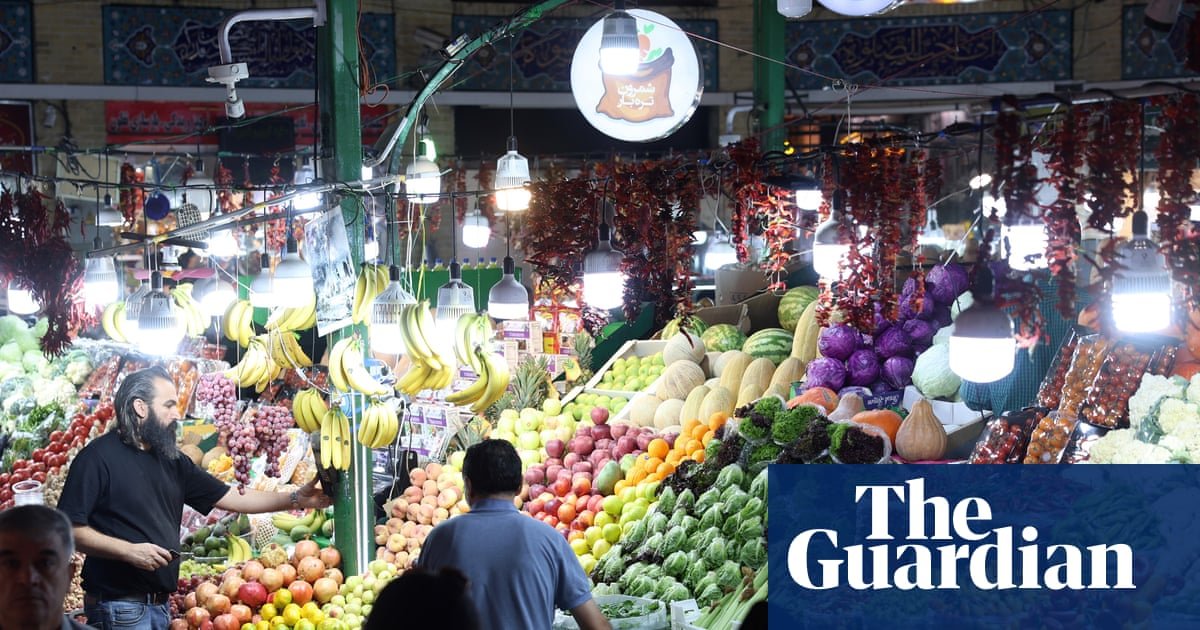
People shop at Tajrish Bazaar in northern Tehran, Iran.
The city’s mayor has promised to freeze the price of 12 basic items for six months.
Departure comes amid large drop in oil receipts, rampant inflation and shrinking economy Iran’s oil minister has resigned days after allegations that an intermediary trust selling Iranian oil abroad owed millions of dollars’ worth of export receipts to the state.
Mohsen Paknejad’s departure comes as Iran grapples with a dire economic situation, including inflation running at 85%.
An overall drop in oil receipts has led to a massive shortfall in foreign exchange earnings and one of the biggest drops in the value of the rial since the Iranian revolution in 1979.
The Iranian president, Masoud Pezeshkian, said he had accepted the resignation of Paknejad, who had given personal reasons for going.
The rial is trading more than 10% lower than a month ago, largely due to the US naval blockade preventing Iran from selling oil, the mainstay of government receipts.
Emergency government meetings over the weekend to combat the crisis have yielded little tangible progress, and there are growing reports that the professional middle class, notably teachers and nurses, are resigning in large numbers because their salaries are not keeping up with price rises.
The central bank says its role is not to defend a specific rate, but manage fluctuations.
Iran’s economy contracted by 10% in the first three months of the year.
Despite concerns that continued sanctions may lead to protests, Iranian diplomats are not planning any new concessions after a proposal to speed the process of nuclear negotiations was rejected by Donald Trump a week ago.
Masoud Pezeshkian said he had accepted the resignation of Paknejad.
A report last week by the Farhikhtegan newspaper alleged that a trust set up on Paknejad’s watch to recoup income from Iran’s overseas oil sales owed the state-owned National Iranian Oil Company nearly $2bn (£1.5bn) in revenues.
Three individual trustees awarded oil contracts allegedly owe hundreds of millions of dollars each to the NIOC.
Some of the leaks behind the reporting may reflect a power struggle inside the oil industry.
Reza Sepahvand, a spokesperson for the parliament’s energy commission, has announced the launch of an inquiry.
Although Iran’s oil export problem, and its impact on foreign exchange reserves, is primarily caused by the US naval blockade on Iran’s oil exports, reports of lax management or possibly corruption will do little to bolster confidence in government at a time when most Iranians are going through an unprecedented squeeze on their standards of living.
It is claimed the difficulties were regarded as so serious that they were conveyed by one security official to the president and then before the US attack on Iran in February to the supreme Leader himself.
The president apparently took up the complaint with the oil minister but no satisfactory response was received.
In an attempt to shore up public confidence in the government’s strategy, ministers have been seeking to rebut Donald Trump’s claim that oil is now flowing through the strait of Hormuz at near pre-blockade rates.
The number of attacks on ships trying to use the strait’s southern route close to the Oman shoreline has risen in recent days, including four attacks in the past 48 hours.
It was also reported that Saudi Arabia’s east-west pipeline had been forced to close again after a further attack.
Reuters reported last week that the seven-day moving average of the region’s crude oil exports reached 18.5m barrels a day on 1 October.
About the same amount was exported before the US-Israeli war with Iran began.
The dollar traded at 269,000 tomans (a toman is 10,000 rials) this week, a record high, and has risen 12% since 9 September.
The minimum monthly wage of 166m rials is worth about $66.
Food inflation is 130%.
Alireza Zakani, the mayor of Tehran, has announced he is freezing the price of 12 basic items including sugar, rice, oil and detergent for six months.
There has been scepticism about how these price controls will be enforced, but he claimed the national government was going to study his plan.
Ministers also said a second rise in public sector wages was likely.
Mohammad Sharifi Moghaddam, the secretary general of the Nurses’ House organisation, stressed the scale of the squeeze on living standards: “Nurses have explored all possible avenues – logical, legal, professional, and every type of protest or critical path – to achieve their demands.
“The current healthcare system has shown no regard for the issues and demands of the nursing community.️ Nurses have come to the conclusion that it is more cost-effective and less damaging to their wellbeing to stay home and receive a salary of 25m tomans.” At the same time, repression of mainstream dissidents has continued, with the summoning of the leadership of the Reform Front by the ministry of intelligence to explain criticisms it had issued during the crackdown on protests.
The front has already written to the government calling for transparency about corruption at a time when people are facing pressure from inflation, high prices and falling living standards.
Explore more on these topicsIran Middle East and north Africa Protest US-Israel war on Iran news Share Reuse this content