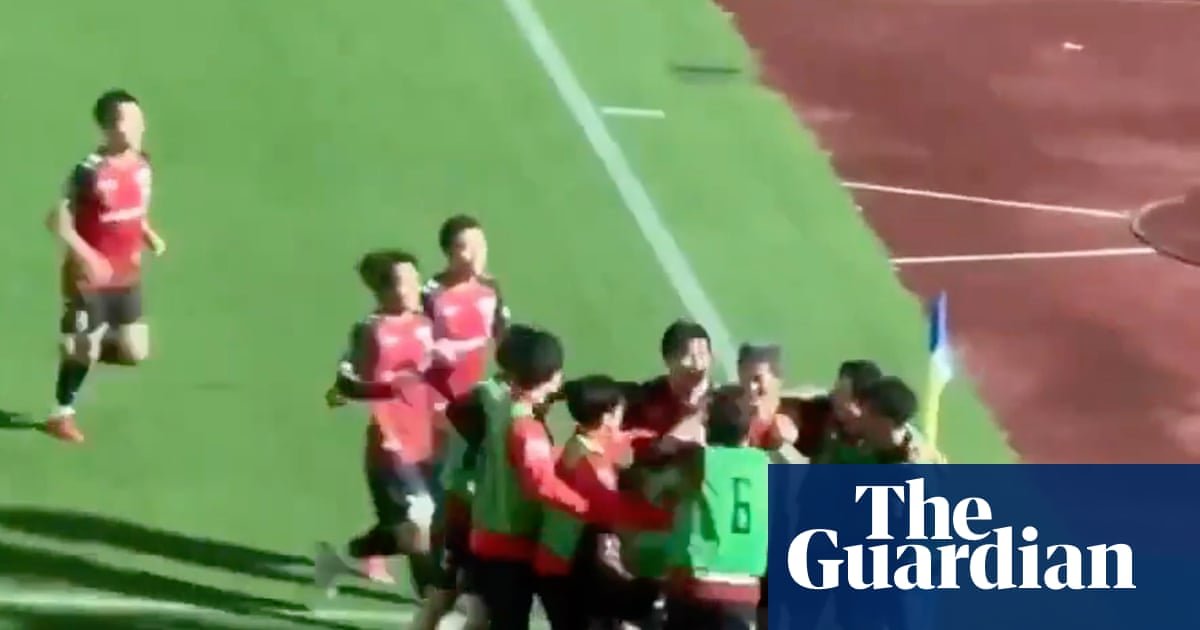
Kazuyoshi Miura after scoring for Fukushima United against Iwaki Furukawa.
Plus: UK prime ministers’ football allegiances, top-flight W teams in England and united Uniteds Mail us with your all of your questions and answers “Kazuyoshi Miura recently scored in the Emperor’s Cup at the tender age of 59 – is he the oldest goalscorer in football history?” asks Terry Winter.
If we were picking an all-time Knowledge XI, ‘King Kazu’ would be in the mix for a place.
He’s appeared in various age-related queries over the years, and tales of his exploits always give us hope as we wheeze through middle-age.
On Saturday, Miura scored his first competitive goal in nearly four years as Fukushima United thrashed Iwaki Furukawa 7-0 in the Emperor’s Cup.
Miura’s goal extended his record for the oldest goalscorer in professional football.
These are the oldest goalscorers we could find, but drop us a line if you can beat them.
59 years 149 days, Kazuyoshi Miura: Fukushima United 7-0 Iwaku Furukawa, Emperor’s Cup, 25 July 2026 51 years 5 days, Innocent Benza: Herentals College FC 1-2 Hwange Colliery, Zimbabwe Premier Soccer League, 25 May 2023 49 years 208 days, Billy Meredith: Brighton 1-5 Manchester City, FA Cup, 23 February 1924 49 years, 14 days, Stanley Matthews: Stoke City 2-2 Swansea City, FA Cup, 15 February 1964 Innocent Benza, aka IB9 and no we didn’t make that up, was on target when Herentals College FC lost 2-1 to Hwange Colliery in the Zimbabwe Premier Soccer League three years ago.
He’s believed to be the oldest top-flight goalscorer.
In fact he may have scored a more recent goal, as he was still going strong last season when he reached 200 games for Herentals College FC.
Benza has got another 20 years to go if he wants to become the oldest goalscorer on record, though.
In March 2020, Ezzeldin Bahader scored a penalty on his debut for 6th of October SC in the Egyptian Third Division.
He was – and you’ll like this – 74 years, 125 days old.
For the sake of Portugal’s future World Cup chances, Cristiano Ronaldo should not be made aware of this record.
Top of the tree in women’s football appears to be Formiga, who scored for Brazil against Canada in November 2019 at the age of 41 years, 249 days.
She retired soon after, having amassed 234 caps over a 26-year international career.
Formiga before the 2019 World Cup.
(A few years ago, he appeared on our own Daniel Harris’s podcast to discuss the 1995 FA Cup final.) We’ve made a list of PMs who have publicly spoken about being a fan of a particular team or have shown an allegiance in some other way, and, from our initial research, it looks like the balance of power is spread thinly, with no team belonging to more than one prime minister.
Boris Johnson once stated he “supports all London teams” but we are counting none of the capital’s clubs as belonging to him.
Before the second world war it was very rare for a prime minister to talk about football, so our list doesn’t go beyond 1945.
If you can add to it, or find a team supported by more than one of the country’s leaders, please .
Andy Burnham showing some retro support.
Andy Burnham (2026-) Everton Keir Starmer (2024-2026) Arsenal Rishi Sunak (2022-2024) Southampton Liz Truss (2022) Norwich City David Cameron (2010-2016) Aston Villa (definitely not West Ham) Gordon Brown (2007-2010) Raith Rovers Tony Blair (1997-2007) Newcastle United John Major (1990-1997) Chelsea Edward Heath (1970-1974) Burnley Harold Wilson (1964-1970 and 1974-1976) Huddersfield Town Clement Attlee (1945-1951) Fleet Town (mainly because he played for them) Labour leader Tony Blair takes part in a heading contest with Newcastle United boss Kevin Keegan in Brighton during a break at the 1995 party conference.
“That feels weird as there are usually a couple of clubs below them (West Ham, West Brom, Watford, Wolves, Wigan, Wimbledon and whatnot).
When was the last time the Premier League (or First Division) didn’t include any W team?
However, a league without clubs beginning with the letter B would be truly shocking.
Has that ever occurred?” Prepare to be shocked, Robert.
An English top-flight without a B-team is reasonably-common.
It last happened in the Premier League just over a decade ago.
Blackburn Rovers and Bolton Wanderers were relegated in 2011-12; Burnley rejoined the Premier League in the 2014-15 season. (If you list AFC Bournemouth thus, rather than Bournemouth, it also occurred in 2015-16 while Burnley were yo-yoing.) Those are the only examples in the Premier League era – but the last six years of the old Division One were similarly bereft after Birmingham City were relegated in 1985-86.
The answer to your first question depends on how pedantic you are feeling.
This season will be the first in which the men’s English top flight has included no teams whose name begins with W, but there is one historical example where the only W-team subsequently changed their name.
Between 1906-11, Woolwich Arsenal flew the flag for the Ws in the English top flight.
In women’s football it’s a more familiar sight – there were no W-teams in the top flight between Watford (2009-10) and West Ham (2018-19).
Knowledge archive “Apart from Newcastle United how many other clubs using United in their name are actually two teams who merged together to form one?” wondered Keith Gilroy in 2011.
Unsurprisingly, the Magpies aren’t the only United formed by the merger of two clubs (in Newcastle’s case Newcastle West End and Newcastle East End), though there are surprisingly few in the Football League.
Plenty of Uniteds seem to have simply plumped for the name – Lincoln Amateurs, for example, were forced into a name change once they began to pay players in the 1950s.
With Lincoln City already taken, United just beat Rangers in the club’s vote for a new suffix.
Some that aren’t strictly united Uniteds are: Sheffield (formed from Sheffield United Cricket Club), Leeds (formed following the demise of Leeds City FC in 1919), Manchester (name change from Newton Heath LYR FC), West Ham (formerly Thames Ironworks) and there are plenty more.
But here are a few clubs in the pyramid who truly are united Uniteds: The Thames Ironworks and Shipbuilding Company Limited was a shipyard and iron works straddling the mouth of Bow Creek at its confluence with the River Thames, at Leamouth Wharf (often referred to as Blackwall) on the west side and at Canning Town on the east side.
Who this anonymous other team was is unclear, but in 1910 the new club merged with nearby Lindsey United just to make sure.
Hereford United: According to the club: “Before the formation of Hereford United there were four leading amateur clubs in Hereford and it was believed that a higher class of football could be sustained if they were to amalgamate.
After a meeting in the city, both Hereford City and Hereford Thistle decided to remain independent while St Martins and RAOC (Rotherwas) decided to merge, and thus Hereford United was formed in 1924 with Dr E.W.
Maples as chairman.” Torquay United: A slightly labyrinthine one this.
The original Torquay United merged with Ellacombe in 1910 to become, slightly counter-intuitively, Torquay Town.
The new club took Ellacombe’s Plainmoor ground, sharing with Babbacombe FC, with whom they then merged in 1921, becoming Torquay United once more.
Maidenhead United: The wonderfully-named Maidenhead Norfolkians joined forces with Maidenhead FC in 1904.
Initially Maidenhead Town, they became a United in 1920.
Sutton United: Formed in March 1898 by the amalgamation of two leading junior sides, Sutton Association and Sutton Guild Rovers.
Ebbsfleet United: A United formed of two Uniteds.
Gravesend United and Northfleet United merged to form Gravesend & Northfleet FC in 1946, before becoming Ebbsfleet United in May 2007.
Hayes and Yeading United: One of the newest Uniteds, Hayes and Yeading were formed in May 2007 after the merger of Hayes and, yes, Yeading.
Chesham United: The merger of Chesham Town and their neighbours meant the football world was deprived of the brilliantly monikered Chesham Generals from 1917.
United are currently flying high in the Zamaretto Premier.
Aylesbury United: The former Conference side “were founded in 1897 when three local sides: Night School FC, The Printing Works and Aylesbury Town decided to merge”.
The KnowledgeCan you help?
“Malachi Fagan-Walcott’s final game of last season was for York City against Rochdale in the National League.
His first competitive game of 2026-27 season was for Hearts against Sturm Graz in a Champions League qualifier.
Has a player ever made a bigger leap in competitive levels between consecutive club games?” asks Tom Reed.
“On Sunday, Sean Murdoch was the referee for St Mirren v Dunfermline in the Scottish League Cup.
Murdoch was previously a goalkeeper and played for Dunfermline.
Are there any other examples of a former player refereeing a match for a club they had played for?” asks Ian Golightly.
“My beloved Kilmarnock have won only four of their 21 penalty shootouts, a 19% success rate,” writes Andy Kerr.
“Does any professonal club have a worse record?” “Seeing the picture of Omar Sivori in last week’s Knowledge, I noticed the referee in the background dressed in black, as was the norm.
Were there any instances of colour clashes with the likes of Notts County, Newcastle, etc, causing problems during matches before referees went full spectrum?” wonders Paul Huby.
Mail us with your questions and answers Explore more on these topicsFootball The Knowledge features Share Reuse this content