The 15-year-old is tailor-made for short-form cricket, but he may just have the power to reimagine red-ball batting
The ball is short outside off. Vaibhav Sooryavanshi goes to pull it, hoiks it high to deep midwicket, is out for 44 off 37 balls. Almost immediately, a portion of the 12,000 fans who have risen at dawn to queue outside the Chepauk Stadium for free tickets begin to vacate their seats. The Duleep Trophy final in Chennai between East Zone and South Zone is scheduled for five days and has been going for barely an hour. But for some, the show is already over.
Of course, Sooryavanshi is part of the reason the final is taking place in Chennai in the first place. It was originally slated for the national academy on the outskirts of Bengaluru, only to be moved in order to accommodate the thousands of fans desperate to glimpse the child prince of Indian cricket in the flesh. Sooryavanshi is the hottest player in the world right now, a 15-year-old left-handed jaw-dropping genius with records spilling out of his pockets. But when it comes to red-ball cricket, the classic form of the game, he’s still – by any objective measure – not very good.
Going into this final, Sooryavanshi’s first-class average is a shade above 23, rendering him statistically a less effective red-ball batter than Craig Overton. Here, in perfect batting conditions, he scores a brisk and brash 44 in a mammoth total of 708, before dancing down the pitch and getting stumped for eight in the second innings as East Zone chase the outright win. None of which really tells us anything conclusive. The numbers are largely subservient to the project, the hypothetical, the burning question with implications not just for Sooryavanshi, not just for India, but very possibly for cricket itself.
At the moment, and for all the hype and heroics for Rajasthan Royals in the Indian Premier League, Sooryavanshi is nowhere near the India Test side. Only last week he was named in the Twenty20 squad to face Afghanistan, rather than the India A side who will play Australia in a multi-format series this month, which is where you logically would put a prodigious young batter whom you were grooming for Test cricket. All of which raises a fascinating paradox. Given his skillset, his upbringing, his 7.6m Instagram followers, the basic sense of declinism in many parts of the sport, could Sooryavanshi be the first player in history who needs Test cricket less than it needs him?
Because, let’s face it, the kid is going to be a superstar whatever he chooses. This year he obliterated the record for the number of sixes in an IPL season. He’s hit the second and third fastest centuries in competition history. He smashed the first ball he ever faced from Jasprit Bumrah over the rope. He made his national team debut this summer. He strikes at 216 and hits 16% of good-length balls for six. He is – and we should keep repeating this, because it doesn’t remotely make sense – 15 years old. This is the biggest and most lucrative stage in the sport and whatever path he chooses to navigate, he is already on course to be one of the most celebrated and richly rewarded cricketers of all time.
And so, does it ultimately matter if he plays a Test match? How important is it that he conquers the “supreme” form of the game, which at the moment appears to consist of Ollie Robinson jagging it back off a fifth-stump length in some overcast British city? And, just as pertinently, what should we want to happen? Should we want him to struggle or succeed? Is the idea of willing Sooryavanshi into Test cricket the sporting equivalent of making a Kardashian read Beowulf, like making ChatGPT tell a joke: extrinsically satisfying but basically content, pub fodder, a celebrity stunt?
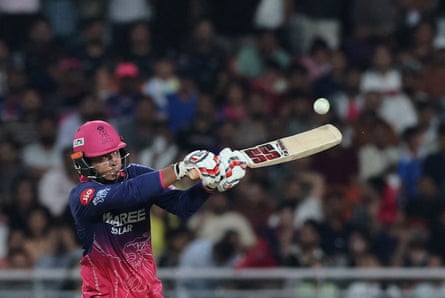
If this sounds extreme, then Sooryavanshi is about as extreme a batter as Test cricket is ever likely to encounter. This is a technique not simply adapted for short-form cricket but steeped in it, built entirely around the mechanics of hitting hard and high. His trigger movement takes the front foot out towards mid-on, clearing the leg for a big swipe. The torso leans towards off, the eyes are unlevel. At the point of impact virtually all the weight is on the back leg, which is pretty much the opposite of what any classical textbook will tell you. Consequently, there is almost no attempt to keep the ball down. The hands are fast, flowing and brilliant. It may or may not surprise you to know that Sooryavanshi’s batting hero is Brian Lara.
Then there are the intangibles of stamina and patience, management of the game and management of conditions. In his entire professional career Sooryavanshi has never batted for longer than 90 balls, never been out there for longer than a couple of hours, never really faced a spell that had to be survived or ground out. As his former coach Manish Kumar Ojha once told Cricinfo: “As long as he trained, I’ve never seen him train defence.”
Sooryavanshi, a player with every shot in the book, could block the ball if he wanted to. By the same token, against Lucknow in this season’s IPL, he said that the wild swipe that dismissed him was a result of having faced five dot balls and not being able to bear playing out a maiden over. At this point many of you are probably salivating at the prospect of putting him up against Mitchell Starc at a baying Gabba, or making him bat out an entire day for a draw with the ball turning square out of the rough and five men around the bat.
I want to see this happen. You want to see this happen. But at the same time it’s probably also worth turning the question around. What if Sooryavanshi’s game – which has already to a large extent reimagined the art of white-ball batting – manages to reimagine Test batting too? What if he generates a new orthodoxy: to go aerial, trust the eye, hit everything, don’t defend ever? If Test cricket ends up being decrypted by the kid with a native T20 game, then in the end what was the point of Test cricket?
Obtaining the unknowable answers to these questions will rely a little on economics and a little on politics. To the extent that a 15-year-old in a machine can express any kind of autonomous thought, Sooryavanshi has expressed a wish to play Test cricket one day. But then so did Nicholas Pooran, who ended up retiring from the West Indies at 29 with zero Tests to his name. Everyone knows this is what you are supposed to want. But wanting it and making it happen are two very different things.
A tentative prediction: market forces and basic animal curiosity will dictate that Sooryavanshi plays a Test match sooner rather than later. Pretty much everyone, with the possible exception of a few Rajasthan ultras, wants this to happen. As for what transpires when it does: well, this is the caprice and fascination of cricket. Every series, every test, every ball, is a new adventure. From which a second prediction emerges: if Sooryavanshi ever comes into contact with Test cricket, neither will emerge unscathed from the experience.