Israeli media say incident, which raised fears of possible hijacking, stemmed from feud between plane’s two pilots
Full report: Israel-bound passenger plane makes emergency landing in Saudi Arabia
52m agoRead our full report here...
1h agoWhat we know so far
2h agoIsraeli minister claims 'terrorist' attempted to crash plane bound for Tel Aviv
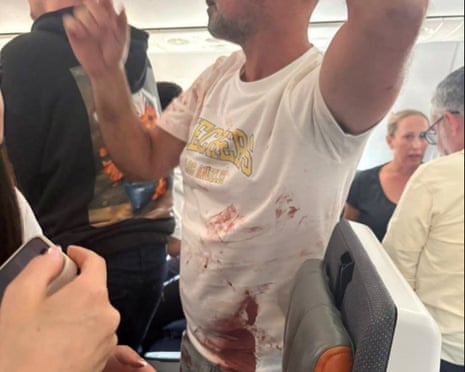
The FlyDubai flight FZ 1073 from Dubai to Tel Aviv made an emergency landing in Saudi Arabia this morning after transmitting emergency signals.
According to Israeli media, a fight had broken out between the plane’s two pilots. Passengers described one of the pilots being seriously injured in an alleged stabbing.
The Boeing 737 plane, which Israeli officials said had between 160 and 180 passengers on board, transmitted a general emergency signal about two and a half hours after departing from Dubai, according to flight-tracking website Flightradar24.
It diverted to Saudi Arabia as it flew over Jordanian airspace, transmitting another emergency signal that indicated what is known as a possible unlawful interference.
The plane again transmitted the initial general emergency signal before later landing at Saudi Arabia’s Tabuk airport.
The aircraft’s data appeared to show that it had suddenly and rapidly descended by nearly 14,000 feet in less than 30 seconds before the first emergency signal. It was not immediately clear who transmitted the emergency signals.
Tabuk airport said the plane landed at 9.45am local time and that both pilots were taken to hospital after sustaining injuries.
The Israeli prime minister’s office said the situation was “under control” and that steps were being taken to bring the passengers to Israel.
In a video from inside the plane that was reposted by Israeli social media users, one passenger, blood dripping from an open wound on his head, pleaded for assistance and said they were descending into Saudi Arabia, with which Israel has no diplomatic relations.
“We are here during an attack on the plane. We just subdued the terrorists and are preparing to land,” the man said in Hebrew.
“Anyone who can hear me, we need help. We are about to land in Tabuk, apparently in Saudi Arabia. An unknown area. All the passengers are safe and well, except for the pilot. We need help.”
A key piece of information from the FlyDubai flight is that someone in the cockpit transmitted emergency codes.
Pilots use four-digit ‘squawk codes’ to broadcast their position for air traffic control. These are used for routine flight but also in emergency situations.
Aircraft trackers at Flight Radar say the FlyDubai plane transmitted both emergency and hijack signals.
The plane transmitted a 7700 squawk code that means emergency. It also transmitted a 7500 squawk code, which can mean a hijacking.
These codes have to be manually entered from the cockpit.
An Israeli official has identified the attacker as an Omani national, Reuters is reporting.
The co-pilot of a flight from Dubai to Tel Aviv is believed to have stabbed the captain in a possible attempted “terror attack”.
Passenger Miryam Shira Ohayon said the plane was “pretty much out of control” when the alleged stabbing took place over Jordan on the flight’s path from Dubai to Tel Aviv.
“The co-pilot tried to murder the pilot and basically carry out a suicide attack on the plane,” she told reporters by speakerphone held up by her mother who was waiting at Ben Gurion Airport near Tel Aviv.
“It was really on the way to crashing and it was simply the resourcefulness of many people who took control of the co-pilot and neutralised him,” she said.
“There was also a doctor who gave first aid and people who treated both of them. Other than the pilot, there were no injuries but the bigger fear was really a crash, which is exactly what he was trying to do.”
Her mother, Yasmin Abukasis, said her daughter was on the flight to attend a service for her brother killed in the 7 October 2023 Hamas attack.
Her daughter “thought they were going to die”, Abukasis told AFP, adding that one woman “went to the [cockpit] and saw a lot of blood”.
She said that two other pilots were on the plane and took charge, diverting it to Saudi Arabia.
A commercial plane travelling from Dubai in the United Arab Emirates to Israel has been forced to make an emergency landing in Saudi Arabia, after an apparent brawl between its pilots prompted distress signals that briefly raised fears of an attempted hijacking.
The flydubai flight was over Jordan when it diverted to Saudi Arabia, transmitting three emergency signals, one of which indicated a possible unlawful interference.
The plane dipped dramatically during the reported fight, descending about 16,000ft in just two minutes.
Israeli officials scrambled fighter jets, fearful of a possible hijacking attempt on a plane containing dozens of Israelis, and the plane landed at Tabuk airport in north-western Saudi Arabia.
A passenger told the Jerusalem Post that one pilot stabbed another and tried to force him out of the cockpit, prompting other Israelis to rush into the cockpit and subdue the attacker as the plane began to plunge.
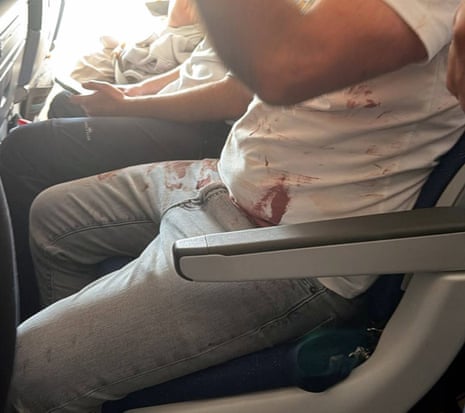
It was not immediately possible to verify those reports. Pictures of a passenger with blood on their shirt were published by Israeli media.
A spokesperson for the Israeli prime minister’s office initially said that the flight diversion was not because of a hijack attempt; authorities later said they were investigating.
An Israeli minister has decried what he described as a “terrorist” incident to kill Israelis after a flight was forced to land in Saudi Arabia when a physical altercation between the pilot and co-pilot prompted initial fears of a hijacking.
A Boeing 737 Max 8 with up to 180 passengers on board made an emergency landing at Saudi Arabia’s Tabuk airport this morning after transmitting three emergency signals, one of which indicated what is known as a possible unlawful interference. Israeli media have reported dramatic testimonies and video from people on board, with some describing passengers storming the cockpit to subdue the attacker and one of the pilots being seriously injured.
The Israeli national security minister, Itamar Ben-Gvir, said the incident highlighted the need for Israel to escalate its military campaigns across the region.
“Thank God and the heroic passengers, but Israel’s security doctrine must be taken to the next level,” he wrote on X, adding that the country “must continue until achieving total victory” in Iran, Lebanon, Gaza and the occupied West Bank.
“The naive notion that our enemies value life and deserve our pity was given yet another stark reminder this morning in the form of a terrorist who planned to blow up a plane and murder the 180 Israelis on board.”
Similarly, the Israeli finance minister, Bezalel Smotrich, said that “anyone who tried to bring down a plane and murder 180 Israelis should pay as though they had murdered them – as should any country or terrorist organisation that sent them”.
According to the Israeli Hareetz newspaper, citing an unnamed official, authorities were treating it as a “terror” incident and “believe that one of the pilots may have purposefully attempted to crash the plane”. The newspaper added that other scenarios were also being considered.
Commenting this morning, the Israeli prime minister’s office said the situation was “under control” while measures are being taken to bring the passengers to Israel. Local media reported the military had scrambled fighter jets after fears of a possible hijacking, which the prime minister’s office had ruled out shortly after the incident came to light.
In a statement, Tabuk airport said the flight that was bound for Tel Aviv landed at 9.45am local time and that its captain and co-pilot “were found to have injuries and were transported to hospital”.
FlyDubai said flight FZ 1073 “experienced an incident while en route” and that all passengers “are safe and accounted for”.
My colleague William Christou has more on the story here:
Middle East and north Africa